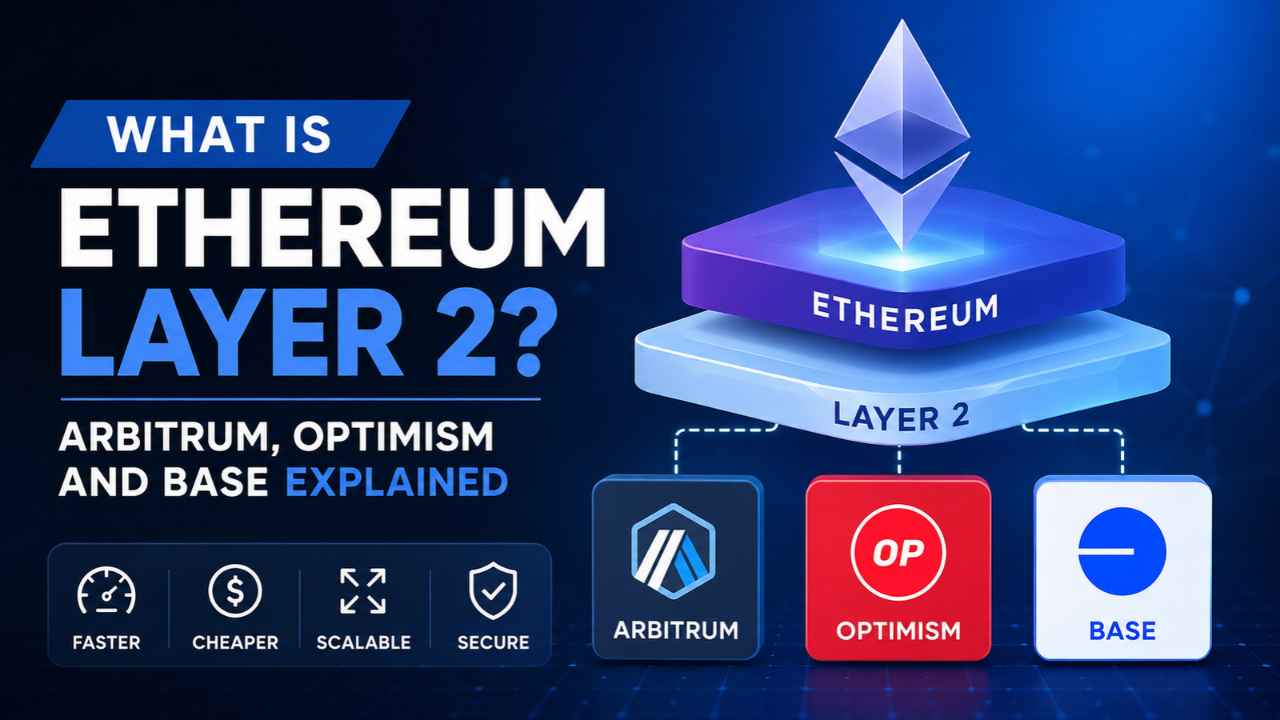
Ask anyone who tried sending ETH on mainnet during a busy week in 2021 what the problem was, and they will say the same thing. Gas fees ate the transaction alive. That pain is exactly why Ethereum Layer 2 exists, and by 2026 it is no longer a side experiment. It is where most of Ethereum’s actual activity happens.
What Is Ethereum Layer 2 in Simple Terms
Ethereum Layer 2 is a separate network that processes transactions away from Ethereum’s main chain, then reports the results back to it. Ethereum stays the settlement layer and the source of security. The Layer 2 does the heavy lifting of executing thousands of transactions cheaply and quickly. Think of Ethereum as the bank vault and the Layer 2 as the teller counter that handles the daily rush without opening the vault every single time.
This inheritance of security is the part that separates a genuine Layer 2 from a sidechain. On a rollup, transaction data and proofs get posted back to Ethereum, and Ethereum ultimately decides what counts as final. A sidechain runs its own validators and its own security budget, even if assets move between the two.
Why Ethereum Needed Layer 2 Scaling
Ethereum mainnet can only process a limited number of transactions per second because every full node has to verify every transaction. That is the price of decentralization. During high demand periods, users were bidding against each other in gas auctions, sometimes paying more in fees than the transaction itself was worth. Layer 2s were built to break that bottleneck without weakening Ethereum’s security guarantees.
The 2024 Dencun upgrade, which introduced cheaper blob space for rollups to post data, cut L2 fees by roughly 80 to 90 percent almost overnight. The 2026 Fusaka upgrade and its PeerDAS feature pushed blob capacity even further, so most major rollups now charge a few cents per transaction instead of dollars.
How Layer 2 Rollups Actually Work
Most Ethereum L2s today are rollups, and they come in two families. Optimistic rollups assume every transaction is valid unless someone proves otherwise within a challenge window, usually around seven days. Zero knowledge rollups generate a cryptographic proof for every batch of transactions, and Ethereum verifies that proof directly, which allows faster withdrawals.
Arbitrum, Optimism and Base are all optimistic rollups. That challenge window is the tradeoff you accept for lower cost and easier compatibility with existing Ethereum tools. If you want your funds back on mainnet fast, you either wait out the window or use a third party bridge that fronts the liquidity for a small fee.
Arbitrum Explained
Arbitrum, built by Offchain Labs, is the largest Ethereum L2 by total value locked in 2026, sitting somewhere around 14 to 17 billion dollars depending on whether you count DefiLlama’s TVL or L2BEAT’s total value secured. Its Nitro tech stack uses interactive fraud proofs, and its BOLD upgrade made those proofs fully permissionless, which earned it L2BEAT’s Stage 1 security rating.
What makes Arbitrum stand out is depth, not flash. GMX, Aave v3, Pendle, Camelot and Radiant all run there, and serious DeFi traders treat it as the default venue for larger positions. Native USDC arrived through Circle’s CCTP integration, and combined stablecoin liquidity on the chain has stayed well above 4 billion dollars through 2026. It has a native token, ARB, used for governance.
Optimism Explained
Optimism runs OP Mainnet and, more importantly, created the OP Stack, the open source framework that powers an entire family of chains called the Superchain. Base itself is built on the OP Stack. So even though OP Mainnet’s own TVL is smaller than Arbitrum’s or Base’s, roughly 2 to 5 billion dollars depending on the source, Optimism’s technology influences a huge share of all L2 activity once you count every chain running on its stack.
Optimism’s real differentiator is governance. The Optimism Collective funds public goods through Retroactive Public Goods Funding, rewarding projects after they prove useful rather than before. It is one of the more genuine attempts at decentralized governance in the L2 space, and it has its own token, OP.
Base Explained
Base is Coinbase’s Layer 2, and it has been the fastest growing chain in the entire ecosystem. Its TVL went from around 2 billion dollars in late 2024 to somewhere between 10 and 13 billion dollars by mid 2026, and on some L2BEAT measures it has briefly overtaken Arbitrum entirely. Daily active addresses regularly cross the million mark, far ahead of any other rollup.
The reason is distribution, not novelty. Coinbase funnels its retail user base straight onto Base through its app and wallet, with almost no friction. Base has no native token of its own. Sequencer revenue flows back to Coinbase, with a share going to the Optimism Collective under the Superchain agreement. Aerodrome, the dominant decentralized exchange on the chain, and a wave of consumer apps, memecoins and stablecoin payment tools have made Base the default home for onchain retail activity in 2026.
Arbitrum vs Optimism vs Base: Quick Comparison
| Factor | Arbitrum One | Optimism (OP Mainnet) | Base |
|---|---|---|---|
| Rollup type | Optimistic | Optimistic | Optimistic (OP Stack) |
| Approx. TVL, mid 2026 | $14B to $17B | $2B to $5B | $10B to $13B |
| Native token | ARB | OP | None |
| Strength | DeFi depth and liquidity | Governance and Superchain tech | Retail reach via Coinbase |
| L2BEAT security stage | Stage 1 | Stage 1 | Stage 1 |
| Typical fee per transaction | A few cents | A few cents | Often under 5 cents |
Which Layer 2 Should You Use
If you are trading perpetuals, lending, or running larger DeFi positions, Arbitrum has the liquidity depth and the protocol lineup to match. If you are new to crypto and already use Coinbase, Base gets you onchain in a couple of taps with the lowest friction of the three. If you care about how governance and public goods funding actually work in practice, Optimism is worth exploring directly, and understanding its OP Stack also helps you understand Base, since they share the same underlying design.
Plenty of experienced users simply run wallets on all three, since bridging between them takes minutes and the fees are now small enough that switching around is not a real cost anymore.
Risks to Know Before Using an L2
Layer 2s reduce cost, not risk to zero. Bridges remain a common attack target, and the seven day challenge window on optimistic rollups means your funds are not instantly available if you need to exit fast. Always confirm you are using the official bridge listed on the project’s own site, since fake bridge links are a recurring scam pattern. Check a project’s L2BEAT stage before moving meaningful capital, since Stage 0 chains still rely on a trusted operator rather than fully permissionless proofs.
FAQ
What is Ethereum Layer 2 in one line? It is a network that processes Ethereum transactions off the main chain for lower fees, while still relying on Ethereum for final security.
Is Arbitrum better than Base? Arbitrum has deeper DeFi liquidity and more established protocols, while Base has far more daily users and easier onboarding through Coinbase. Neither is universally better, they serve different needs.
Does Base have its own cryptocurrency? No. Base does not have a native token. Coinbase collects sequencer fees and shares a portion with the Optimism Collective.
Is it safe to move funds to a Layer 2? It is generally considered safe when you use official bridges and stick to Stage 1 rated networks, but bridge risk is real and you should never use a bridge link you found through search ads or unsolicited messages.
What is the difference between a rollup and a sidechain? A rollup posts its transaction data and proofs back to Ethereum, so Ethereum enforces its security. A sidechain has its own independent validator set and security model.
Which Layer 2 has the lowest fees in 2026? Base and Arbitrum both average a few cents per transaction after the Dencun and Fusaka upgrades, with Base often coming in slightly lower for simple transfers.
Sources: L2BEAT, DefiLlama, The Block 2026 Layer 2 Outlook, Coin Bureau 2026 L2 analysis