Bitcoin gets all the headlines. But Ethereum quietly powers an entire digital economy. It runs the code behind decentralized lending platforms, tokenized treasury bonds, and internet-native organizations. In 2026, Ethereum remains the most widely used programmable blockchain on the planet. Its Layer 2 networks now process over 50 million daily transactions. If you want to understand Web3 at its core, you need to understand Ethereum first. This guide covers everything from the ground up.
Also Read: Bitcoin Fundamentals Explained: The Complete Beginner Guide for 2026
What Is Ethereum? (Core Definition)
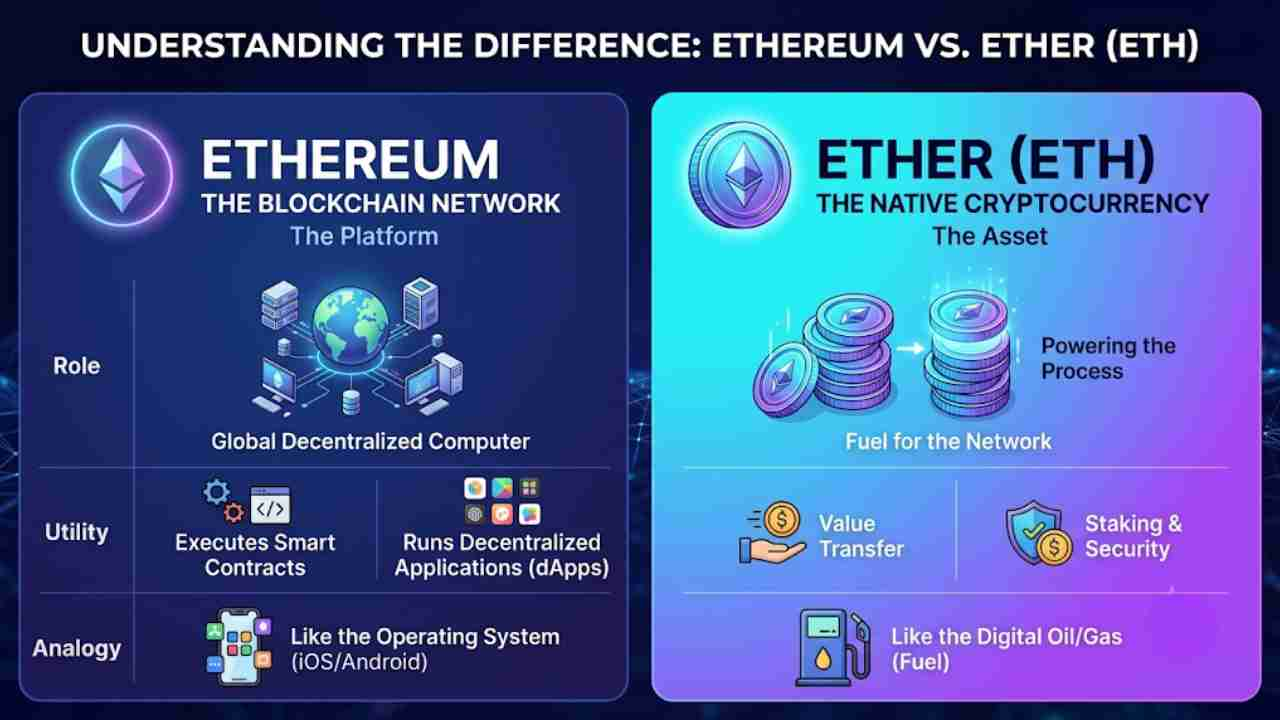
Ethereum is an open-source, decentralized blockchain platform. It was proposed by Vitalik Buterin in 2013 and went live in July 2015. Unlike Bitcoin, which was designed purely as digital money, Ethereum was built to run programs. Those programs are called smart contracts. They execute automatically when pre-defined conditions are met. No middlemen. No servers. No centralized authority. The network is maintained by thousands of independent computers spread across the globe. That global distribution is precisely what makes it so powerful and so hard to shut down.
What Is Ether (ETH)?
Ether is the native currency of the Ethereum network. It has two core functions. First, it pays for gas fees. Every computation on the network costs a small amount of ETH to run. Second, ETH is used to stake and secure the network under Proof of Stake. Think of ETH less like a coin and more like a fuel or utility token. Without ETH, nothing moves on Ethereum. That built-in demand is one reason investors treat ETH as a long-term asset. As of June 2026, ETH trades near $1,670, down sharply from its all-time high of $4,951 hit in August 2025.
How Smart Contracts Actually Work
A smart contract is just code stored on the blockchain. It contains rules. When the rules are met, the contract executes automatically. Example: a lending protocol holds your collateral in a smart contract. If your position drops below a threshold, the contract liquidates it instantly. No loan officer needed. No delay. No human error. Smart contracts are transparent, auditable, and unstoppable once deployed. They have powered billions of dollars in DeFi activity. They also run NFT platforms, DAOs, insurance protocols, and tokenized assets. They are the fundamental building block of the entire Ethereum ecosystem.
The Ethereum Virtual Machine (EVM): The World Computer
The Ethereum Virtual Machine is the runtime environment that executes all smart contracts. Think of it as a global operating system. Every node on the network runs the EVM. When a developer deploys a contract, it runs identically across all nodes simultaneously. This makes Ethereum tamper-proof and censorship-resistant by design. The EVM has also become a global standard. Dozens of blockchains now use EVM-compatible architecture, including Polygon, Arbitrum, Base, and BNB Chain. Developers who learn to code for Ethereum can instantly deploy on any EVM chain. That network effect is deeply underrated.
Gas Fees: What You Pay and Why
Every transaction on Ethereum costs gas. Gas is a unit of measurement for computational work. The fee is paid in ETH. Gas prices fluctuate based on network demand. When the network is congested, fees spike. When it is quiet, fees drop. After the EIP-1559 upgrade in 2021, a portion of every gas fee is permanently burned. This removes ETH from circulation forever. In theory, high network activity makes ETH deflationary. In practice, post-Merge issuance has been cut by 88% to around 1,700 ETH per day. The deflationary mechanics are real but currently limited by low gas activity on Layer 1 in 2025 and 2026.
The Merge: Ethereum’s Most Historic Upgrade
In September 2022, Ethereum made one of the biggest transitions in crypto history. It switched from Proof of Work to Proof of Stake. This event is called “The Merge.” Before The Merge, miners used massive computing power to secure the network. It consumed enormous amounts of electricity. After The Merge, validators replaced miners. Validators lock up 32 ETH as collateral to participate in block production. If they behave dishonestly, their ETH is “slashed” or destroyed. The Merge cut Ethereum’s energy consumption by approximately 99.95%. It was a technical marvel executed without interrupting a live network worth hundreds of billions of dollars.
How Proof of Stake Security Works in 2026
Ethereum’s security now depends on economic incentives rather than raw computing power. Validators stake ETH as a security deposit. Bad behavior costs them their stake. The cost of attacking the network is proportional to the total ETH staked. To revert a finalized block, an attacker would need to risk at least one-third of all staked ETH. As of 2026, over 30% of all ETH supply is currently staked. Validators have grown to over one million in total. Historical uptime has been 99.7% since staking began. Staking currently earns validators around 4 to 5% annually. It is one reason institutional investors are increasingly treating ETH as a yield-bearing infrastructure asset.
Ethereum Layer 2 Networks: Scaling Without Compromise
Ethereum’s base layer (Layer 1) prioritizes security and decentralization above speed. That creates congestion during high demand. Layer 2 networks solve this problem. They process transactions off the main chain. They bundle thousands of transactions together and settle the compressed proof back on Ethereum. This preserves security while dramatically cutting costs and increasing speed. Arbitrum leads with $16.7 billion in total value locked. Base, backed by Coinbase, holds $10.7 billion in TVL. By 2026, Ethereum Layer 2 networks collectively process more than 50 million daily transactions. The combined L2 TVL exceeds $34 billion in some market reports. Layer 2 is not a workaround. It is Ethereum’s intended scaling architecture.
Key Ethereum Upgrades Through 2025 and 2026
Ethereum follows a systematic upgrade roadmap. Each hard fork adds new capabilities.
Shapella (April 2023): Enabled staking withdrawals for the first time. This unlocked liquidity for hundreds of thousands of validators.
Dencun (March 2024): Introduced EIP-4844 (proto-danksharding). This added blob transactions and dramatically lowered Layer 2 fees by increasing data availability.
Pectra (2025): Combined 11 Ethereum Improvement Proposals. It raised the maximum validator balance from 32 ETH to 2,048 ETH. It also improved wallet UX via smart-account-like behavior for standard wallets.
Fusaka (December 2025): Implemented PeerDAS, which improved data availability sampling and enabled safer, more decentralized blob scaling for Layer 2 networks.
Glamsterdam (Mid-2026): The upcoming upgrade targets parallel execution, higher gas limits, and better transaction efficiency on Layer 1.
Ethereum’s 2026 Roadmap: Three Strategic Tracks
The Ethereum Foundation has reorganized its development into three formal tracks for 2026.
Scale: Focuses on bigger blocks, enhanced proposer-builder separation (ePBS), and higher network throughput via Layer 2 growth.
Improve UX: Targets account abstraction and faster transaction confirmations. The goal is making Ethereum as easy to use as any mainstream app.
Harden the L1: Covers quantum-resistant security and stronger censorship resistance. This is a long-term defensive investment in the protocol.
Two major upgrades are planned for the year: Glamsterdam and Hegota. Hegota will implement Verkle Trees, which reduce the data needed to verify the network and make running a node far more accessible. The long-term “Strawmap” vision targets 10,000 TPS on Layer 1, near-instant finality, and native privacy features by 2029.
Ethereum DeFi: The Decentralized Financial System
Decentralized Finance is the most impactful use case Ethereum has ever produced. DeFi platforms let users lend, borrow, trade, and earn yield without using a bank. Everything runs on smart contracts. Protocols operate 24/7 without human operators. In 2026, Ethereum captures 63 to 68% of the total DeFi market by TVL across all blockchains. That is a dominant position despite fierce competition from Solana and other Layer 1 rivals. The appeal is simple. Users retain full custody of their funds. No KYC. No bank accounts. No office hours. Just code running on a global network that never sleeps.
Tokenized Real-World Assets: The Institutional Frontier
One of the most significant trends on Ethereum in 2026 is the tokenization of real-world assets. Major financial institutions are now issuing on-chain versions of treasury bonds, money market funds, and real estate. BlackRock, JPMorgan, and others have been active in this space. Ethereum currently controls around 80% of the tokenized real-world asset market. When a government bond is tokenized on Ethereum, it becomes programmable. It can be used as collateral in DeFi. It can settle instantly. It can be fractionalized. Tokenization is not a speculative idea. It is already happening at scale. And Ethereum is the primary settlement layer for it.
DAOs: Organizations Run by Code
Decentralized Autonomous Organizations are internet-native companies with no CEO. They are governed by token holders. Decisions are made through on-chain votes. Treasury funds are controlled by smart contracts. A DAO can fund development, make investments, or manage a protocol, all without centralized management. The Enterprise Ethereum Alliance was an early institutional signal. It launched in 2017 with 30 founding members including JPMorgan. It grew to over 150 members by mid-2017. DAOs represent a genuinely new form of human coordination. They are experimental and imperfect. But they are also a legitimate organizational primitive that could reshape how teams and capital are managed on the internet.
Ethereum ETFs and Institutional Adoption in 2026
Spot Ethereum ETFs launched in the United States in mid-2024. That was a pivotal moment for institutional adoption. By 2026, cumulative ETF inflows have reached $11.6 billion. Institutional investors can now access ETH exposure inside traditional brokerage accounts. Staking products for institutional clients are also growing rapidly. Price growth for 2026 is expected to be driven substantially by institutional staking demand. Analyst year-end targets for ETH in 2026 range widely. Citi projects $3,175. Standard Chartered targets $7,500. More aggressive analysts like Tom Lee suggest $12,000. The spread reflects genuine uncertainty about macro conditions and Layer 2 fee dynamics rather than disagreement on Ethereum’s fundamentals.
Ethereum vs. Competitors: Where It Stands in 2026
Ethereum is not without rivals. Solana offers faster base-layer throughput and lower transaction costs. It has gained ground in trading volumes and consumer apps. But Ethereum’s advantages remain substantial. It has the largest developer community on Earth. It has the deepest DeFi ecosystem by total value locked. It has the strongest institutional infrastructure. It has the most mature tooling and auditing standards for smart contracts. Alternative Layer 1 networks compete on speed and cost. Ethereum competes on security, decentralization, and trust. For high-value applications like real-world asset settlement or institutional DeFi, those properties matter more than raw speed.
Risks Every Ethereum Investor Should Know
No guide is complete without addressing risk honestly.
Price Volatility: ETH fell over 55% from its August 2025 all-time high of $4,951 to trade near $1,670 in June 2026. Recession fears and macro pressure contributed heavily. Crypto markets can see 50% drawdowns within a single cycle.
Layer 2 Fee Cannibalization: As more activity moves to Layer 2, base layer fee revenue declines. This reduces the ETH burn rate and weakens deflationary dynamics.
Competition: Solana, Sui, and newer Layer 1 blockchains are building fast and attracting developers. Ethereum’s dominance is durable but not guaranteed.
Regulatory Risk: Regulatory clarity is improving in the United States. But global regulatory uncertainty remains a real drag on institutional participation.
Key Loss: There is no password reset on Ethereum. If you lose your private keys or seed phrase, your funds are permanently inaccessible. Hardware wallets and secure backups are not optional.
Ethereum Fundamentals: FAQ Section
What is the difference between Ethereum and Bitcoin? Bitcoin is designed as a decentralized store of value and digital gold. Ethereum is a programmable computing platform. Bitcoin has a fixed supply cap of 21 million coins. Ethereum does not. Bitcoin processes simple transactions. Ethereum executes complex smart contracts and hosts entire applications. They serve different purposes and should not be directly compared as investments.
What is ETH gas and why does it fluctuate? Gas is the unit that measures computational work on Ethereum. Users pay gas fees in ETH for every transaction or smart contract call. Fees fluctuate based on network demand. When many users are competing for the same block space, fees rise. When activity is low, fees fall. Layer 2 networks dramatically reduce gas costs by batching transactions off-chain.
Is Ethereum a good investment in 2026? That depends entirely on your risk tolerance and investment horizon. Ethereum has strong fundamental demand from DeFi, real-world asset tokenization, and institutional staking products. Over 30% of supply is staked and off the market. But ETH is highly volatile. It has dropped over 55% from its all-time high in a matter of months. Any investment in ETH should be sized appropriately within a diversified portfolio. This is not financial advice.
What is account abstraction on Ethereum? Account abstraction allows standard Ethereum wallets to behave like programmable smart contracts. Users can set spending limits, enable social recovery in case of key loss, require multi-signature approvals, and pay gas fees in tokens other than ETH. The Pectra upgrade in 2025 laid important groundwork for this. It is one of the most significant UX improvements Ethereum has ever introduced.
What does the Glamsterdam upgrade do? Glamsterdam is the major Ethereum upgrade targeting mid-2026. It introduces parallel execution of transactions, higher default gas limits, and enhanced proposer-builder separation. These changes improve throughput on Layer 1 and reduce execution costs. A successful Glamsterdam rollout is widely viewed as the most important near-term technical catalyst for ETH price action in 2026.
What happens if Ethereum gets hacked? No blockchain is unhackable in theory, but a direct attack on Ethereum would require an attacker to control at least one-third of all staked ETH. With over 30% of supply staked, that represents tens of billions of dollars in capital. The cost of attack makes it economically irrational. Individual smart contracts can still contain bugs and vulnerabilities, which is a separate and very real risk. Always audit code and only use protocols with established security track records.
Conclusion: Ethereum in 2026 and Beyond
Ethereum is not perfect. It is expensive at peak demand. It faces real competition. Its price is volatile and unpredictable in the short term. But its underlying architecture has proven remarkably durable. The transition to Proof of Stake was a success. Layer 2 adoption is accelerating. Institutional infrastructure is deepening. The roadmap is ambitious and increasingly well-organized. Ethereum is the settlement layer for a significant portion of global on-chain activity. That position is hard-won and hard to replicate. Whether you are a developer, investor, or curious observer, understanding Ethereum fundamentals is no longer optional. It is the baseline literacy for the decentralized internet.
Disclaimer: This article is for informational and educational purposes only. It does not constitute financial advice. Always conduct your own research before making any investment or trading decisions in digital assets.