You’ve probably heard someone call Cardano “the academic blockchain.” Or maybe you’ve seen ADA sitting quietly on a price chart, refusing to do anything dramatic while Bitcoin and Solana grab all the headlines. Either way, if you’ve landed here, you want the real answer to a simple question: what is ADA, and does it actually do anything?
Good news. This is one of the more interesting projects to understand precisely because it doesn’t behave like the rest of the market. Let’s get into it.
What Is Cardano, In Plain English
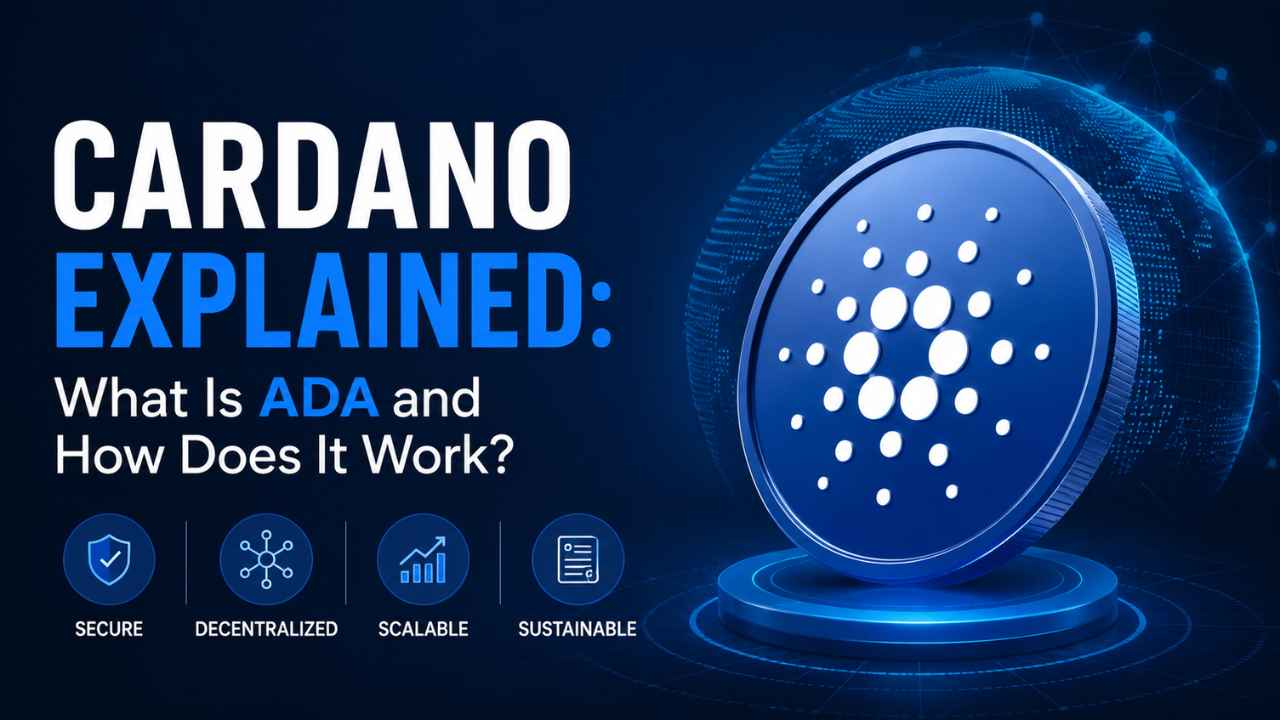
Cardano is a public blockchain, and ADA is the cryptocurrency that runs on it. Think of the blockchain as the road and ADA as the fuel you put in the car to use it. You need ADA to pay transaction fees, to stake and earn rewards, and to participate in the network’s governance votes.
The project launched in 2017, built by Input Output Global (IOG), a company cofounded by Charles Hoskinson, who was also one of the early cofounders of Ethereum before he left to build something different. That “different” turned into Cardano’s whole identity. Where most chains ship first and patch later, Cardano insists on peer reviewed research before anything gets deployed. Slower, yes. But that’s the tradeoff the team chose on purpose.
The token is named after Ada Lovelace, the 19th century mathematician often credited as the first computer programmer. It’s a fitting name for a chain that leans so heavily on formal methods and academic rigor.
As of August 28, 2026, ADA trades around $0.213, with a market cap near $7.99 billion, putting it around rank 19 among all cryptocurrencies. Circulating supply sits at roughly 37.49 billion ADA out of a hard capped max supply of 45 billion. That cap matters. Unlike Ethereum, Cardano was designed from day one with a fixed ceiling on total supply, similar in spirit to Bitcoin’s scarcity model.
How Does Cardano Actually Work
Here’s where it gets genuinely different from most Layer 1 chains you’ve read about.
Ouroboros: The Proof of Stake Engine
Cardano runs on a consensus protocol called Ouroboros, the first proof of stake protocol to be backed by peer reviewed academic research rather than just a whitepaper and good intentions. Instead of miners burning electricity to solve puzzles like Bitcoin, Cardano relies on stake pools. ADA holders delegate their tokens to a pool, and the network selects block producers based on the proportion of stake behind each pool. More stake behind you, better odds of producing the next block and earning rewards.
This is also why Cardano’s energy footprint is a fraction of Bitcoin’s. No mining rigs, no warehouses full of GPUs. Just validators running relatively modest hardware.
Two Layers, One Chain
Cardano splits its architecture into two parts: the Cardano Settlement Layer, which handles ADA transactions and balances, and the Cardano Computation Layer, where smart contracts and dApps actually run. The idea is separation of concerns. Keep the money layer simple and secure, keep the logic layer flexible enough to evolve without risking the base settlement system.
Voltaire and Real On Chain Governance
This is arguably the most underrated part of the whole project. Cardano’s Chang hard fork, which went live on September 1, 2025, formally launched the Voltaire era and made the network fully community governed. Through CIP 1694, ADA holders can now elect Delegated Representatives (DReps) to vote on protocol changes, alongside a constitutional committee and the network’s Stake Pool Operators (SPOs). A portion of transaction fees funds an on chain treasury that pays for future development, decided by community vote rather than a single company’s roadmap.
By early 2026, the Cardano Foundation had even shipped full Conway era governance support into its Rosetta API, letting exchanges and institutional integrators plug directly into DRep delegation and on chain voting. It’s a small technical update, but it signals something bigger: governance here isn’t a slide in a pitch deck, it’s live infrastructure people actually use.
Scaling: Hydra and What’s Coming With Leios
Cardano’s biggest historical criticism has been throughput. Hydra, the project’s Layer 2 scaling solution, reached mainnet in October 2025, and its testnet runs have already demonstrated speeds in the range of a million transactions per second under stress testing conditions. For 2026, the roadmap points to Ouroboros Leios, a base layer upgrade targeting somewhere between 1,000 and 10,000 transactions per second on layer one itself, a massive jump from where the chain sits today.
There’s also Midnight, a privacy focused sidechain that launched its NIGHT token in 2025 and is preparing for full mainnet deployment. It’s built to let developers create applications with selective data privacy, something Cardano’s base layer doesn’t natively offer.
Staking ADA: How It Works and What You Earn
Staking is probably the single biggest reason regular people hold ADA long term instead of just trading it. Here’s the appeal: you delegate your ADA to a stake pool, you never lose custody of your coins, there’s no lockup period, and you can even spend your ADA while it’s staked. Try that with most other proof of stake networks.
Typical staking yields land somewhere between 3% and 5% annually after pool fees, depending on which pool you choose and how saturated it is. The minimum to start delegating is a few ADA, nowhere near Ethereum’s old 32 ETH validator threshold. Roughly 59% to 70% of all circulating ADA has historically been staked at any given time, which tells you something about how comfortable holders are locking in that passive yield without actually locking anything.
Cardano in 2026: The Honest Picture
Let’s talk numbers, because a good crypto guide doesn’t just sell you the vision.
ADA has had a rough stretch. The token still trades roughly 93% below its all time high of $3.09, set back in September 2021. On August 21, 2026, the broader market turned sharply bullish after comments from President Trump pushed Bitcoin to an intraday high near $79,500, and ADA rode that wave, jumping over 15% from the $0.18 to $0.19 range up toward $0.2175. Daily transactions and active addresses climbed alongside the price, a sign the move wasn’t pure speculation.
But there’s a real weak spot: DeFi activity. Cardano’s total value locked in decentralized finance sits in the tens of millions of dollars, a tiny fraction of Ethereum’s roughly $38 billion. That gap is the honest answer to “why doesn’t ADA’s price match its market cap ranking.” The chain has the infrastructure and the governance, but builder adoption hasn’t caught up yet. In March 2026, rival Layer 1 Hyperliquid’s HYPE token briefly overtook ADA in market capitalization, a symbolic moment that stung, and a reminder that investors are increasingly rewarding chains with revenue generating activity over research first roadmaps.
On the regulatory side, there’s real tailwind. SEC Chair Paul Atkins proposed a “safe harbor” framework in March 2026 that would classify most crypto assets, ADA included, as not securities, removing a legal cloud that had hung over the sector for years. Spot ADA ETF filings from Grayscale, VanEck, 21Shares, and Canary Capital are currently pending. If even one gets approved, it would be a genuine catalyst, similar to what spot Bitcoin and Ethereum ETFs did for those markets.
Cardano vs Ethereum vs Solana: Quick Comparison
| Metric | Cardano (ADA) | Ethereum (ETH) | Solana (SOL) |
|---|---|---|---|
| Consensus | Ouroboros PoS | PoS | PoS |
| Governance | On chain, Voltaire era DReps | Off chain, developer led | Off chain, foundation led |
| Max Supply | 45 billion (capped) | No hard cap | No hard cap |
| Typical Staking Yield | 3% to 5% | 3% to 4% | 6% to 8% |
| DeFi TVL (approx, 2026) | Tens of millions | ~$38 billion | Tens of billions |
| Known For | Research rigor, governance | Largest dApp ecosystem | Speed and throughput |
Where Does ADA Fit In Your Portfolio
If you’re weighing ADA against something like Bitcoin or Ethereum, treat it as a longer horizon bet on governance and formal verification winning out over speed at all costs. That’s not a prediction, it’s just what the project is optimized for. The upside case leans heavily on Leios actually shipping and closing the throughput gap, plus real DeFi builders showing up once the infrastructure is fast enough to matter.
The downside case is just as real. Adoption metrics have been soft for a while, and crypto has a short memory for chains that promise big roadmaps and take years to deliver them. Do your own research, size the position accordingly, and don’t treat any single asset as your whole portfolio.
Buying and Taxing ADA in India
Indian investors can buy ADA through FIU registered exchanges like Mudrex or CoinDCX, which keeps you on the right side of India’s crypto compliance rules. Tax wise, nothing about ADA is special. Gains fall under Section 115BBH, taxed at a flat 30% regardless of how long you held the asset, with no deduction for losses against other income. Every sale or swap above the threshold also triggers a 1% TDS under Section 194S, deducted at the exchange level. Keep your trade records clean, because the TDS credit only helps you at filing time if the paperwork matches up.
FAQ
Is Cardano proof of work or proof of stake? Proof of stake, running on the Ouroboros protocol, which was the first peer reviewed academic proof of stake system in crypto.
What is ADA used for? Paying transaction fees, staking for rewards, and voting in Cardano’s on chain governance through the DRep system introduced in the Voltaire era.
Can I stake ADA without losing access to it? Yes. Delegated ADA stays in your wallet, has no lockup period, and remains spendable even while earning staking rewards.
Is there a Cardano ETF? Not yet approved as of August 2026, but spot ADA ETF applications from several major issuers are currently pending with regulators.
Why has ADA underperformed other Layer 1 tokens? Mainly weak DeFi and dApp adoption relative to its market cap, though scaling upgrades like Hydra and the upcoming Leios protocol aim to close that gap.