You’ve got a few thousand dollars in stablecoins just sitting there. Not doing anything. Not losing value, sure, but not earning a rupee either. And somewhere on Crypto Twitter someone’s flexing an 8% APY screenshot while your USDT sits flat at zero.
Here’s the thing nobody tells you upfront. USDC, USDT, and DAI are all pegged to a dollar, but the way each one turns into actual yield is completely different. One pays you through a company’s rewards program. One barely pays anything on its own. One is basically a decentralized central bank running its own interest rate. Mixing these up is how people end up chasing the wrong number.
So let’s actually break it down. Not theory. Real rates, real risk, real platforms.
Quick Answer: Which Stablecoin Pays More Right Now
If you want the short version before the long one, here it is.
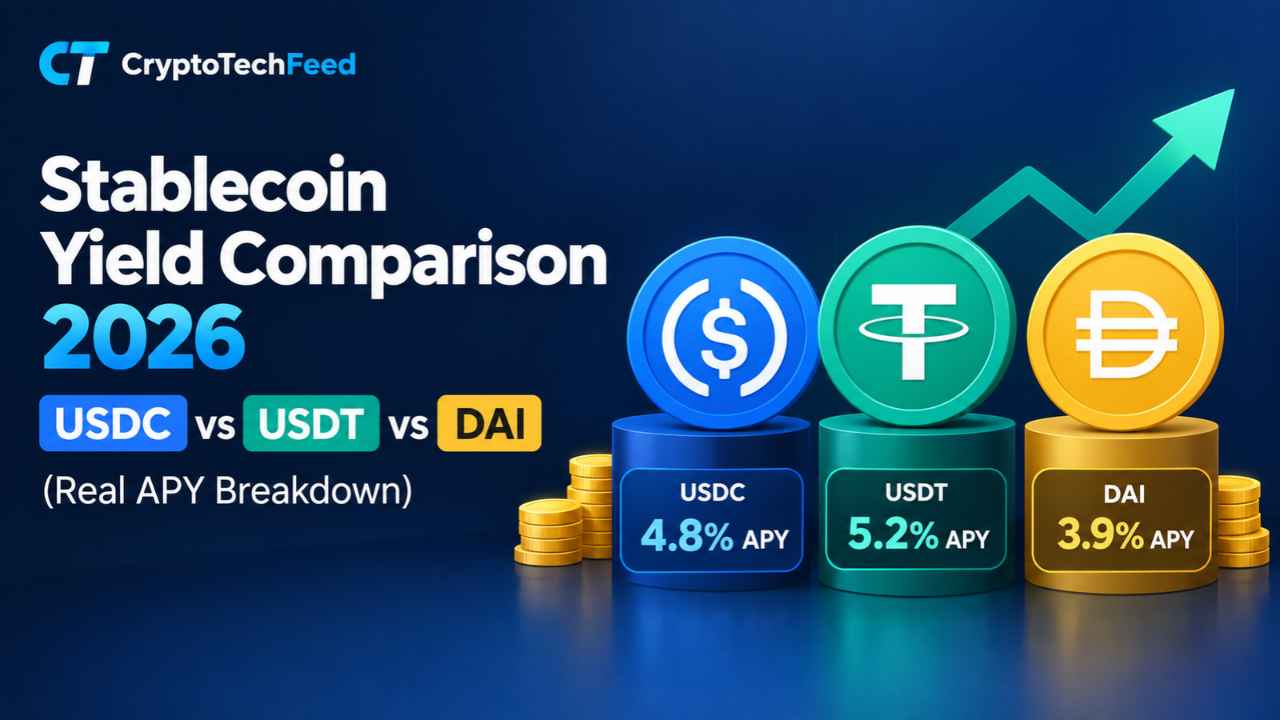
- DAI (via sDAI, the Sky Savings Rate) usually sits highest among the “safe” options, often in the 4% to 6% range, and has spiked as high as 8% during specific governance periods.
- USDC through Coinbase Rewards typically runs 3.5% to 4.1%, though it’s now gated behind a paid Coinbase One subscription for most users.
- USDT has the narrowest set of easy yield options. DeFi lending on Aave puts it around 3.6% to 5.4%, but there’s no native “USDT savings rate” the way DAI has.
Those numbers move constantly. Treat them as a starting point, not gospel.
Why These Three Behave So Differently
Here’s what most comparisons miss. USDC, USDT, and DAI aren’t structurally the same product wearing different labels. They’re built on three completely different models, and that’s the whole reason their yields don’t line up.
USDC: The Reserve Stays With Circle
USDC is issued by Circle. Circle holds the reserves, mostly short-term US Treasuries and cash, and Circle keeps the interest those reserves generate. You, the USDC holder, get nothing directly from Circle. Zero. Nada.
Any yield you see on USDC comes from a third party choosing to share a slice of what they’re earning. Coinbase is the obvious example. It pays USDC rewards, currently hovering near 4% APY, but as of late 2025 that perk got locked behind Coinbase One, a paid membership starting around $4.99 a month. So the “free” USDC yield story quietly ended.
Beyond Coinbase, USDC yield lives in DeFi. Aave, Morpho, Fluid, tokenized Treasury products like BUIDL and Ondo’s OUSY. All of these route your USDC into lending markets or T-bill baskets and pay you a cut.
USDT: Biggest Market Cap, Smallest Yield Menu
USDT is the largest stablecoin by market cap, sitting well above $150 billion. You’d think that size would mean the deepest yield ecosystem. It doesn’t. Most DeFi protocols were built USDC-first. Sky’s Peg Stability Module, for instance, doesn’t even mint against USDT at all.
That leaves USDT holders with a shorter menu. Aave V3 supports it, generally in the 3.6% to 5.4% range. Curve’s 3pool lets you earn swap fees on a USDC/USDT/DAI basket. Centralized exchanges like Binance and Kraken run flexible USDT savings products, usually 3% to 6%, with fixed-term options paying more if you’re willing to lock funds up.
There’s no single dominant “USDT yield” the way DAI has its savings rate. It’s scattered across platforms, each with its own risk shape.
DAI: A Protocol That Pays You to Hold Its Money
DAI works nothing like the other two, and this is the part that actually matters. DAI is issued by Sky Protocol, formerly MakerDAO, and it’s overcollateralized by a mix of crypto assets and real world assets, including a large allocation to short-term Treasuries now.
Because Sky earns real revenue from those RWA holdings, it can afford to pay DAI holders directly through something called the Dai Savings Rate, or DSR. You deposit DAI into the DSR contract (usually via Spark Protocol, receiving sDAI in return) and your balance just grows. No lockup. No subscription tier. No borrowing required.
The DSR has been genuinely volatile though. It touched around 8% in May 2026 during Sky’s USDS migration period, then cooled toward the 4.5% range more recently as governance adjusted the rate. That swing alone tells you something: DAI yield is a policy decision, not a fixed feature.
Current APY Comparison Table
| Platform / Method | Stablecoin | Typical APY (Sept 2026) | Access Type | Lockup |
|---|---|---|---|---|
| Coinbase Rewards | USDC | 3.5% – 4.1% | CeFi, Coinbase One required | None |
| Sky Savings Rate (via sDAI/Spark) | DAI | 4% – 6% (has spiked to 8%) | DeFi, non-custodial | None |
| Aave V3 | USDC | 3.3% – 5% | DeFi, non-custodial | None |
| Aave V3 | USDT | 3.6% – 5.4% | DeFi, non-custodial | None |
| Morpho curated vaults | USDC | 4% – 5.7% | DeFi, non-custodial | None |
| Morpho USDT vaults | USDT | 4.2% – 7.1% | DeFi, non-custodial | None |
| Curve 3pool LP | USDC/USDT/DAI | 3.1% – 6.4% | DeFi, LP risk | None |
| Tokenized T-bills (BUIDL, OUSG, USDY) | USDC-linked | 4.2% – 4.5% | Hybrid, custody varies | Varies |
| Binance/Kraken flexible Earn | USDT | 3% – 6% | CeFi | None (flexible tier) |
| Pendle fixed-rate PT | USDT/USDC | 5.8% – 9.2% | DeFi, fixed to maturity | Yes, until maturity |
Rates shift weekly based on borrowing demand and Fed policy. Always check the live rate on the platform before you deposit anything.
Risk Isn’t the Same Across These Three Either
This is the part people skip, and it’s honestly the more important half of the comparison. A slightly lower APY with lower risk usually beats a flashy number sitting on shakier ground.
USDC risk factors:
- Centralization risk. Circle can freeze addresses, and has, under legal pressure.
- Third-party dependency. Your yield depends on Coinbase or a DeFi protocol staying solvent, not on USDC itself.
- Reserve transparency is strong, monthly attestations, which is genuinely a point in its favor.
USDT risk factors:
- Historically thinner reserve disclosure compared to USDC, though Tether has improved this over the years.
- Regulatory pressure remains a live issue in the US and EU under MiCA.
- Yield sources are more fragmented, so due diligence per platform matters more.
DAI risk factors:
- Smart contract risk sits at the protocol layer itself, not just the yield venue.
- The DSR rate is a governance vote away from changing, sometimes overnight.
- Growing dependence on real world assets means DAI’s yield is now tied to traditional interest rate cycles more than pure crypto demand.
None of these are dealbreakers on their own. But pretending any of the three is “risk free” just because it says $1.00 on the price chart is how people get caught out.
Which One Should You Actually Hold
Honestly, there’s no single right answer here. It depends on what you’re optimizing for.
If you want the least friction and don’t mind paying a small subscription, USDC through Coinbase Rewards is about as plug and play as it gets. Open the app, opt in, done.
If you already hold DAI or you’re comfortable moving between Spark and your wallet, the Sky Savings Rate is hard to beat when it’s running hot. Just don’t assume the rate you see today is the rate you’ll get in six months.
If you’re sitting on a large USDT position from trading, don’t leave it idle. Aave or a reputable exchange’s flexible Earn product turns dead capital into something, even if it’s a modest 3% to 5%.
And if you’re chasing the higher end of these ranges, the 7% to 9% territory, understand that you’ve stepped into DeFi lending curation, fixed-term Pendle positions, or liquidity pools. That’s a different risk category entirely, closer to actively managed yield than passive savings.
A reasonable approach many experienced holders use: split across two or three of these rather than betting everything on whichever number looks biggest this week. Diversifying the yield source matters just as much as diversifying the stablecoin itself.
FAQ
Is DAI always the highest yielding stablecoin? Not always. The Dai Savings Rate is set by governance and moves with market conditions. It’s frequently among the highest of the three, but USDT or USDC yields on DeFi platforms occasionally overtake it depending on borrowing demand.
Can I lose money earning yield on stablecoins? Yes. Smart contract exploits, platform insolvency, and depegging events have all happened before. The stablecoin holding steady at $1 doesn’t mean the yield product wrapped around it is risk free.
Does Circle pay interest on USDC directly? No. Circle keeps the reserve interest. Any USDC yield you see comes from a third party like Coinbase or a DeFi protocol sharing part of their own returns with you.
Is stablecoin yield taxable? In most jurisdictions, yes, typically as ordinary income the moment it’s credited, separate from any capital gains on the stablecoin’s price. Check the current rules for your country before assuming otherwise.
What’s the safest way to earn interest on stablecoins? A regulated CeFi platform or a tokenized Treasury product generally sits at the lower risk end, usually in the 4% to 5% range. Lower yield, but fewer moving parts that can break.