I had two block explorer tabs open last week. One showed Solana. One showed Sui. I kept hitting refresh on both, like a kid checking if the microwave popcorn is done yet. It’s a dumb habit. But it taught me something. The numbers you see on Twitter and the numbers you see live are two very different stories.
Everyone throws around 65,000 TPS for Solana. Everyone throws around 100,000 plus TPS for Sui. Neither number tells you what happens when you actually hit send on a transaction today. So let’s cut through it. Here’s what a real solana tps vs sui throughput test looks like in September 2026, with the marketing stripped out.
Solana TPS Explained: Theoretical vs Real World Numbers
Solana’s headline number is 65,000 TPS. That figure comes from its Proof of History architecture, tested under lab conditions with optimized hardware and low congestion. It’s a ceiling. Not a daily report card.
Real Solana throughput in 2026 tells a calmer story. Chainspect data puts live sustained TPS around 1,500 to 4,000 in normal conditions, with a recorded 100 block peak near 6,284 TPS. During a single day in late January 2026, the network processed over 148 million non vote transactions, a record driven largely by memecoin and Pump.fun activity.
A few things worth knowing:
- Block time sits at roughly 400 milliseconds
- Full finality lands around 12 to 13 seconds today
- The Firedancer validator client, live since late 2025, has already lifted reliability and throughput ceilings in testing
- Alpenglow, Solana’s next consensus upgrade expected around October 2026, targets finality under 150 milliseconds
So Solana isn’t running anywhere close to 65,000 TPS on a normal Tuesday. It’s running closer to Visa’s average daily load of about 1,700 TPS, which honestly is still impressive for a public blockchain.
Sui Throughput Explained: Mysticeti and the Object Model
Sui plays a different game entirely. Instead of one global state machine processing transactions in order, Sui treats everything as an object. Simple transfers between two wallets can skip full consensus and finalize the moment validators sign off. Complex, multi object transactions still route through consensus, just faster than before.
The consensus engine behind this is Mysticeti, live on mainnet since July 2024. It cut Sui’s latency by roughly 80 percent compared to the earlier Narwhal Bullshark setup, taking commit times from around 1,900 milliseconds down to near 400 milliseconds.
In controlled test environments, Mysticeti has shown numbers in the 100,000 to 300,000 TPS range, and some Mysticeti V2 tests have gone even higher under specific latency conditions. That’s the “theoretical” side of Sui’s story.
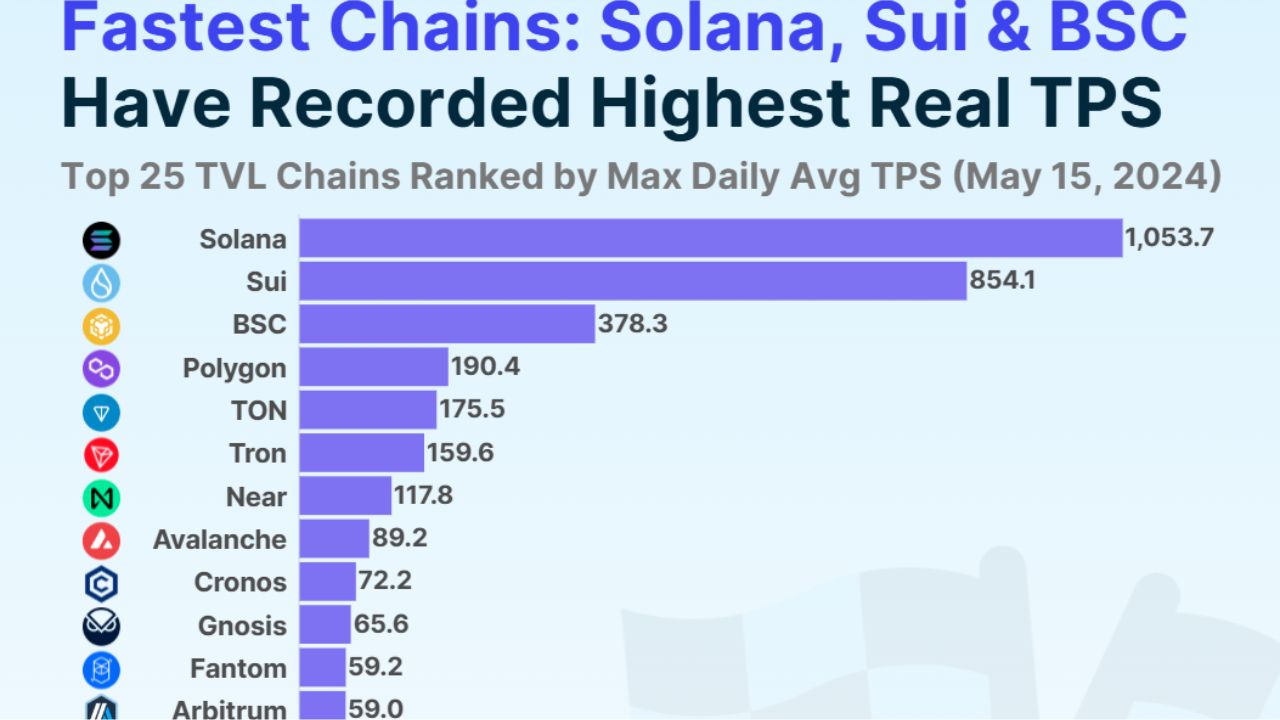
Real world usage looks much smaller. By early 2026, Sui was consistently processing somewhere around 800 to a few thousand real transactions per second, depending on network demand, with sub second finality holding steady even during busier periods. Sui set an earlier record of 5,414 TPS back in 2023 during a live stress event, and daily transaction counts have climbed well past that baseline since.
Solana TPS vs Sui Throughput Test: The Side by Side Numbers
Here’s the comparison stripped down to what actually matters.
| Metric | Solana (2026) | Sui (2026) |
|---|---|---|
| Theoretical max TPS | 65,000 | 100,000 to 300,000+ (test conditions) |
| Real world sustained TPS | 1,500 to 4,000 | 800 to a few thousand |
| Peak recorded TPS | ~6,284 | 5,414 (2023 stress test) |
| Block/commit time | ~400 ms | ~390 to 500 ms |
| Time to full finality | 12 to 13 seconds (sub second economic finality) | Under 1 second for simple transfers |
| Average fee | ~$0.00025 | Fraction of a cent |
| Consensus model | Proof of History + Proof of Stake | Mysticeti (DAG based BFT) |
| Execution model | Parallel via Sealevel | Parallel via object ownership |
Notice the finality row. That’s where things get genuinely interesting.
Finality Is Where Sui Actually Pulls Ahead
Raw TPS gets all the attention, but finality is what a trader or a game developer actually feels. Solana’s economic finality happens fast, often sub second in practice. But full, unstoppable finality still takes around 12 to 13 seconds today, because it depends on a supermajority of stake voting across multiple slots.
Sui’s fast path skips a lot of that overhead. A simple wallet to wallet transfer that doesn’t touch shared state can finalize in well under a second, sometimes closer to 250 milliseconds under ideal conditions. That’s because Sui doesn’t need the whole network to agree on ordering for transactions that don’t conflict with anything else.
Think of it this way. Solana processes more raw transactions per second right now. Sui often confirms individual transactions faster, especially simple ones. Different strengths, different jobs.
Alpenglow will close this gap significantly once it ships. Until then, Sui holds a real edge on finality speed for basic transfers, even while trailing Solana on raw daily transaction count.
Why Marketing Numbers and Real Numbers Never Match
Every chain publishes its best possible number. That’s not lying exactly, it’s just physics under lab conditions rather than a live network with real users, real congestion, and real validator hardware spread across the globe.
A few reasons the gap stays wide:
- Vote transactions inflate Solana’s raw TPS if you don’t strip them out
- Test environments use optimized, geographically clustered validators, not the messy real world spread
- Actual throughput always depends on demand, not capacity. Nobody sends 65,000 TPS worth of transactions unless there’s a reason to
- Shared object transactions on Sui still route through full consensus, slowing the “theoretical” number down in practice
This is true for basically every Layer 1 that quotes a big number. Ethereum’s 30 TPS base layer figure is also a real world number, not a theoretical one, and that gap runs both directions depending on the chain.
Fees: The Quiet Winner Nobody Argues About
Both chains are cheap enough that fees rarely decide anything on their own. Solana averages around $0.00025 per transaction. Sui runs in the same fraction of a cent range. Compare that to Ethereum mainnet, where a simple swap can run $2 to $10 during busy periods, and both Solana and Sui look nearly free.
If you’re building something that needs thousands of microtransactions, like an on chain game or a high frequency trading bot, this cost floor matters more than the TPS headline number ever will.
Which One Should You Actually Use?
This is the part people skip past to get to a verdict. But the honest answer depends on what you’re building or trading.
Pick Solana if:
- You need the largest existing liquidity pool for DeFi and memecoins
- You’re building something that benefits from a huge, established user base
- Raw daily transaction volume and ecosystem maturity matter more than sub second finality
Pick Sui if:
- You’re building a consumer app, game, or something needing instant, predictable finality
- Your transactions are mostly simple transfers that can use the fast path
- You want an object centric model that scales more naturally with hardware
Neither chain “wins” a solana tps vs sui throughput test in every category. Solana wins on ecosystem depth and proven real world transaction volume. Sui wins on finality speed for simple transactions and a more elegant scaling story on paper.
FAQ
What is Solana’s real TPS in 2026, not the theoretical number?
Solana’s real world sustained throughput runs roughly 1,500 to 4,000 TPS, with recorded peaks near 6,284 TPS. The 65,000 TPS figure is a theoretical ceiling under optimized lab conditions, not a daily average.
What is Sui’s actual TPS compared to its 100,000+ claims?
Real world Sui throughput sits closer to 800 to a few thousand TPS depending on demand, even though Mysticeti has demonstrated 100,000 to 300,000+ TPS in controlled test environments.
Is Sui faster than Solana?
It depends what you mean by faster. Sui often finalizes simple transfers quicker, sometimes under a second, thanks to its fast path. Solana processes more total transactions per day right now and has full finality closer to 12 to 13 seconds.
Will Solana’s Alpenglow upgrade change this comparison?
Yes, significantly. Alpenglow targets finality under 150 milliseconds, which would close most of the current gap with Sui’s fast path finality once it ships around October 2026.
Which chain has lower fees, Solana or Sui?
Both are extremely cheap, running in the fraction of a cent range per transaction. Neither is a meaningful cost factor compared to Ethereum mainnet fees.