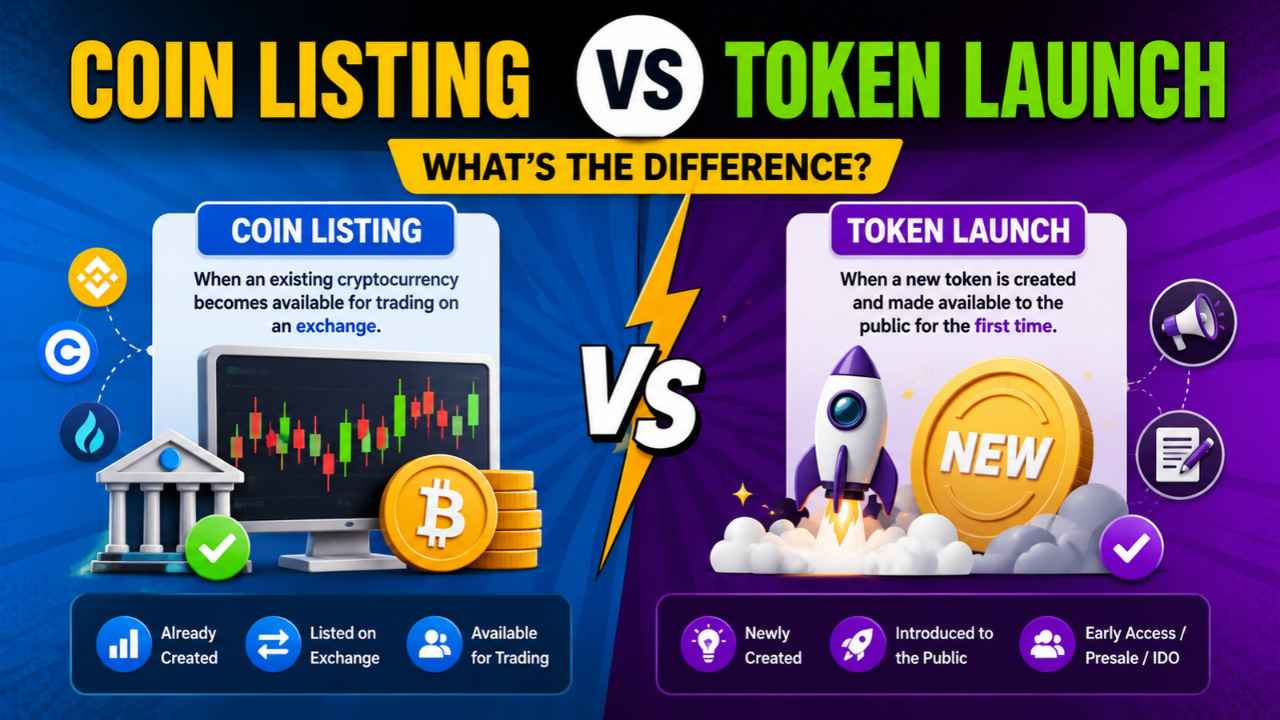
Scroll through any crypto Telegram group and you will see both phrases thrown around like they mean the same thing. They do not. A coin listing is an existing asset getting added to a new exchange. A token launch is a brand new asset entering the market for the first time. One is a distribution event. The other is a creation event. Mixing them up is how new investors end up buying something they thought was already proven, when it was actually day one.
Binance itself draws this line publicly. The exchange separates new listings, meaning tokens already trading elsewhere that get added to Binance, from token launches, meaning brand new tokens that debut through Binance’s own programs like Alpha. That single distinction from the world’s largest exchange by volume is worth sitting with, because it tells you the risk profile changes completely depending on which side of the line an asset falls on.
What a Coin Listing Actually Is
A coin listing happens when a cryptocurrency that already exists, already trades somewhere, and already has a price history gets added to a new trading venue. Think of Bitcoin getting added to a smaller regional exchange, or an altcoin that has traded on KuCoin for a year finally landing on Coinbase. The asset itself does not change. What changes is access, liquidity, and visibility.
This is why listings move prices so sharply. Messari’s research found tokens see an average gain of around 91 percent within five days of a Coinbase listing, a pattern traders now call the Coinbase Effect. Binance and Bybit listings tend to produce smaller but still meaningful bumps, often in the 20 to 80 percent range. New buyers flood in, existing holders on other platforms get easier exit routes, and price discovery improves almost overnight.
Also Read: New Token Listing Checklist: What to Research First
Coinbase approved just 9 new assets in December 2025 and 11 in January 2026, against thousands of projects seeking a spot. That scarcity is deliberate. Exchanges review security practices, tokenomics, community strength, and trading demand before agreeing to list anything, and a rushed or poorly vetted listing can damage an exchange’s own reputation just as easily as the project’s.
What a Token Launch Actually Is
A token launch is the birth of a new asset. There is no price history because there is no prior trading. The project mints supply, often through a smart contract on an existing chain like Ethereum, Solana, or BNB Chain, and makes it available to the public for the first time through an IDO, IEO, presale, or a launchpad program.
Binance Alpha is a useful case study here. Across 2025, the program launched 221 tokens and saw 105 of them graduate to Binance Futures, ending the year with a combined market cap of 14.8 billion dollars and 8.2 billion dollars in daily trading volume. Every one of those 221 tokens started with zero trading history. Buyers were betting on a concept, a team, and a tokenomics model rather than an established market.
This is also where most of the real risk sits. A 2026 read of the launch landscape from ICOholder notes that projects holding value tend to share transparent vesting schedules, credible teams, and working products by the time tokens trade, while projects that fail tend to rhyme too, with aggressive unlock schedules and opaque insider allocations. A launch has no track record to check. That is exactly the problem.
Coin Listing vs Token Launch: Side by Side
| Factor | Coin Listing | Token Launch |
|---|---|---|
| Asset history | Already trading elsewhere | Brand new, zero history |
| Price discovery | Mostly established already | Happens for the first time |
| Typical venue | Centralized exchange (CEX) | DEX, IDO, IEO, or launchpad |
| Main risk | Overpaying after the pump | Team, tokenomics, and rug risk |
| Vetting done by | The exchange | Mostly the buyer, sometimes the launchpad |
| Historical example | BNB moving from Ethereum token to its own chain listing | Binance Alpha’s 221 token debuts in 2025 |
BNB is actually a neat example of both worlds colliding. It started life as an ERC-20 token on Ethereum during Binance’s 2017 token launch, then migrated to its own blockchain in 2019, becoming a coin in the technical sense once it had a native chain to call home. Very few assets make that jump, but it shows the two categories are not always permanent.
Why This Distinction Matters for Your Portfolio
Treating a token launch like a coin listing is one of the fastest ways to lose money in this market. A listing on Coinbase or Binance means an asset has already survived months or years of trading, community scrutiny, and often a security audit trail. A launch has survived none of that. The tokenomics might be sound, or the entire supply could unlock into insider wallets within weeks.
For Indian investors specifically, this matters even more given the tax structure. Under Section 115BBH, gains on both listed coins and freshly launched tokens are taxed at a flat 30 percent, with 1 percent TDS under Section 194S applying on trades above the threshold regardless of whether the asset is three years old or three days old. The tax office does not care about the distinction. Your risk assessment should.
New Token Listing Checklist
Before buying into any fresh token launch, run through this quickly. It takes minutes and can save real money.
- Confirm the smart contract has been audited by a recognized firm, not a self-published report
- Check wallet concentration; if a handful of wallets hold most of the supply, walk away
- Read the vesting and unlock schedule, since cliff unlocks often trigger sharp sell-offs
- Search for the team’s real identities and prior project history
- Check whether liquidity is locked and for how long
- Look for genuine community activity, not just bot-driven follower counts
- Verify the project has addressed regulatory posture in its home jurisdiction
Where Each One Fits in Your Strategy
Coin listings suit investors who want exposure to an asset that already has proven demand but limited access on their preferred platform. The volatility is real but shorter lived, usually settling within a week or two as the initial rush fades. Token launches suit investors comfortable with early stage risk in exchange for potentially outsized upside, the same trade off venture investors make, just compressed into a much shorter and far more public timeline.
Neither is inherently safer. A coin listing can still be a poorly built project finally getting exchange access after failing to gain traction elsewhere. A token launch can turn into one of the best performing assets of the cycle if the fundamentals hold up. The difference is really about what kind of homework you are doing and how much history you actually have to check before you commit capital.
FAQ
Is a token launch riskier than a coin listing?
Generally yes, since a launch has no trading history, no established liquidity, and no prior market behavior to study, while a listed coin already has months or years of data to review before buying.
Can a token become a coin later?
Yes. BNB is the clearest example, starting as an Ethereum based token during its 2017 launch before migrating to its own blockchain in 2019 and becoming a coin in the technical sense.
Why do prices spike after a coin listing?
New exchange access brings fresh buyers and improved liquidity almost immediately. Research from Messari found Coinbase listings alone have driven average gains near 91 percent within five days.
What is the safest way to evaluate a new token launch?
Run through a full new token listing checklist covering audits, wallet concentration, vesting schedules, team background, liquidity locks, and community activity before committing any capital.
Do coin listings and token launches get taxed differently in India?
No. Both fall under Section 115BBH’s flat 30 percent tax on gains, with 1 percent TDS under Section 194S applying to eligible trades regardless of whether the asset is newly launched or already listed.