
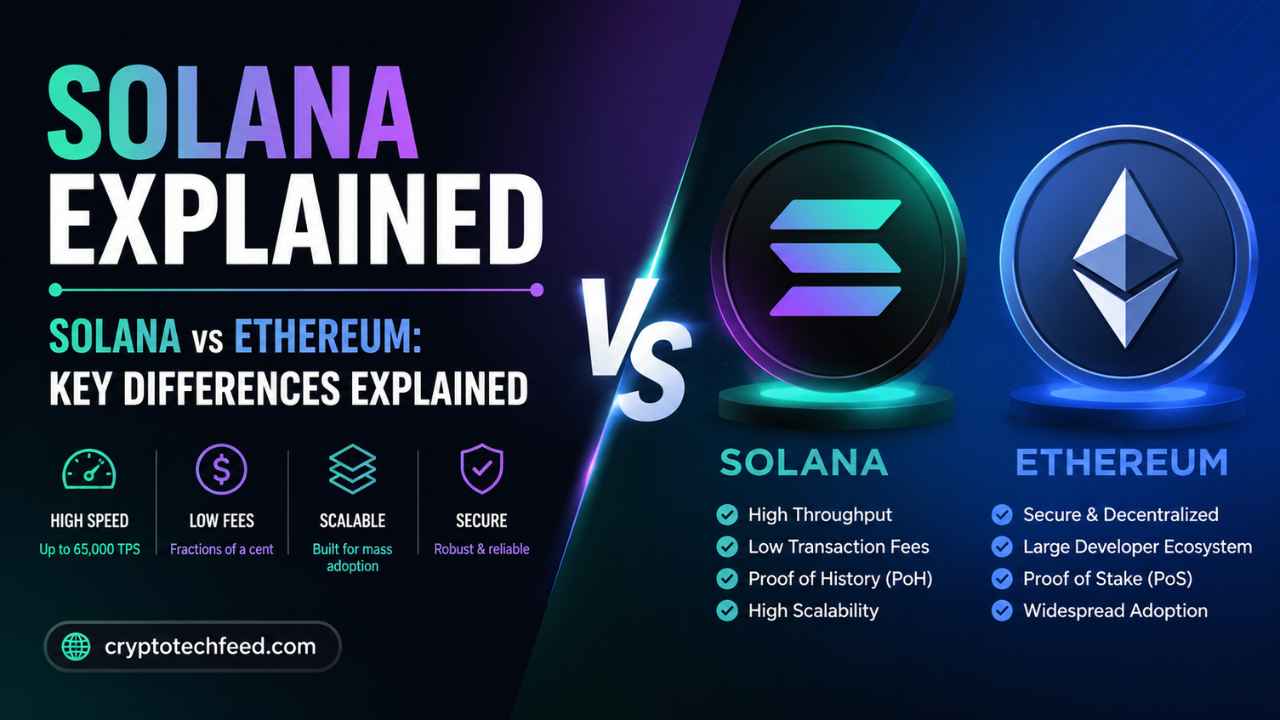
Ask ten people which chain is “better,” Solana or Ethereum, and you’ll get eleven answers. That’s crypto for you. But strip away the tribalism and Twitter noise, and the two networks aren’t even really competing for the same thing anymore. They just happen to share a leaderboard.
Ethereum was crypto’s first real programmable blockchain, the place where DeFi was born and where Uniswap, Aave and Lido still sit on tens of billions of dollars in locked value. Solana came later with a different bet entirely. Skip the queue. Skip the wait. Make a blockchain feel like a normal app. And in 2026, that bet is paying off in ways even skeptics didn’t expect.
This guide walks through what actually separates these two chains today. Not the marketing decks, the real numbers.
The Quick Answer
If you’re short on time, here’s the honest version. Ethereum still commands the deepest liquidity in DeFi, the largest developer base, and the strongest institutional trust, including ETF access since 2024. Solana wins on raw speed, fees so low they’re practically free, and a trading culture that never sleeps. Neither chain is “winning” outright. They’re built for different jobs.
Architecture: Two Very Different Bets
Ethereum runs on Proof of Stake, where validators lock up ETH to secure the network and confirm blocks roughly every twelve seconds at the base layer. It’s deliberate by design. Ethereum’s founders chose security and decentralization first, throughput second, and pushed the speed problem down to Layer 2 networks like Arbitrum, Optimism and Base instead of solving it on the main chain.
Solana took the opposite path. It pairs Proof of Stake with something called Proof of History, essentially a built in clock that timestamps transactions before they’re even grouped into a block. That shaves enormous amounts of time off consensus. Combine that with block times under half a second, and you get a chain that feels instant to the end user, no L2, no bridging, no waiting.
Here’s the trade off nobody markets loudly. Solana runs on somewhere between 800 and 1,500 validators. Ethereum runs on close to a million. More validators generally means harder to attack and more resistant to any single point of failure. Solana has also had a handful of network outages over the years, something Ethereum hasn’t experienced at the base layer. Speed came at a cost, and that cost is decentralization.
Speed and Fees, Where Solana Pulls Away
This is the category Solana was built to win, and it does. Real world throughput on Solana runs somewhere in the range of a few thousand transactions per second depending on network conditions, with a theoretical ceiling in the tens of thousands once Firedancer, its next generation validator client, rolls out fully. Ethereum’s base layer, by contrast, processes roughly 15 to 30 transactions per second. That’s not a typo. It’s just how the two chains were engineered.
Fees tell the same story. A Solana transaction typically costs a fraction of a cent, often quoted around $0.00025. An Ethereum transaction can run anywhere from a dime to several dollars depending on how congested the network is. Ethereum’s Layer 2 rollups have closed a lot of that gap for everyday users, but if you’re comparing base layer to base layer, Solana isn’t close, it’s just cheaper.
For anyone doing frequent trades, running a DCA strategy, or experimenting with small positions, that fee gap matters a lot more than it sounds on paper. Paying two dollars to swap fifty dollars of a token makes no sense. Paying a fraction of a cent does.
TVL and Liquidity, Where Ethereum Still Leads
Now flip to Total Value Locked, and the story reverses completely. Ethereum’s DeFi ecosystem, spanning its mainnet and its Layer 2 rollups, holds somewhere around $55 billion in locked value, roughly two thirds of the entire DeFi market. Solana’s TVL sits meaningfully lower, generally quoted somewhere between $8 and $12 billion depending on the data source and the day you check.
But TVL isn’t the whole picture, and this is where a lot of comparison articles stop short. Solana actually outpaces Ethereum on weekly DEX trading volume, driven largely by Jupiter, its dominant aggregator, which alone handles billions in daily swap volume. More capital sits parked on Ethereum. More trades actually happen on Solana. Both facts are true, and they tell you something different depending on whether you’re a long term liquidity provider or an active trader chasing flow.
Ethereum also still dominates stablecoin supply on chain and remains the settlement layer institutions gravitate toward, largely because it’s been battle tested across multiple market cycles without a base layer failure.
Staking Yields, a Bigger Gap Than People Expect
Here’s a stat that surprises a lot of newer investors. Ethereum staking through providers like Lido currently yields somewhere around 2.8 to 3 percent APY. Solana’s baseline staking reward runs closer to 6.6 percent, and liquid staking platforms like Jito can push that past 8 percent once MEV rewards are factored in.
The reason comes down to supply and inflation mechanics. Solana’s protocol issues new SOL at a higher rate to reward stakers, and with roughly two thirds of its circulating supply staked, competition for those rewards is lower per validator than you’d think. Ethereum has a smaller share of its supply staked and a much larger validator set splitting the pie.
One caveat worth flagging. Solana doesn’t currently enforce slashing penalties the way Ethereum does, which is great for staking flexibility but weaker from a pure economic security standpoint. Higher yield, slightly softer guardrails. That’s the trade.
Security and Decentralization
This is the argument Ethereum maximalists lean on hardest, and it’s not unfair. Nearly a million validators, a mature client diversity ecosystem, and years of uptime without a base layer outage make Ethereum the chain institutions trust with serious capital. Solana has closed a lot of ground technically, but its smaller validator count and history of network halts, even if increasingly rare, still show up in every serious risk assessment.
Neither point should be dismissed. If you’re parking six figures in a protocol for years, decentralization and uptime history matter enormously. If you’re swapping tokens fifteen times a day, they matter a lot less than the fee you’re paying each time.
Solana vs Ethereum Comparison Table
| Metric | Solana | Ethereum |
|---|---|---|
| Consensus | Proof of History + Proof of Stake | Proof of Stake |
| Real world TPS | Roughly 3,000 to 5,500 | Roughly 15 to 30 (base layer) |
| Average fee | About $0.00025 | $0.10 to several dollars |
| DeFi TVL | Roughly $8 to 12 billion | Roughly $55 billion |
| Staking APY | Around 6.6% (up to 8%+ via MEV) | Around 2.8% to 3% |
| Validators | 800 to 1,500 | Close to 1 million |
| ETF access | Spot ETFs launched in 2025 | Spot ETFs since 2024 |
| Best suited for | Speed, low fees, active trading | Security, deep liquidity, institutional capital |
So Which One Should You Actually Use
Honestly, it depends on what you’re doing, and anyone telling you otherwise is probably holding a bag. If you’re trading frequently, experimenting with new tokens, or building a consumer app where fees need to be invisible to the user, Solana’s architecture fits that job better. If you’re deploying serious capital into DeFi, need the deepest liquidity for large trades, or want the chain with the longest uninterrupted track record, Ethereum remains the safer bet.
A lot of active investors in 2026 simply hold both. That’s not indecision, that’s just matching the tool to the task.
Think about it this way. You wouldn’t use a sports car to move furniture, and you wouldn’t use a moving truck to win a race. Ethereum is the moving truck, slower, sturdier, built to carry serious weight without breaking down. Solana is the sports car, built for speed and built to feel good doing it. Both get you somewhere. They just get you there differently, and the smart move is knowing which trip you’re actually on before you pick the vehicle.
There’s also a builder side to this decision that retail investors often skip past. Developers choosing where to launch a new protocol face the exact same trade off, just with code instead of capital. Ethereum’s tooling is mature, its documentation is extensive, and its Layer 2 ecosystem means a new app can inherit Ethereum level security while still offering users cheap, fast transactions through Arbitrum, Base or Optimism. Solana’s tooling has caught up fast, and its single chain design means no fragmented liquidity across a dozen rollups, but it also means betting your entire app’s uptime on one network’s track record. Neither choice is wrong. It genuinely comes down to what you’re building and who you’re building it for.
For Indian Investors
If you’re buying either token from India, both are available on FIU registered exchanges like CoinDCX and Mudrex, and the tax treatment is identical regardless of which chain you choose. Under Section 115BBH, gains are taxed at a flat 30 percent with no deduction for losses against other income, and every trade above the threshold attracts a 1 percent TDS under Section 194S. Neither Solana nor Ethereum gets any special exemption here, so factor that flat tax into your return expectations before you compare yields on paper.
FAQ
Is Solana faster than Ethereum? Yes, significantly. Solana’s real world throughput runs into the thousands of transactions per second while Ethereum’s base layer handles around 15 to 30. Ethereum closes much of that gap through Layer 2 rollups, but on a base layer comparison, Solana is faster by a wide margin.
Which has lower fees, Solana or Ethereum? Solana. Its average transaction fee sits around a fraction of a cent, while Ethereum mainnet fees can run from a dime to several dollars depending on congestion.
Is Ethereum more secure than Solana? By most measures, yes. Ethereum has close to a million validators and no history of base layer outages, while Solana operates with a smaller validator set and has experienced network halts in the past, though these have become rarer as the network has matured.
Which is better for staking rewards? Solana generally offers a higher yield, with baseline staking around 6.6 percent APY compared to Ethereum’s roughly 2.8 to 3 percent, though Ethereum’s staking carries stronger slashing based security guarantees.
Should I invest in Solana or Ethereum in 2026? There’s no universal answer. Many investors hold both because they serve different purposes, Ethereum for deep liquidity and long term DeFi exposure, Solana for speed, low fees and active trading. Always research independently before investing.