There’s a particular kind of screenshot that gets passed around crypto Telegram groups. Someone’s portfolio. Forty thousand tokens of something. Bought for pocket change.
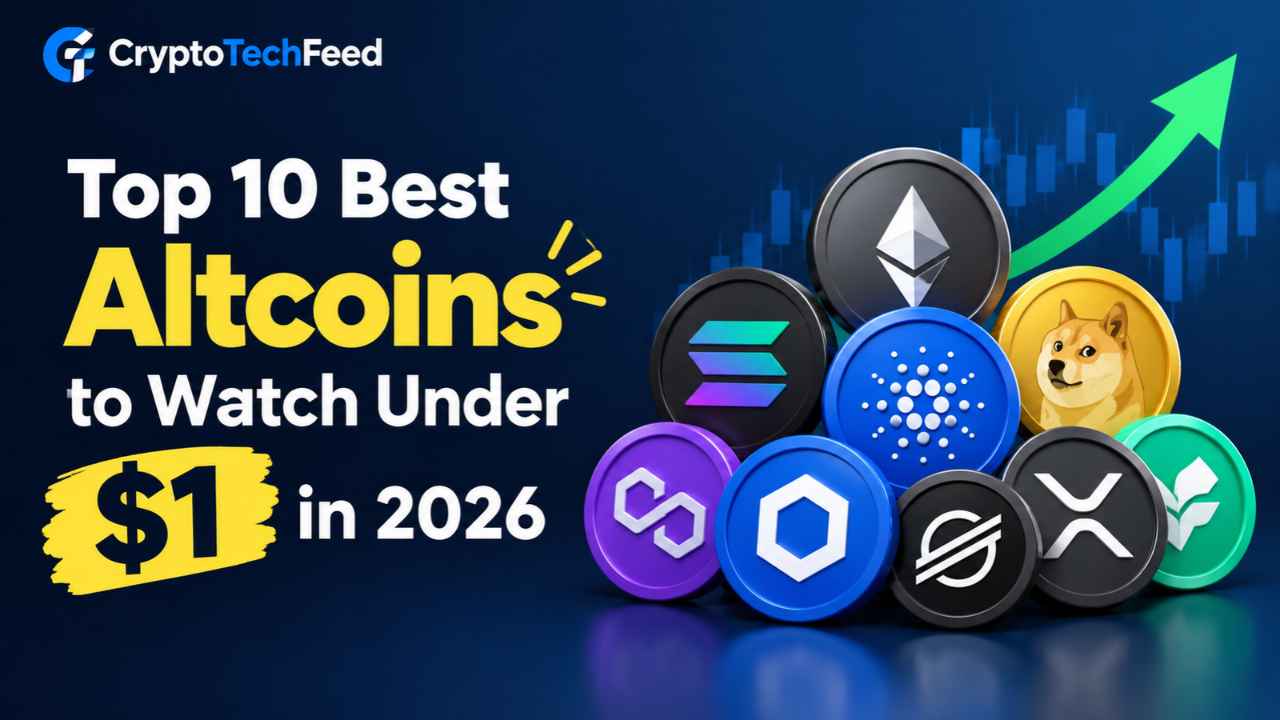
I get the pull. I really do. When a coin costs twenty cents, your brain quietly whispers that getting to two dollars is easy. It isn’t. But that doesn’t mean the sub-dollar shelf is worthless, it just means you have to read it properly. Right now, in September 2026, that shelf is crowded with names that were nowhere near it eighteen months ago. Cardano fell into it. Stellar sank deeper into it. This isn’t a list of lottery tickets. It’s a list of assets the market has repriced hard, and which ones actually deserve a second look.
Why the best altcoins to watch under $1 get so much attention
Here’s the honest version. Price per token tells you almost nothing. A coin at $0.08 with 150 billion tokens is bigger than a coin at $4 with 200 million. Market cap is the number that matters. Everyone in crypto knows this and everyone ignores it anyway, because holding a big round number of something just feels better.
But there’s a real reason to look here too, and it’s not psychological:
- Deep drawdowns push good infrastructure into cheap territory
- Sub-$1 large caps usually have real liquidity, so you can actually exit
- Most are already listed everywhere, which removes rug risk
- Percentage recoveries from a low base can be brutal in the good way
So the filter isn’t “cheap.” It’s “cheap and still shipping.”
What changed about this list in 2026
Two years ago, a list of altcoins under $1 meant microcaps and presales. Projects with three developers and a Discord. That’s not what this is anymore.
The 2026 drawdown dragged established, top-20 networks down into penny territory. Cardano at twenty cents. Stellar at nineteen. Hedera under eight. These are chains with years of development, real validator sets, exchange listings on every venue that matters.
That’s a genuinely different risk profile. You’re no longer betting on whether the project survives. You’re betting on whether the market repriced too far. Those are very different questions, and the second one is much easier to research.
1. Cardano (ADA) — around $0.21
ADA is the big one, and it stings. Down roughly 76% over the past year, sitting near twenty cents, more than 93% off its 2021 peak. That’s the bad news and I’m not going to dress it up.
The good news is that the network didn’t stop. CME launched ADA futures, which is genuine institutional plumbing. The Constitutional Committee renewal passed. A pre-accelerator programme is funding early payments and DeFi teams. There was also a wallet exploit that cost holders millions, and that headline risk is real.
So: patient infrastructure bet, not a trade. ADA is the best altcoin under $1 for people with a three-year horizon and a strong stomach.
2. Stellar (XLM) — around $0.19
Stellar keeps doing the least glamorous thing in crypto. Moving money. Cheaply. Across borders. No AI pivot, no gaming metaverse, just payment rails and, lately, tokenisation partnerships with traditional finance names.
The price has been hostage to Washington. XLM dropped over 7% when the CLARITY Act vote failed in the Senate, which tells you exactly what this token is trading on right now, regulatory clarity, not technology. It’s down about half from a year ago.
Watch the $0.195 resistance zone. Analysts have flagged it repeatedly. Without a policy catalyst, the upside stays capped, and that’s just the honest read.
3. TRON (TRX) — around $0.33
TRX is the strange one on this list. While everything else bled, TRON mostly didn’t. It’s the most expensive coin here and arguably the most boring, and those two things are connected.
Why it holds up: enormous USDT settlement volume. People in emerging markets move stablecoins on TRON because it’s fast and costs almost nothing. That’s not a narrative. That’s a habit, and habits are stickier than narratives.
The critique is fair too, it’s centralised, and the token doesn’t capture as much value as the network generates. But among the best altcoins to watch under $1, this one has actual cash flow behind it.
4. Hedera (HBAR) — around $0.075
Seven and a half cents. Down 86% from its 2021 high. Ouch.
Hedera’s pitch has never changed: enterprise-grade distributed ledger, governed by a council of large corporations, built for compliance-heavy use cases. That governance model is either the most underrated thing in crypto or the most overrated, depending on who you ask at what point in the cycle.
There’s a small but real HBAR ETF flow trickling in now, we’re talking hundreds of thousands, not millions, so temper it. Technically, the coin’s been grinding inside a contracting triangle with support near $0.09-$0.10 and resistance way up at $0.25.
5. Algorand (ALGO) — around $0.089
ALGO is the value-investor pick of the group, and I mean that with all the baggage that phrase carries.
The tech is genuinely mature. Instant finality, no forks, low fees, a research pedigree that came straight out of MIT. The problem was never the engineering. It was distribution. Layer 1 competition got brutal, and Algorand kept building excellent infrastructure that not enough people used.
At under nine cents with a market cap around $800 million, you’re paying very little for that infrastructure. Whether “undervalued” ever becomes “revalued” depends entirely on usage showing up. It hasn’t yet, and years of waiting is a real cost. Watch developer activity and transaction counts, not price charts.
6. Ondo (ONDO) — the tokenised assets play
If one narrative survives this bear phase intact, my money’s on real-world assets. Tokenised treasuries, tokenised funds, yield-bearing instruments that institutions can actually hold without their compliance team fainting.
Ondo is the cleanest pure-play here. It’s been shipping through the downturn, a network pivot, a completed token burn, product milestones stacking up while the price consolidated sideways. That gap between “building” and “priced” is exactly what you’re hunting for in a bad market.
The risk is obvious. RWA is a crowded story now, and Ondo has to prove protocol usage translates into token demand. Those are not automatically the same thing. Plenty of protocols process serious volume while their token does nothing, and RWA has more of that problem than most sectors, because the institutional money flows through the product without ever touching the token.
7. Arbitrum (ARB) — around $0.08
ARB has been an absolute punishment for holders. Eight cents. Technical indicators reading strong sell for months. Fear index in the low thirties.
And yet, Arbitrum is still one of the largest Ethereum Layer 2 networks by activity and total value locked. The chain works. The chain is used. The token, meanwhile, has been drowned in unlocks and a governance model that hands out a lot of ARB.
That’s the whole tension. Great network, difficult token. If you believe Ethereum scaling stays relevant and that ARB eventually gets real fee capture, this price is interesting. If not, it’s a value trap with a nice logo.
8. The Graph (GRT) — the picks and shovels bet
Nobody tweets about The Graph. That’s sort of the point.
GRT powers the indexing layer that lets applications query blockchain data without running their own infrastructure. Every dApp needs this. It’s the most unsexy, load-bearing piece of the stack, and it sits comfortably in the cheap crypto to buy under $1 bracket.
Here’s my slightly contrarian take: indexing demand goes up when AI agents start reading on-chain data at scale, and that’s already starting. GRT is one of the few sub-dollar tokens with a plausible AI angle that isn’t just a rebrand. Slow burn, though. Don’t expect fireworks.
9. VeChain (VET) — supply chain, still waiting
VET has been “about to happen” for roughly six years now. Enterprise supply chain tracking, sustainability credentials, real corporate partnerships that somehow never showed up in the token price.
Technicals are ugly, bearish across every moving average, forecasts pointing lower. I’m including it anyway, because the sub-cent price and the genuine enterprise relationships make it one of those coins that goes nowhere for three years and then does 5x in eleven weeks.
That’s not analysis. That’s pattern recognition from watching this asset too long. Treat it as a small position or skip it entirely.
10. Dogecoin (DOGE) — around $0.08
Let me be blunt. DOGE has no roadmap, no meaningful development, and no reason to exist on fundamentals.
It’s on this list because fundamentals aren’t the only thing that moves markets. DOGE has brand recognition that most Layer 1s would pay a fortune for, deep liquidity on every exchange, and a retail base that reappears the instant sentiment turns. At eight cents, it’s down enormously, and it has historically led retail-driven recoveries rather than followed them.
I wouldn’t hold it long-term. But if you’re tracking when altcoin season actually begins, DOGE volume is a better signal than most technical indicators.
How to actually filter this list
Don’t buy all ten. That’s not a portfolio, that’s a shopping spree. Run each one through these questions instead:
- Is the network being used? Check transactions and active addresses, not Twitter followers.
- Where does supply go next? Unlock schedules have killed more altcoins than bad tech ever did.
- Who holds it? Heavy concentration in a few wallets means you’re exit liquidity.
- Does the token capture value? Network success and token success are different things.
- Can you exit at 3am? If daily volume is thin, your paper gains are decoration.
Three questions answered badly is a pass. It’s fine to pass.
The risks nobody puts in the headline
Low-priced altcoins fall harder and recover slower. That’s the trade. In a drawdown like this one, Bitcoin around $75,000, Ethereum near $2,400 — the sub-dollar segment takes the worst of it, because it’s the first thing people sell when they need cash.
And a cheap coin can absolutely get cheaper. ADA at $0.21 looked like a bargain at $0.40. Twice.
There’s a second trap that’s less obvious. Liquidity thins out at the bottom. Spreads widen, order books get shallow, and the slippage on a decent-sized sell can eat a chunk of whatever gain you were celebrating. The top names here are fine on that front. The smaller ones, less so.
So size positions you can forget about. Use a schedule instead of a single entry. Keep records for tax, because Indian crypto reporting is not forgiving. And treat every price target you read online, including the ones above, as a guess wearing a suit.
Quick answers
Which altcoin under $1 could explode in 2026? Nobody knows, and anyone claiming otherwise is selling something. On usage and positioning, ONDO and XLM have the strongest narrative fuel. TRX has the steadiest real demand.
Are cheap altcoins better than expensive ones? No. Price per token is a number, not a valuation. Compare market caps.
Is now a good entry point? Sentiment is in fear territory and most of these are 70-90% off their highs. Historically that’s where accumulation happens. Historically it’s also where people get their faces ripped off. Both are true.
Pick two names from this list. Learn them properly, read the docs, check the explorer, follow the developers. Then decide. That beats owning ten things you can’t explain.
Disclaimer: Prices quoted are approximate as of mid-September 2026 and move constantly. This is analysis, not financial advice. Do your own research before putting money anywhere.