In 2014, a guy named Jed McCaleb walked away from a company he cofounded. That company was Ripple. The coin he left behind was XRP. A few months later he started something new called Stellar, and he built its native coin, XLM, using code that was, honestly, pretty close to the original XRP codebase.
So yeah. These two coins share DNA. Same founder, same rough starting point, same original mission of making money move faster than a bank wire ever could. And yet a decade later they’ve grown into completely different animals with different customers, different politics, and wildly different price tags. That’s the part most comparison articles skip. They’ll throw a table at you and call it a day. We’re going to actually explain why these two split apart.
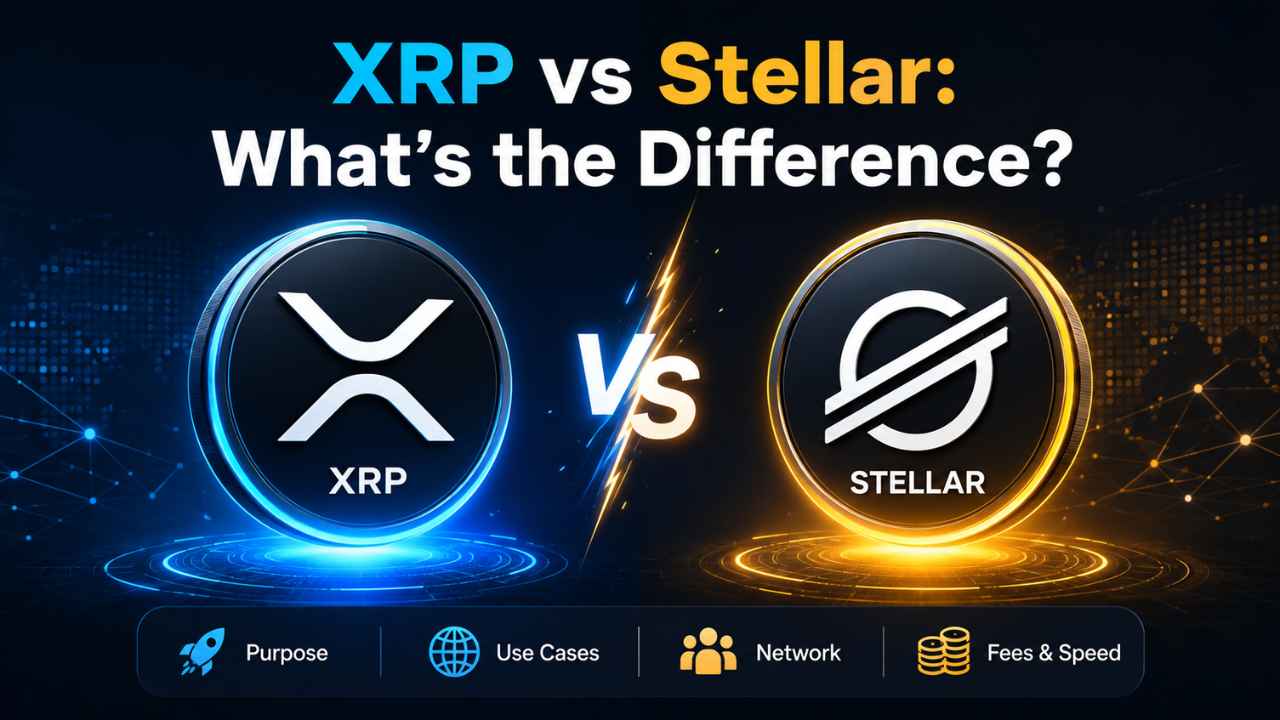
If you’ve typed “xrp vs stellar: what’s the difference” into Google today, you’re probably trying to decide where to put money, or you’re just trying to understand two coins that keep getting mentioned in the same breath. Either way, let’s get into it.
The Family Resemblance, And Where It Ends
Both networks exist to solve the same annoying problem. Sending money across borders through the traditional banking system is slow, expensive, and honestly kind of embarrassing in 2026. A wire from Mumbai to Manila can take days and eat a chunk of the value in fees along the way. XRP and Stellar were both built to settle that kind of transaction in a few seconds for a fraction of a cent.
Here’s where the resemblance stops though. Ripple, the company behind XRP, decided early on that its real customers would be banks, payment processors, and financial institutions. Big players, big volume, direct partnerships. Stellar took the opposite bet. Jed McCaleb wanted a network built for the unbanked, for remittance corridors, for regular people moving small amounts of money who don’t have a corporate relationship manager on speed dial.
That single decision, who the network is actually for, explains almost everything else about how these two coins have evolved.
How Each Network Actually Works
Both chains skip Bitcoin style mining entirely, which is one reason transactions confirm in seconds instead of minutes. But the way they reach agreement on what’s true is genuinely different under the hood.
XRP runs on the XRP Ledger, which uses something called the XRP Ledger Consensus Protocol. In practice, a set of trusted validator nodes known as the Unique Node List agree on transaction order roughly every three to five seconds. Ripple the company doesn’t control the network outright anymore, but it remains an influential validator and the loudest voice in the ecosystem, which critics have pointed to for years as a centralization concern.
Stellar uses the Stellar Consensus Protocol, built on an idea called Federated Byzantine Agreement. Instead of one master list of trusted nodes, anyone running a Stellar node picks their own set of validators they trust, and those overlapping circles of trust ripple outward (no pun intended) until the whole network agrees. It’s a more distributed approach on paper, and it lets Stellar settle transactions in about five seconds too, at a cost that’s often even lower than XRP’s.
Neither one needs the electricity bill of Bitcoin mining. Both were built for speed first.
The Numbers, As Of Late August 2026
Let’s talk price, because that’s usually the real reason someone lands on this article.
XRP has had a wild few weeks. It’s trading around $1.44 to $1.48, with a market cap sitting near $90 to $91 billion, which keeps it locked in at the number five spot by market cap among all cryptocurrencies. It came off a violent rally, gaining more than 50% in a matter of days on a mix of short liquidations and renewed ETF inflows, before cooling off with a sharp pullback in the days that followed. Circulating supply sits around 62.7 billion tokens out of a hard cap of 100 billion, and Ripple still releases a meaningful chunk from escrow every month.
Stellar’s XLM is trading in a much quieter range, somewhere between $0.17 and $0.19, giving it a market cap in the $6.5 billion to $9.5 billion range depending on the day you check. It doesn’t get the same headline volatility XRP does, but it’s been climbing too, up more than 20% over a recent seven day stretch on the back of quieter, less speculative news: real world asset tokenization volume on the network has been climbing steadily. Circulating supply is around 34.6 billion XLM against a hard capped max supply of 50 billion, and there’s no ongoing inflation. Back in 2019 the Stellar Development Foundation actually burned more than half the token supply in circulation at the time, over 55 billion XLM gone in one move, to simplify the token’s long term economics.
That’s a meaningful difference if you’re the type of investor who cares about dilution. XRP still has nearly 37 billion tokens waiting to enter circulation from Ripple’s escrow. XLM’s ceiling is fixed and has been for years.
Who’s Actually Using Each Network
This is where the two projects really diverge, and it’s the part that matters most if you’re trying to judge long term value instead of just chart patterns.
XRP’s use case has always centered on Ripple’s institutional relationships. Ripple’s On Demand Liquidity product uses XRP as a bridge currency so banks and payment companies don’t need to pre fund accounts in every currency they operate in. After Ripple’s multi year legal fight with the SEC finally wrapped up with a settlement in August 2025, institutional interest picked up noticeably, and a spot XRP ETF launched not long after, giving traditional investors an easier onramp without needing to touch a crypto exchange directly.
Stellar has quietly built something different: a growing footprint in tokenized real world assets. Firms like WisdomTree and Amundi have been issuing tokenized funds on Stellar, and MoneyGram runs live settlement rails on the network. Stablecoin transfer volume through Stellar hit a record $11.4 billion in the second quarter of 2026 alone. Tokenized asset value on the chain has crossed the $3 billion mark. None of that generates the kind of price fireworks XRP produces, but it’s steady, usage driven growth, and usage is ultimately what gives any crypto asset a reason to exist beyond speculation.
XRP vs Stellar: Comparison Table
| Feature | XRP (XRP Ledger) | Stellar (XLM) |
|---|---|---|
| Founded | 2012, by Ripple Labs | 2014, by Jed McCaleb and Joyce Kim |
| Consensus mechanism | XRP Ledger Consensus Protocol (UNL based) | Stellar Consensus Protocol (Federated Byzantine Agreement) |
| Transaction speed | 3 to 5 seconds | 5 seconds |
| Primary focus | Banks, payment processors, institutional settlement | Individuals, remittances, tokenized real world assets |
| Circulating supply | ~62.7 billion XRP | ~34.6 billion XLM |
| Max supply | 100 billion XRP | 50 billion XLM |
| Market cap (Aug 2026) | ~$90 to $91 billion | ~$6.5 to $9.5 billion |
| Market cap rank | #5 | Outside top 20 |
| Regulatory history | SEC lawsuit, settled August 2025 | No comparable litigation |
| ETF availability | Spot XRP ETF live | No spot XLM ETF as of Aug 2026 |
| Notable partners | Santander, SBI Holdings, various banks | MoneyGram, WisdomTree, Amundi |
Risks Worth Knowing About Before You Buy Either
Neither coin is a sure thing, and anyone telling you otherwise is selling something.
XRP’s biggest overhang is supply. Ripple still holds tens of billions of tokens in escrow, releasing roughly a billion a month back into circulation, which creates constant sell pressure that ETF and institutional demand has to absorb just to keep price flat. XRP is also more sentiment driven than Stellar, meaning it tends to move harder in both directions when broader crypto markets swing.
Stellar’s risk profile looks different. Its price has historically lagged its own fundamentals, sitting roughly 80% below its 2018 all time high even as real usage on the network has grown. Trading volume and liquidity are noticeably thinner than XRP’s, which means larger buy or sell orders can move the price more than you’d expect. And without a spot ETF yet, Stellar hasn’t caught the same wave of institutional capital that’s been flowing into XRP.
For Indian investors, both fall under the same tax treatment: a flat 30% tax on gains under Section 115BBH, plus 1% TDS on transactions under Section 194S. Buying either through an FIU registered exchange like CoinDCX or Mudrex keeps you compliant and avoids the reporting headaches that come with offshore platforms.
So Which One Should You Actually Care About
Honestly, it depends what you’re trying to do. If you want exposure to the institutional side of crypto, the banks, the ETFs, the settlement volume moving through Ripple’s corporate partnerships, XRP is the more established bet, even with the supply overhang hanging over it. If you’re more interested in the slow build, in real world asset tokenization and remittance infrastructure that’s quietly growing without much hype, Stellar is worth watching, even though its price hasn’t caught up to its fundamentals yet.
They started from the same place. They’re not the same coin anymore, and treating them as interchangeable is where a lot of beginner research goes wrong.
FAQ
Is XRP the same as Stellar? No. They share a common origin since Stellar’s founder previously cofounded Ripple, but they run on separate blockchains with different consensus mechanisms, different token supplies, and different target users.
Which is faster, XRP or Stellar? Both settle transactions in roughly 3 to 5 seconds, which is close enough that speed alone shouldn’t be your deciding factor.
Why is XRP worth so much more than XLM? Mostly institutional adoption, ETF availability, and Ripple’s direct banking partnerships, combined with XRP’s much larger circulating supply and market cap relative to Stellar.
Does Stellar have an ETF like XRP? Not as of August 2026. XRP has a live spot ETF, while Stellar does not yet have one approved.
Is Stellar a good long term investment compared to XRP? That depends on your goals. Stellar’s usage in real world asset tokenization has been growing steadily, but its price has historically lagged that growth. XRP carries more institutional momentum but also a larger token supply still entering circulation. Neither is financial advice, always do your own research.
Can I buy XRP and Stellar in India? Yes, through FIU-IND registered exchanges such as CoinDCX or Mudrex. Both are subject to the standard 30% flat crypto tax and 1% TDS under Indian tax law.