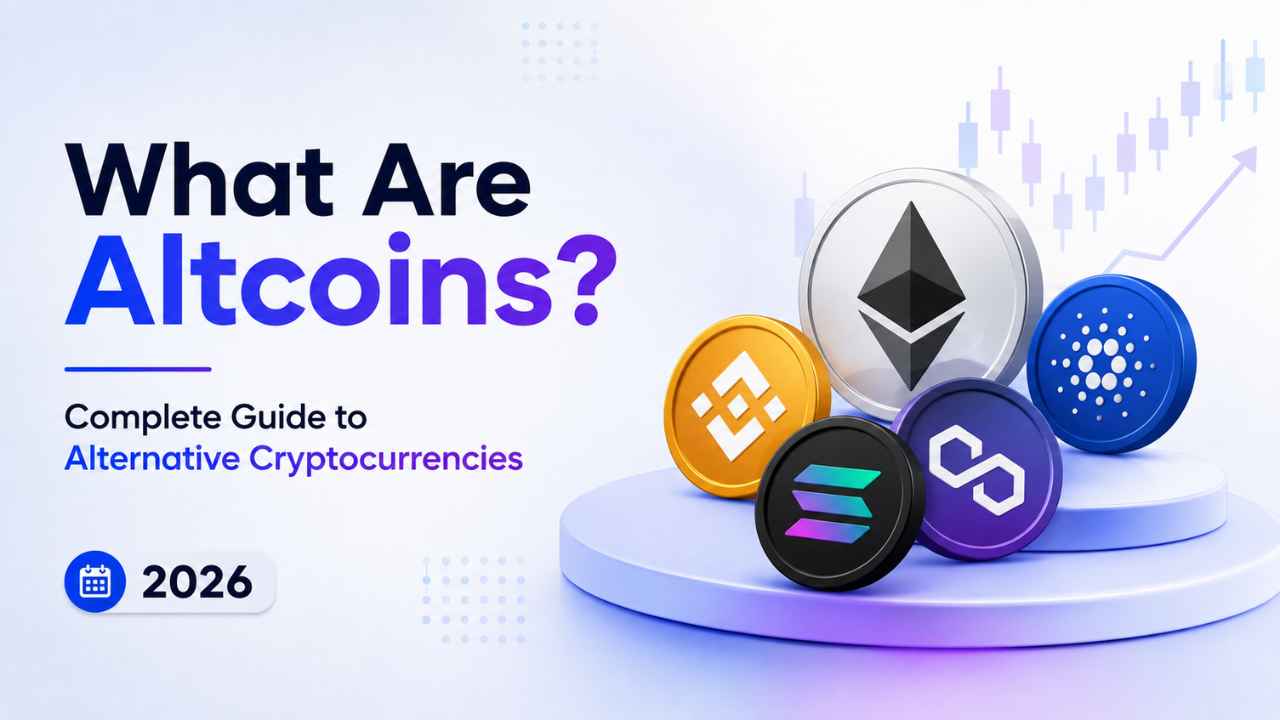
Altcoins are every cryptocurrency that is not Bitcoin, from Ethereum and Solana down to the smallest token launched on a blockchain last week. That is the one line answer. Everything else in crypto that trades on an exchange, gets staked, or shows up in a DeFi pool and is not BTC falls under this one umbrella term. There are tens of thousands of them now, ranging from genuinely useful infrastructure projects to tokens with no purpose beyond a meme and a Telegram group. Knowing the difference between the two is arguably the single most useful skill a crypto beginner can build in 2026.
Altcoins Explained in Plain English
Break the word down and it explains itself. Alt plus coin, an alternative to the original coin. Bitcoin launched in 2009 as the first successful cryptocurrency, and within a couple of years developers started forking its code or building entirely new blockchains to fix what they saw as Bitcoin’s limitations, slow transaction speeds, limited programmability, high energy use. Every one of those projects, no matter how different from each other they eventually became, still gets filed under the same altcoins label today. Ethereum is an altcoin. So is a stablecoin like USDT. So is a token that exists purely to fund a meme. The category is defined by what it is not, not by what it is.
Where Altcoins Came From
Litecoin usually gets credit as the first real altcoin, launching in 2011 as a faster, lighter version of Bitcoin’s core code. Namecoin followed the same year, trying to apply blockchain to domain name registration instead of payments. The real turning point came in 2015 with Ethereum, which introduced smart contracts and turned blockchain into a programmable platform rather than just a payment rail. That single innovation is why the altcoin market looks the way it does today, thousands of projects building lending platforms, exchanges, games, and identity systems on top of blockchains, instead of every altcoin simply trying to be a faster Bitcoin.
The Main Types of Altcoins in 2026
Lumping every non-Bitcoin token into one bucket stops being useful pretty fast, so it helps to know the rough categories. Smart contract platforms like Ethereum, Solana, and Avalanche host other applications on top of themselves. Stablecoins like USDT and USDC peg their value to a currency like the dollar to avoid crypto’s usual volatility. DeFi tokens power lending, trading, and yield platforms such as Uniswap and Aave. Utility tokens grant access to a specific service or network. Governance tokens let holders vote on a protocol’s future decisions. Meme coins trade almost entirely on community attention and social momentum rather than underlying utility, and remain the highest risk category by a wide margin.
Bitcoin Dominance and the Altcoin Season Index Right Now
This is where a lot of altcoin content gets vague, so here are the actual numbers as they stand in August 2026. Bitcoin dominance, the share of total crypto market value held by BTC alone, has sat in the 58 to 60 percent range for most of the year, and the Altcoin Season Index, which tracks whether altcoins are broadly outperforming Bitcoin, has been reading in the 30 to 35 zone. A confirmed altcoin season needs that index above 75, so by that measure 2026 has stayed a Bitcoin dominated market rather than a rotation into alts. Total altcoin market capitalization excluding Bitcoin has still held around 1.06 trillion dollars, which is worth noting since a large, liquid altcoin market can exist even without a confirmed altseason underway. Spot Bitcoin ETF inflows are a big part of why this cycle behaves differently from 2017 and 2021, with institutional capital landing directly in BTC rather than flowing through retail exchanges into smaller tokens the way it used to.
Real Examples Worth Knowing in 2026
Ethereum remains the reference point for the entire smart contract category, hosting the largest share of DeFi activity and NFT infrastructure despite years of newer competitors chasing its position. Solana has built a reputation around speed and low fees, becoming a hub for high frequency trading applications and meme coin launches alike. XRP continues pushing an institutional payments narrative, leaning into cross border settlement use cases. On the higher risk end, projects like Pepeto and other emerging meme and utility tokens illustrate how quickly narrative driven altcoins can move, for better and for worse, which is a theme covered in more depth in our dedicated altcoin analysis piece on Hyperliquid, Uniswap, Worldcoin, and Pepeto.
The Risks Nobody Should Skip
Altcoins carry meaningfully more risk than Bitcoin, and pretending otherwise does readers no favors. Liquidity is the first issue, since many smaller altcoins can be difficult to sell in size without moving the price significantly against you. Smart contract risk is real too, a single bug or exploit in a DeFi protocol’s code has wiped out user funds before and will again. Regulatory uncertainty adds another layer, since how a given token gets classified and taxed can shift as frameworks like MiCA in the EU and evolving US rules continue to develop. And plain volatility remains the most obvious risk of all, smaller market caps mean smaller amounts of buying or selling pressure can swing prices dramatically in either direction within hours.
How to Research an Altcoin Before Buying, Practical Steps
A little discipline goes a long way in a market this noisy. Start by reading the project’s own whitepaper or documentation rather than relying purely on social media summaries. Check whether the code is open source and, ideally, whether it has been through an independent security audit. Look at actual on chain activity, transaction volume, active wallet counts, total value locked, rather than trusting price charts alone. Understand the tokenomics, how many tokens exist, how many are still locked up for the team, and when those unlock. Finally, size any altcoin position deliberately, treating it as higher risk capital than a Bitcoin or Ethereum allocation, and never invest more than you are prepared to lose entirely.
Altcoins vs Bitcoin, Quick Comparison
| Factor | Bitcoin | Altcoins |
|---|---|---|
| Primary purpose | Store of value, digital gold narrative | Varies widely: smart contracts, DeFi, payments, utility |
| Market dominance (Aug 2026) | Roughly 58 to 60 percent | Remaining 40 to 42 percent combined |
| Liquidity | Highest in crypto | Ranges from very high (ETH, SOL) to very thin |
| Volatility | High relative to traditional assets | Typically higher than Bitcoin, especially small caps |
| Programmability | Limited by design | Many support smart contracts and dApps |
Frequently Asked Questions
What are altcoins in simple terms? Altcoins are any cryptocurrency other than Bitcoin, ranging from major platforms like Ethereum and Solana to small, speculative tokens.
Are altcoins riskier than Bitcoin? Generally yes, most altcoins carry higher volatility, thinner liquidity, and additional smart contract or regulatory risk compared to Bitcoin.
What is the Altcoin Season Index? It is a metric tracking whether the majority of large altcoins are outperforming Bitcoin over a 90 day period, with a reading above 75 signaling a confirmed altcoin season.
How many altcoins exist in 2026? Tens of thousands of altcoins exist across various blockchains, though only a small fraction maintain meaningful liquidity or active development.
Is it a good time to buy altcoins in 2026? This guide does not offer investment advice or price predictions. Bitcoin dominance and the Altcoin Season Index are useful context, but any decision should follow your own research and risk tolerance.
Sources and Related Reading
Data referenced in this guide draws on Blockchain Center’s Altcoin Season Index, CoinMarketCap and CoinGecko market capitalization figures, and reporting from BeInCrypto and Bitget on 2026 Bitcoin dominance trends. For deeper reading on related CryptoTechFeed guides, see our Altcoins hub, our altcoin analysis of Hyperliquid, Uniswap, Worldcoin, and Pepeto, our Bitcoin fundamentals guide, our Ethereum fundamentals guide, our explainer on what a Layer 1 blockchain is, and our guide to crypto regulation covering MiCA, the GENIUS Act, and the CLARITY Act.