Last Friday, XRP was sitting near its August high, up something like 31% for the month. Then Fed Chair Kevin Warsh said a few hawkish words at Jackson Hole. Within hours, XRP dropped to $1.36 and about $488 million in leveraged crypto positions got wiped out, more than $360 million of that in XRP alone. Nobody changed anything about XRP’s technology that day. No hack, no exploit, no bad news about the project itself. A central banker talked about interest rates, and a token most people had never even considered rate sensitive fell off a cliff.
Here’s the thing that makes this worth understanding. That same week, XRP was also staring down a Senate vote tied to crypto market structure legislation. So you had two forces landing on the price almost simultaneously: a macro rate signal and a regulatory calendar date. And honestly, most retail traders couldn’t tell you which one did more damage, because by the time the candle prints, it’s already baked into one number.
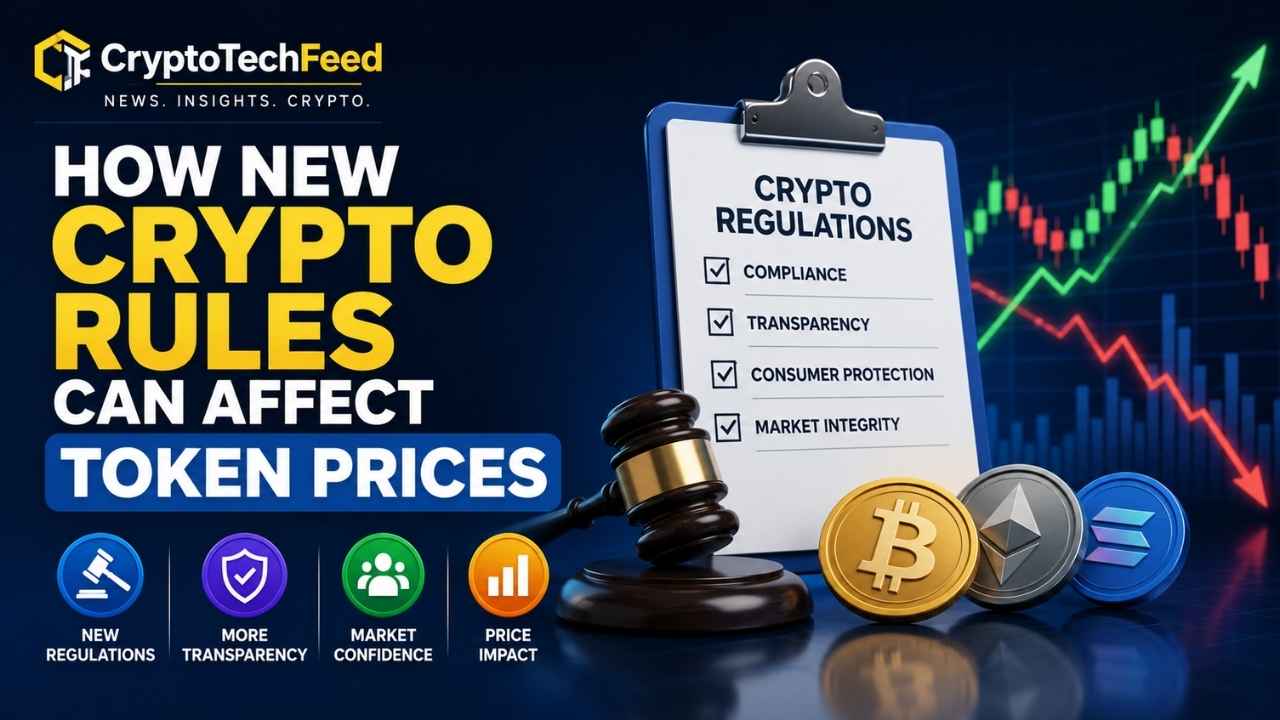
That’s what this guide is really about. Not just listing the rules (though we’ll get into the actual ones moving markets in 2026), but showing you the mechanism. Why does a proposed regulation, sometimes one that isn’t even law yet, move a token’s price today? Once you get that, reading the next regulatory headline becomes a lot less scary and a lot more useful.
Why Regulation Moves Price Before It’s Even Law
This trips people up constantly. A bill gets introduced, or an agency floats a proposal, and the token jumps or drops immediately. But the rule hasn’t passed. Nothing is enforceable yet. So why does the price move at all?
Markets price probability, not certainty. Think about it this way. If there’s a 40% chance a token gets treated as a security next year, traders don’t wait around for that outcome. They apply a discount right now, today, based on that 40% chance. As the odds shift (a favorable committee vote, a delay, a leaked draft), the discount shifts with it. This is exactly what’s happening with the CLARITY Act in the US right now. It hasn’t passed Congress. But traders, exchanges, and stablecoin issuers are already adjusting positions based on how likely they think passage is this year versus next.
There’s also a simpler channel: access. Regulation decides who’s allowed to hold, trade, or list a token. An exchange operating under MiCA in the EU has to justify why a token stays listed. A US brokerage deciding whether to offer a coin to retail clients cares a lot about its legal classification. When rules tighten access, demand shrinks even if nothing about the underlying project changed. When rules widen access (say, a clearer path for ETFs or institutional custody), demand can expand fast.
And then there’s the liquidity angle, which gets ignored constantly. Big market makers and institutional desks size their positions partly around legal risk. If regulatory uncertainty is high, they trade smaller and pull back faster on bad news, which makes price swings sharper in both directions. Clarity, even boring clarity, tends to calm that down.
The SEC’s New Playbook: Regulation Crypto Assets
Let’s get concrete, because 2026 has actually delivered a real rule change, not just talk.
On August 18, 2026, the SEC formally proposed something called Regulation Crypto Assets, its first purpose built offering framework for crypto in the agency’s history. It was printed in the Federal Register on August 21, and the public comment window runs until October 20, 2026. So to be clear: this is a proposal, not a final rule. Nothing changes for holders today. But the market has already started pricing in what happens if it passes roughly as written, and that’s the point of this whole guide.
The proposal has three moving parts, and each one has a different effect on token economics.
The startup exemption lets a project raise up to $5 million over a rolling four year period with light disclosure requirements. No financial statements needed. General solicitation is allowed, meaning projects can openly market the raise instead of hiding behind private placement rules. There’s no cap on selling to non accredited investors either. This is aimed squarely at small, early stage projects that used to either skip the US market entirely or operate in a legal gray zone.
The fundraising exemption goes bigger: up to $75 million per rolling 12 month period, but in exchange for real transparency, audited financials and periodic reporting. This one mirrors the existing Reg A+ framework used in traditional securities markets, which tells you the SEC is trying to fit crypto into a familiar box rather than invent something totally new.
The safe harbor is the part actually worth watching closest. It offers what the industry has wanted for years: a legal exit ramp. A token that was sold as part of an investment contract (meaning buyers were essentially funding a team and betting on the network growing) can eventually shed that security label once the team has permanently finished or stopped its promised managerial work. Issuers file a Form TR to claim it. Once granted, the token is no longer subject to securities law transfer restrictions, secondary market licensing rules, or exchange registration requirements.
Why does any of this move prices? Because right now, dozens of tokens trade at what analysts have started calling a legal risk discount. A project can have strong users, real developer activity, and healthy liquidity, and still trade cheaper than it should because nobody’s sure if the SEC will eventually challenge its status. A working safe harbor removes that discount for tokens that qualify. That’s not speculation, that’s a structural repricing waiting to happen if and when this becomes final law, which realistically isn’t expected before early 2027.
The CLARITY Act: The Bill Everyone’s Actually Watching
If Regulation Crypto Assets handles how tokens get issued, the CLARITY Act handles something arguably bigger: who regulates crypto trading day to day, the SEC or the CFTC. This market structure bill has been the single largest catalyst on the 2026 calendar, according to multiple market outlooks published this year.
Here’s why it matters so much for price. Under the current patchwork, a project can have strong fundamentals and still trade at a discount purely because nobody knows which regulator has jurisdiction over its trading venue. The CLARITY Act would draw that line clearly. Tokens more clearly falling under CFTC oversight (treated more like commodities) could see what analysts call a regulatory premium, essentially the opposite of the discount we just talked about.
The White House has publicly pushed for the bill’s passage, and there was a meeting between the President, crypto executives, and regulators specifically about moving it forward. But Congress has stalled on it more than once already in 2026. Every delay is itself a price signal. Traders watch committee votes and floor schedule dates the same way they’d watch an earnings date for a stock.
It’s Not Just the US: MiCA, the UK, and Why Geography Matters
Regulation doesn’t happen in one country and stay there. The EU’s MiCA framework has already reshaped which stablecoins EU based exchanges can list, and that ripple affects global liquidity for those tokens even for traders who’ve never set foot in Europe. The UK has taken a different route, building its own FCA authorization regime on a separate timeline running through 2027, explicitly positioning itself as more flexible than the EU to attract fintech firms (we’ve covered the full UK timeline in a separate guide, linked below).
The pattern worth remembering: when a major jurisdiction tightens rules, capital and trading volume often just relocate rather than disappear. When Hong Kong, Singapore, or Dubai loosen licensing requirements, they can pull volume away from stricter markets. This is part of why a token’s price can react to regulatory news in a country where most of its holders don’t even live. The trading venue matters more than the holder’s passport.
Case Study: Watching It Happen in Real Time
Let’s go back to XRP for a second, because it’s such a clean example of layered regulatory pricing. In the same week, you had a Senate vote tied to crypto market structure sitting on the calendar, hawkish Fed commentary raising rate hike odds, and roughly $2.75 billion in short liquidations hitting the broader market from a completely separate stack of catalysts (Treasury buyback news, the SEC’s new framework, CLARITY Act pressure). Bitcoin actually rose nearly 8% that same period, briefly touching the high $69,000s territory during a different stretch, showing that regulatory clarity and macro fear can pull the market in opposite directions within the same news cycle.
The lesson isn’t “regulation always crashes prices” or “regulation always pumps prices.” It’s that regulatory catalysts stack with macro catalysts, and untangling which one moved a specific candle takes actual homework, not vibes.
How Listing and Delisting Decisions Ripple From New Rules
One channel that doesn’t get talked about enough: exchanges themselves respond to regulatory pressure by changing what they list. When rules around a token’s legal classification tighten, exchanges in stricter jurisdictions sometimes quietly delist or restrict it rather than risk enforcement action. That single decision can crush liquidity for a token overnight, even if the underlying regulation never directly targeted that specific project.
The flip side matters too. When a framework like Regulation Crypto Assets creates a clear path for a token to shed its security status, exchanges that previously avoided it for compliance reasons may add it back. New listings bring new demand, new market makers, and often a genuine price bump purely from improved access, separate from anything about the project’s fundamentals changing.
How to Research a Newly Listed Cryptocurrency in This Climate
This is where the regulatory backdrop actually becomes a practical research tool, not just background noise. If you’re looking at a coin that just hit an exchange, here’s what actually matters now.
Start with the issuance path. Did this token launch under something like the SEC’s proposed startup or fundraising exemption, assuming it applies once the rule is final? Projects raising under lighter disclosure requirements (the $5 million startup path) carry less transparency than ones raising under the $75 million tier, which requires audited financials. That’s a real signal about how much information you’ll actually get as an investor.
Check liquidity depth honestly, not just the headline volume number. A lot of newly launched tokens show impressive daily volume that’s mostly wash trading or thin order books that move 20% on a $10,000 trade. Look at how much you’d actually move the price with a modest buy.
Look at holder concentration. If a handful of wallets control most of the supply, regulatory news (good or bad) can trigger outsized moves because those big holders react first and drag the price with them.
Check contract permissions if it’s a token built on a smart contract platform. Can the team mint more supply at will? Pause trading? Blacklist wallets? These aren’t regulatory questions exactly, but they intersect directly with how a project would even qualify for something like the SEC’s safe harbor, since that requires the team to have genuinely stepped back from managerial control.
Vet the team. Real names, real track record, or anonymous with a flashy website? Anonymous teams face a much harder path to any kind of regulatory legitimacy, which matters more now that legitimacy has an actual legal ramp attached to it.
Finally, watch the first few days of price action against volume. A token that pumps hard on launch day with thin volume and then bleeds out for two weeks straight is a very different setup than one holding a range with genuine two way trading.
If you’re trading from India, remember your tax exposure doesn’t care about any of this US or EU rulemaking. Every trade, gain or loss, still falls under India’s 30% flat crypto tax plus 1% TDS regardless of what regulatory tier a token launched under abroad.
A Simple Framework for Tracking Regulatory Risk Going Forward
You don’t need to read 400 page SEC filings to stay ahead of this. Track three things consistently. First, the calendar: comment deadlines, committee votes, and scheduled agency meetings move markets more predictably than surprise news, because traders position ahead of known dates. Second, jurisdiction exposure: know where your exchange operates and which regulatory regime actually governs your trade. Third, the classification question for each token you hold: is it more likely treated as a security, a commodity, or something in between under current proposals? That single question explains a huge share of the price discounts and premiums floating around the market right now.
FAQ: New Crypto Rules and Token Prices
Does a proposed rule affect token prices before it becomes law? Yes. Markets price probability continuously, so traders adjust positions based on how likely a proposal is to pass and in what form, well before any final vote.
What is the SEC’s Regulation Crypto Assets safe harbor? It’s a proposed conditional exit from securities classification for tokens whose issuers have permanently stopped the managerial efforts they originally promised, filed through a Form TR. It was proposed on August 18, 2026 and remains in the public comment period.
Why did XRP crash on Fed comments instead of crypto news? Because macro rate expectations and crypto specific regulatory catalysts, like a pending Senate vote, can land in the same window and compound each other. Both affect risk appetite and leveraged positioning simultaneously.
How does MiCA in the EU affect tokens traded outside Europe? When a major exchange region tightens listing standards, global liquidity for affected tokens can shrink even for traders elsewhere, since trading volume tends to concentrate on fewer venues.
Is the CLARITY Act already law? No, it has not passed Congress as of this writing and has stalled multiple times in 2026 despite White House pressure to move it forward.
Does new regulation matter for coins I already hold in India? Your Indian tax obligations, the 30% flat tax and 1% TDS, stay the same regardless of any US or EU regulatory changes affecting the token itself.