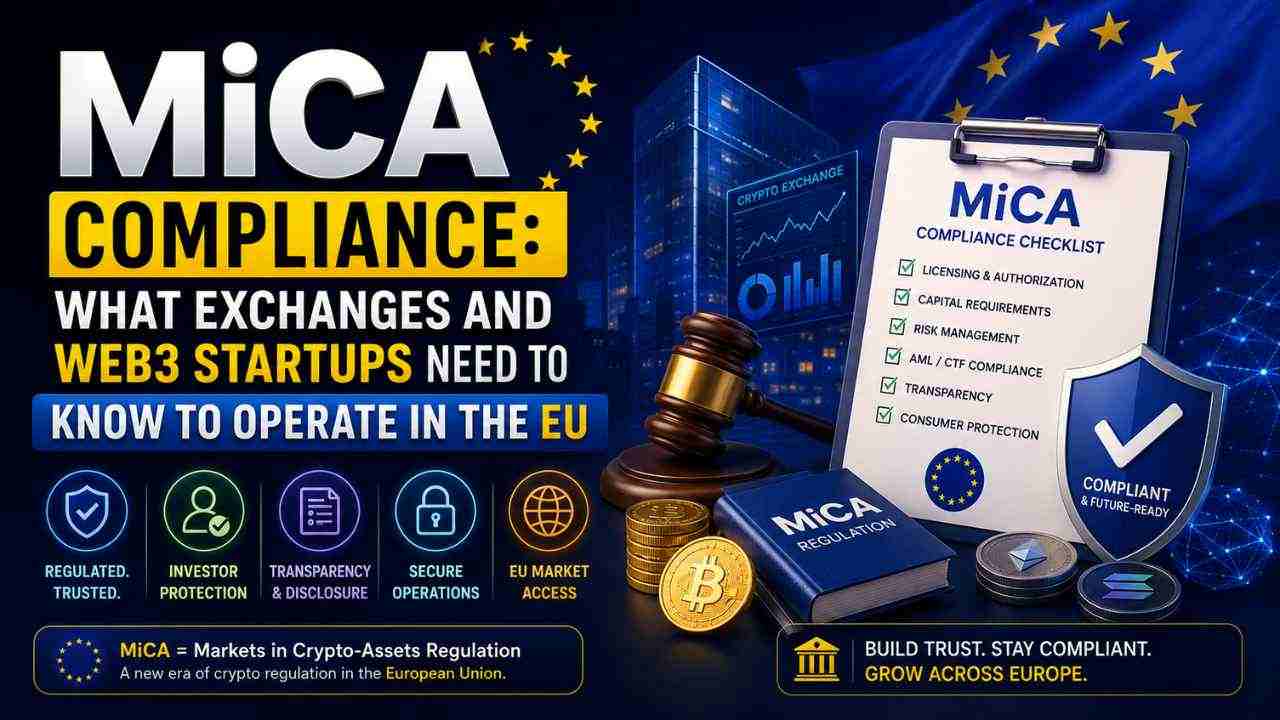
Every crypto founder has heard the acronym by now, but plenty still treat MiCA as a European problem for European companies. That assumption is about to get expensive. The Markets in Crypto Assets Regulation is the world’s first comprehensive, EU wide framework for crypto assets, replacing 27 different national regimes with a single rulebook. The transitional grace period that let existing platforms keep operating without full authorization ends on July 1, 2026, a hard deadline with no further extensions signaled by regulators. After that date, any crypto asset service provider serving EU customers without a CASP license faces enforcement action, regardless of where the company is actually headquartered.
Also Read: Hot Wallet vs Cold Wallet: Which Crypto Storage Actually Keeps You Safe in 2026
Who Falls Under MiCA’s Scope
MiCA casts a wide net, and the definition of a crypto asset service provider, or CASP, covers far more than the obvious names. Exchanges and trading platforms are the clearest case, but the regulation also captures custodial wallet providers, crypto lending platforms, portfolio management services, and any entity that executes orders on behalf of clients. The deciding factor is not where a company is registered, it is whether EU residents can access its services. A Bangalore based exchange with no European office but a sizeable base of German or French users still falls squarely inside MiCA’s reach, which is exactly the trap catching startups that assumed geography alone would protect them.
The Core CASP Obligations Every Exchange Must Meet
Getting licensed is only the entry fee. MiCA layers on operational demands that touch nearly every department inside a crypto business. Authorized CASPs must hold minimum capital reserves, maintain governance structures with fit and proper management, and keep client funds strictly segregated from company assets, a rule born directly out of exchange collapses that wiped out user deposits in earlier cycles. On top of that sits detailed transaction record keeping in standardized formats, transparent fee disclosure, conflict of interest policies, and mandatory incident reporting whenever something breaks. For a lean Web3 startup used to moving fast, this is the point where legal and compliance stop being a line item and start being a full department.
Stablecoins Under MiCA: ARTs and EMTs Explained
If your project touches stablecoins, MiCA gets noticeably stricter, and the regulation splits them into two categories worth knowing by name. Asset Referenced Tokens, or ARTs, are pegged to a basket of assets, currencies, or commodities rather than a single currency. Electronic Money Tokens, or EMTs, are pegged one to one to a single fiat currency, the category a euro backed stablecoin like Circle’s EURC falls into. Issuers of both must be authorized credit or electronic money institutions, hold sufficient reserves, and in some cases now navigate an overlapping requirement with the Payment Services Directive that can effectively double the compliance burden for custody and transfer services.
The Travel Rule, the Compliance Headache Nobody Saw Coming
Ask any compliance officer working through MiCA right now which requirement is causing the most sleepless nights, and the answer usually comes back the same. The MiCA Travel Rule, implemented alongside Regulation 2023/1113, requires CASPs to collect and transmit verified sender and recipient information alongside every crypto transfer, mirroring the rules banks have followed for wire transfers for decades. The technical challenge is real. Crypto transfers were never designed to carry identity metadata the way SWIFT payments were, which means exchanges are now retrofitting infrastructure that was built for pseudonymity to instead satisfy full transparency, often under a deadline that arrived faster than their engineering roadmaps could absorb.
What MiCA Leaves Out: DeFi and NFTs
Here is where founders building outside centralized exchanges catch a temporary break, though calling it a loophole would be premature. MiCA deliberately does not bring full regulatory clarity to decentralized finance protocols or non fungible tokens, leaving both in a gray zone the regulation was not built to address. That gap will not last forever. EU regulators have already signaled that a genuinely decentralized DeFi protocol with no identifiable controlling entity sits outside MiCA’s current scope, but the moment a DeFi front end, governance structure, or fee mechanism looks centralized enough to control, that protection tends to evaporate fast. Web3 startups building in this space should treat the current gray zone as a runway, not a permanent exemption.
Fragmentation Across Member States, the Irony Inside the Harmonization
MiCA was sold as the end of regulatory fragmentation across Europe, and on paper it is. In practice, the rollout has been anything but uniform. The Netherlands pushed local compliance as early as July 2025, Italy followed by December 2025, and several other member states stretched their transitional windows all the way to the July 2026 outer limit. Each national competent authority also interprets requirements slightly differently and processes license applications at its own pace, which means two identical companies applying in two different countries can face meaningfully different timelines and scrutiny. Choosing where to seek initial authorization has quietly become its own strategic decision for startups planning EU market entry.
A Practical Compliance Roadmap for Web3 Startups
Startups short on legal budget still have a workable path forward if they move early rather than reactively. Start by mapping exactly which MiCA category your token or service falls into, since ARTs, EMTs, and utility tokens all carry different obligations. Build AML and Travel Rule infrastructure before it becomes a launch blocker, not after regulators come asking. Choose a member state for initial CASP authorization based on processing speed and regulatory clarity rather than convenience alone. Budget for capital reserve requirements early in fundraising conversations, since retrofitting a balance sheet after a term sheet is signed is far harder than planning for it upfront. Roughly 40 CASP licenses had been issued by late 2025, which shows the process works, but also that the window for an unhurried application is closing.
Why This Matters Even Outside the EU
Founders operating primarily out of India, Southeast Asia, or the US sometimes assume MiCA is someone else’s regulatory headache. That assumption rarely survives contact with an actual growth strategy. The moment a startup wants European users, European liquidity, or a European exchange listing, MiCA authorization becomes the price of entry rather than an optional upgrade. There is also a quieter effect worth watching. MiCA is increasingly becoming the template regulators in other regions study when drafting their own crypto frameworks, which means understanding it now offers a preview of where global crypto compliance is likely headed over the next few years, MiCA compliant today often means less rework tomorrow.
Frequently Asked Questions
What is the MiCA compliance deadline? The final EU wide deadline is July 1, 2026, after which any crypto asset service provider without CASP authorization must stop serving EU customers entirely.
Does MiCA apply to companies outside the EU? Yes, MiCA applies based on whether a company serves EU residents, not where the company is headquartered, so non EU exchanges with European users are still in scope.
What is a CASP license under MiCA? A Crypto Asset Service Provider license is the core authorization required to legally operate exchanges, custodial wallets, lending platforms, and similar crypto services within the EU.
Are DeFi platforms regulated under MiCA? Genuinely decentralized protocols with no controlling entity currently sit outside MiCA’s scope, though platforms with centralized governance or fee control can fall back under it.
What is the MiCA Travel Rule? It requires crypto firms to collect and transmit verified sender and recipient information with every transfer, similar to identity rules banks already follow for wire payments.