
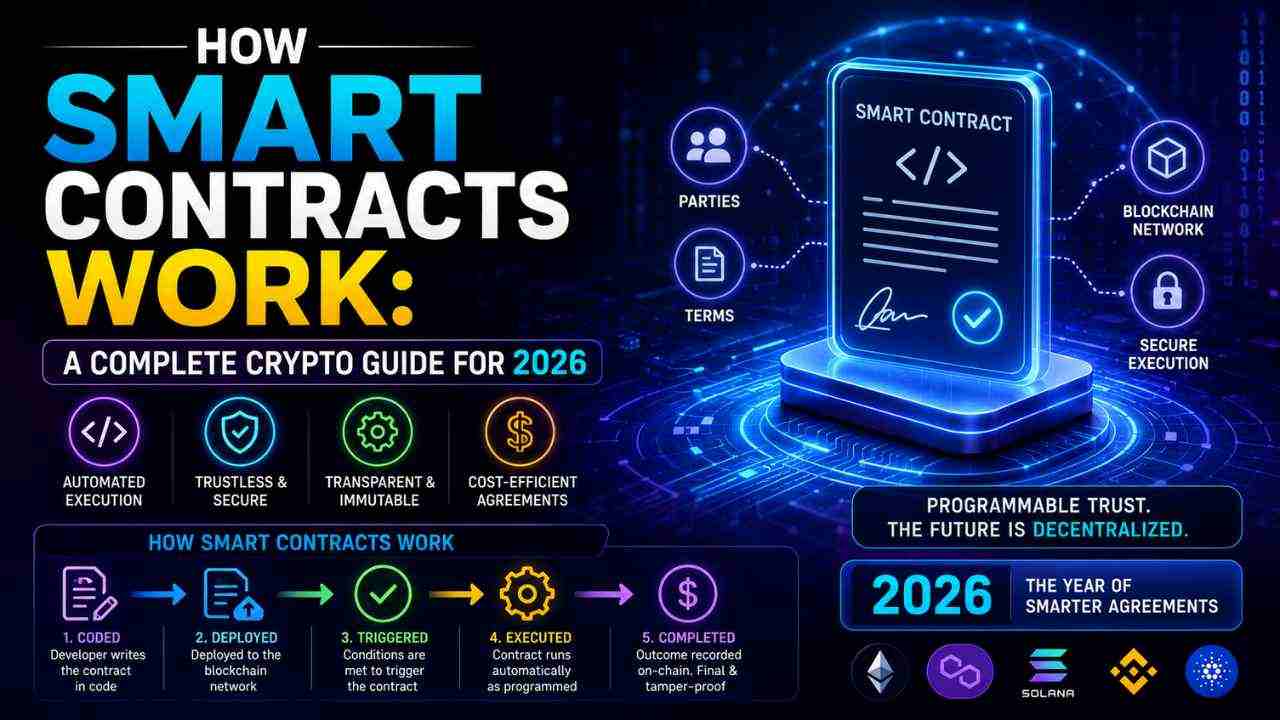
In 1994, long before Bitcoin existed, a computer scientist named Nick Szabo described a vending machine as the simplest smart contract ever built. Insert the right coins, and the machine hands over a snack automatically, no cashier, no negotiation, no possibility of the machine changing its mind halfway through. That same logic, insert the right input and receive the guaranteed output, now runs the backbone of decentralized finance, moving billions of dollars a day without a single human approving each transaction. Ethereum alone has over 50 million contract accounts live on its mainnet as of early 2026, and nearly everything interesting happening in crypto right now traces back to code like this quietly executing itself.
What Is a Smart Contract, in Plain Language
A smart contract is a self executing program stored permanently on a blockchain that runs automatically once its predefined conditions are met. Nobody needs to trust the other party, and nobody needs a lawyer to enforce the deal, because the code itself is the enforcement. Once deployed, that code lives at a fixed address on the network, visible to anyone, unchangeable by everyone, including the person who wrote it. That permanence is the entire point. A smart contract cannot quietly change the rules halfway through a transaction the way a person or a company sometimes can, which is exactly why so much of DeFi is built on top of them instead of traditional intermediaries.
How Smart Contracts Actually Work, Step by Step
Behind that simple idea sits a fairly precise four stage process. First, a developer writes the contract in a language like Solidity, which then gets compiled into bytecode, the low level instructions the network can actually run. Second, that bytecode is deployed to the blockchain through a creation transaction, permanently assigning it a unique address. Third, when a user calls the contract, their transaction gets broadcast to the network and picked up by validators, who queue it into a block. Fourth, every full node independently executes that bytecode, reads the contract’s existing state, applies the logic, and either commits the new state or rolls everything back if the call fails partway through.
Gas Fees Explained: Why Every Action Costs Money
Nothing on a blockchain runs for free, and smart contracts are no exception. Every operation a contract performs, from a basic transfer to a complex swap, consumes a unit called gas, which measures the raw computational effort involved. A simple ETH transfer between two wallets costs a flat 21,000 gas, while deploying a brand new contract adds a further 32,000 gas on top before any of its actual logic even runs. This system exists for a very deliberate reason, since smart contracts are technically capable of running forever, and charging for computation is what stops the network from being spammed into a standstill by a single infinite loop. Developers who write leaner code genuinely pay less, which is why gas optimization has become its own specialized skill inside Solidity development.
Real Smart Contract Examples Running Today
Abstract explanations only go so far, so it helps to look at what is actually running right now. USDC’s minting contract on Ethereum checks whether an incoming call comes from Circle’s verified minter address, and if it does, increases the recipient’s balance automatically, all recorded permanently onchain with no manual approval step. Uniswap’s swap contracts calculate exchange rates and execute trades the instant two parties’ conditions match, without either side ever needing to know or trust the other. Lending protocols like Aave use smart contracts to hold collateral and automatically liquidate a position the moment it crosses a risk threshold, faster and more consistently than any human desk ever could. These are not experimental use cases anymore, they are the plumbing underneath a genuinely enormous share of onchain financial activity in 2026.
Smart Contract Security Risks and Audits
Immutability cuts both ways. A smart contract that cannot be altered also cannot be quietly patched if a mistake makes it into the code, and that gap has cost the industry real money. Security researchers tracked 44 separate smart contract incidents in the first quarter of 2026 alone, totaling roughly 482 million dollars in losses, a reminder that this remains one of the highest stakes areas of software development anywhere. Reentrancy attacks, where a malicious contract calls back into a vulnerable function before its state finishes updating, remain one of the most common exploit patterns years after they were first identified. This is exactly why serious projects pay for independent audits before launch, and why users researching a new protocol should treat an unaudited contract holding significant funds as a real, not theoretical, risk. Our crypto security guide covers how to evaluate a protocol’s risk profile before committing funds.
Smart Contracts vs Traditional Legal Contracts
A traditional contract relies on courts, lawyers, and eventually enforcement if one side does not hold up their end. A smart contract removes that entire chain of dependency by making the agreement self enforcing, the outcome happens automatically the instant conditions are satisfied, with no waiting period and no room for one party to simply refuse. That said, smart contracts are not a universal replacement. They excel at clear, objective conditions, payment on delivery confirmation, collateral liquidation at a set price, but struggle with anything requiring human judgment or subjective interpretation, which is exactly the kind of dispute traditional legal systems were built to handle in the first place.
Why Smart Contracts Matter for the Next Phase of Crypto
Every major theme shaping crypto in 2026, tokenized real world assets, automated DeFi lending, decentralized identity, runs through smart contracts at some level. As more institutions move real value onto public blockchains, the reliability of this underlying code only becomes more important, not less. Understanding how smart contracts work is no longer just a developer’s concern, it is quickly becoming baseline literacy for anyone investing meaningfully in Ethereum or the broader DeFi ecosystem, the same way understanding how a bank actually processes a wire transfer would matter to anyone moving serious money through one.
Frequently Asked Questions
What is a smart contract in simple terms? A smart contract is a self executing program on a blockchain that automatically carries out an agreement once its predefined conditions are met, without needing a middleman.
How do smart contracts make money or charge fees? Users pay gas fees to compensate the network for the computing power needed to execute the contract’s code, not the contract creator directly.
Are smart contracts safe to use? They can be very safe when properly audited, but unaudited or poorly written contracts have caused hundreds of millions of dollars in losses, so checking for a reputable audit matters.
What programming language are smart contracts written in? Most Ethereum smart contracts are written in Solidity, though Vyper is also used, and both compile down to bytecode the network can execute.
Can a smart contract be changed after deployment? Generally no, once deployed a smart contract’s code is permanent and unchangeable, which is why thorough testing and auditing before launch is critical.