
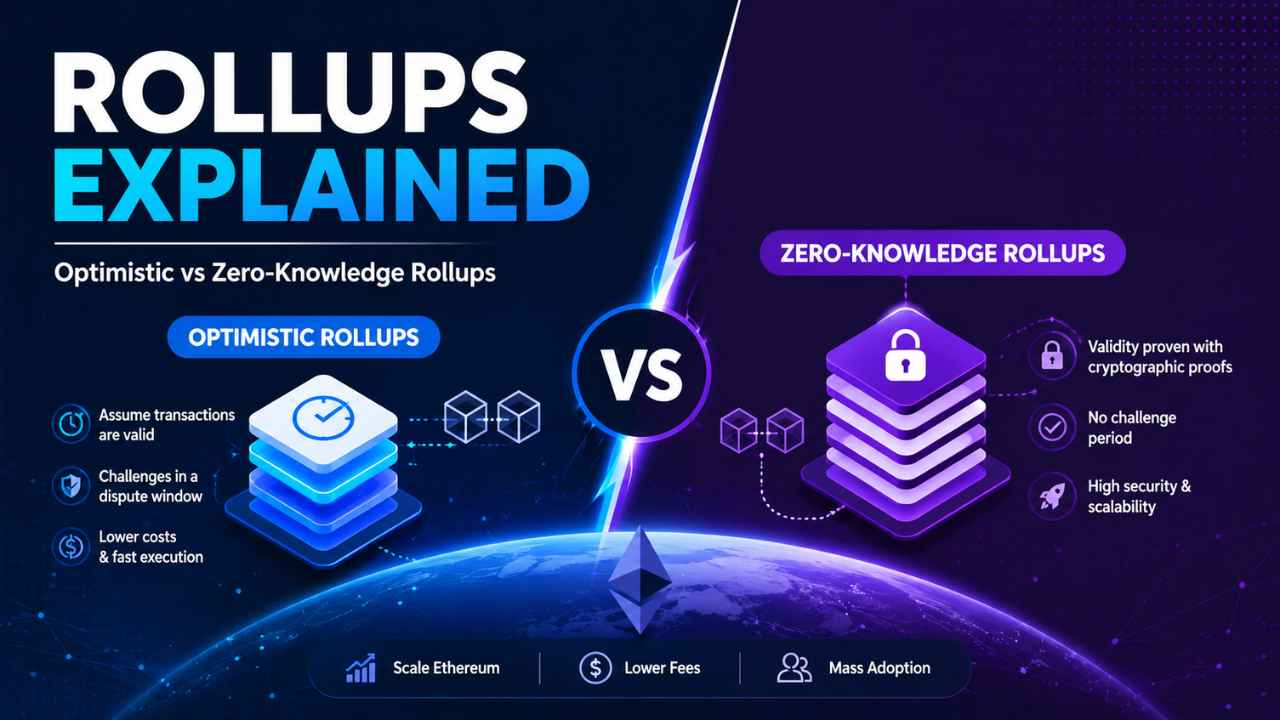
A rollup is a Layer 2 network that executes transactions away from Ethereum’s main chain, then posts a compressed summary of that activity back to Ethereum for security. Optimistic rollups assume every transaction is valid and only check the math if someone challenges it within a set window, usually seven days. Zero-knowledge rollups prove every batch is valid upfront using cryptographic math, so Ethereum can confirm it in seconds instead of waiting on a challenge period. That single difference, assume first versus prove first, is the entire debate this guide unpacks, and it shapes everything from withdrawal speed to which DeFi protocols feel comfortable deploying where.
What Is a Rollup, in Plain English
Ethereum on its own can only process so many transactions per second before fees spike, which is exactly what happened during past bull runs. A rollup solves this by moving the heavy lifting, the actual execution of swaps, trades, and transfers, onto a separate, faster chain. That chain still leans on Ethereum for the two things that matter most, data availability and final security, by posting compressed transaction data back to mainnet. Think of Ethereum as the courtroom of record and the rollup as a busy office handling thousands of cases a day, only occasionally sending the paperwork back to court for the record to stay airtight.
How Optimistic Rollups Work
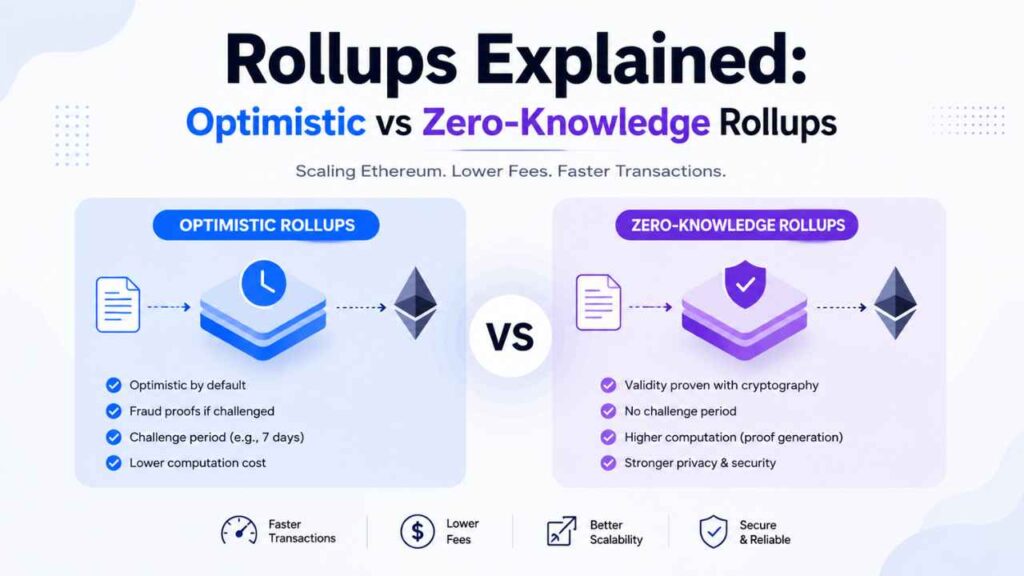
Optimistic rollups, the family that includes Arbitrum, Base, and OP Mainnet, operate on a simple assumption: transactions are innocent until proven guilty. A sequencer processes and batches transactions, posts the compressed data to Ethereum, and the network moves on without waiting for proof. Anyone watching the chain then has a challenge window, typically around seven days, to submit a fraud proof if something looks wrong. If nobody challenges it, the batch finalizes as valid. This is why withdrawing funds from an optimistic rollup back to Ethereum mainnet directly can take up to a week, a friction point most users route around using third party liquidity bridges instead.
How Zero-Knowledge Rollups Work
Zero-knowledge rollups, led by networks like zkSync, Starknet, Linea, and Scroll, take the opposite approach. Instead of assuming validity and waiting to be challenged, they generate a cryptographic validity proof, either a zk-SNARK or zk-STARK, for every batch before it ever reaches Ethereum. Mainnet then verifies that proof directly, a process that takes seconds rather than days. Once the proof lands and is confirmed, withdrawals can finalize in under an hour. The tradeoff historically has been engineering complexity and achieving full EVM equivalence, though that gap has been closing fast through 2026 as proving hardware and recursive proof systems mature.
Optimistic vs ZK Rollups: 2026 Comparison Table
| Factor | Optimistic Rollups | Zero-Knowledge Rollups |
|---|---|---|
| Examples in 2026 | Arbitrum One, Base, OP Mainnet | zkSync Era, Starknet, Linea, Scroll |
| Validity check | Fraud proof, only if challenged | Validity proof, checked every batch |
| Withdrawal time to L1 | Up to 7 days (or instant via bridges) | Under an hour once proof posts |
| EVM compatibility | Very high, mature Solidity support | Improving fast, historically the weaker side |
| Approximate L2 TVL share | Roughly 80 percent of total L2 TVL | Smaller but growing, institutional focus |
| L2BEAT security stage | Arbitrum One at Stage 1, most others Stage 0 | Mostly Stage 0 as of 2026 |
| Best fit for | Mainstream DeFi, deep liquidity needs | Fast finality, privacy, institutional settlement |
Real 2026 Examples and TVL Data
The numbers tell a clear story about where the market actually stands right now. Arbitrum One alone carries somewhere around 13 to 14 billion dollars in TVL, the deepest DeFi liquidity of any single rollup, while Base has become the default onboarding chain for retail users through Coinbase’s distribution and consistently low fees. Together, optimistic rollups control roughly four fifths of all Layer 2 value locked. On the ZK side, zkSync Era, Linea, and Scroll each hold meaningfully smaller totals, generally in the low single digit billions, but they are pivoting hard toward institutional use cases like private settlement and compliance aware DeFi that optimistic architecture cannot easily replicate. Live figures for any of these networks are always best checked directly on L2Beat, since TVL shifts constantly.
The Risks Nobody Puts in the Marketing Deck
Every rollup, optimistic or ZK, still carries real trust assumptions that marketing pages tend to gloss over. Sequencer centralization is the big one, most L2s in 2026 still run a single sequencer, meaning a technical outage or bad actor could delay or reorder transactions even if it cannot outright steal funds. L2BEAT’s stage rating system exists specifically to track this, and as of 2026 only a handful of networks, Arbitrum One among them, have reached Stage 1, where a security council can no longer unilaterally override the system. Most others remain at Stage 0, meaning a multisig council still holds real upgrade power. That is not a reason to avoid L2s, but it is a reason to check a chain’s actual stage rating rather than trusting branding alone before moving serious capital.
How to Actually Pick One, Practical Steps
Choosing between optimistic and ZK rollups comes down to matching the chain to what you are actually doing, not chasing whichever one trended on social media this week. If deep liquidity and battle tested DeFi protocols matter most, Arbitrum or Base currently offer the most mature ecosystem. If withdrawal speed and cryptographic finality matter more than protocol depth, a ZK rollup like zkSync or Starknet is the stronger fit. Always check a network’s current L2BEAT stage before bridging meaningful funds, use official bridges rather than unfamiliar third party ones for large amounts, and remember that lower fees on a newer chain often mean a smaller, less battle tested security model underneath.
Frequently Asked Questions
What is the main difference between optimistic and ZK rollups? Optimistic rollups assume transactions are valid and only verify them if challenged within a window, while ZK rollups prove validity upfront with cryptographic proofs Ethereum checks immediately.
Which rollup type is faster to withdraw from? ZK rollups are generally faster, often finalizing withdrawals in under an hour, while optimistic rollups can take up to seven days without using a liquidity bridge.
Are optimistic rollups less secure than ZK rollups? Not necessarily. Both inherit Ethereum’s underlying security, but they use different proof mechanisms, fraud proofs for optimistic and validity proofs for ZK, each with distinct trust assumptions worth understanding before depositing funds.
Which rollups have the most TVL in 2026? Arbitrum One and Base lead by a wide margin, together holding a large majority of total Layer 2 value locked, according to L2BEAT tracking data.
Is one rollup type objectively better than the other? No single answer fits every case. Optimistic rollups currently offer deeper liquidity and stronger EVM compatibility, while ZK rollups offer faster finality and are gaining ground on institutional use cases.
Sources and Related Reading
Live TVL, fee, and security stage data referenced in this guide can be checked directly at L2Beat’s scaling summary and Dune Analytics’ L2 dashboards, both of which update in real time and are the most reliable references for current figures.
Explore more on CryptoTechFeed’s Crypto Tech hub, or continue with these related guides: what is a Layer 1 blockchain, what is a Layer 2 blockchain, what is blockchain and how it works, how smart contracts work, and Ethereum fundamentals explained.