
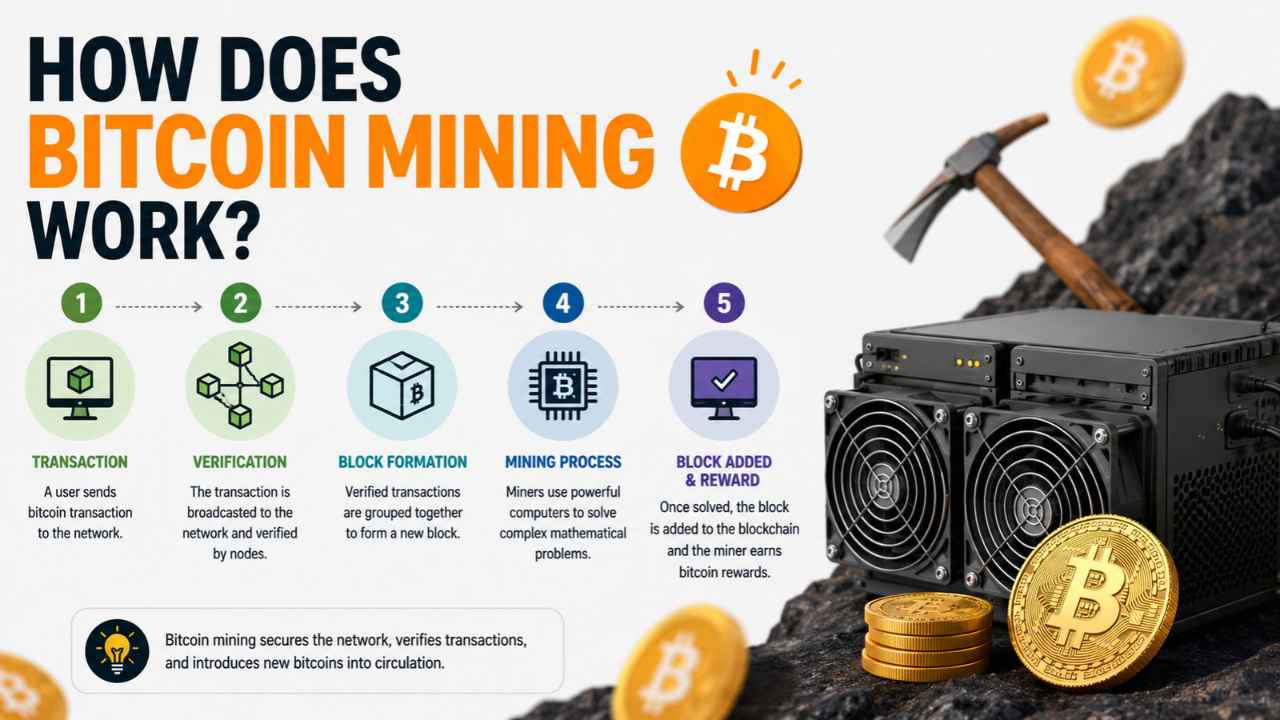
Every few seconds, somewhere on earth, a machine wins a lottery worth millions of rupees in bitcoin. It does not win by luck alone. It wins by burning electricity faster than every other machine on the planet doing the exact same guessing game. That is bitcoin mining in one sentence. Strip away the jargon and it is a race, run every ten minutes, forever, and the prize is new bitcoin plus the fees riders pay to get their transactions confirmed.
What Is Bitcoin Mining, Really
Bitcoin mining is the process that adds new transactions to the blockchain and creates new bitcoin at the same time. Miners run specialized computers that compete to solve a cryptographic puzzle. Whoever solves it first gets to add the next “block” of transactions and collects the block reward. It sounds technical, but the underlying idea is closer to a sealed bid auction than a science experiment. Speed and electricity decide the winner, not intelligence.
Mining also does something quieter but more important. It secures the network. Because rewriting bitcoin’s history would require redoing all that computational work, the ledger becomes practically tamper proof once enough blocks pile on top of it.
How Bitcoin Mining Actually Works, Step by Step
Bitcoin runs on a system called proof of work. Here is what that means in practice, without the textbook language.
First, pending transactions sit in a waiting room called the mempool. Miners pick a batch of them and bundle it into a candidate block. Second, the miner’s hardware starts guessing a number called a nonce, plugging it into a hashing function called SHA 256 along with the block’s data. Each guess produces a completely different, unpredictable output.
Third, the network only accepts a block if the resulting hash falls below a specific target value, one that starts with a long enough string of zeros. There is no shortcut to finding it. Miners simply try trillions of guesses per second until one works. Fourth, once a miner finds a valid hash, it broadcasts the block to the network. Other nodes verify it in seconds and add it to their copy of the chain.
This entire cycle repeats roughly every ten minutes, all day, every day, across hundreds of thousands of machines worldwide.
Bitcoin Mining Hardware: ASICs vs GPUs vs CPUs
In bitcoin’s earliest years, ordinary laptops could mine coins. That era is long gone. Today, mining is dominated by ASICs, chips built for one job only, hashing SHA 256 as fast as physically possible. A modern ASIC from Bitmain or Canaan can push well over 200 terahashes per second while a gaming GPU manages a tiny fraction of that for bitcoin specifically, though GPUs remain relevant for other coins that resist ASIC mining.
| Hardware Type | Hash Power | Best Suited For | 2026 Viability for BTC |
|---|---|---|---|
| CPU | Very low | Learning, testing | Not viable |
| GPU | Moderate | Altcoins, RandomX, Equihash | Not viable for BTC |
| ASIC | Very high | Dedicated bitcoin mining | Industry standard |
| Cloud mining contracts | Rented ASIC power | Passive exposure | Viable with caution |
The takeaway is simple. If the goal is mining bitcoin itself rather than a GPU friendly altcoin, ASICs are the only realistic option in 2026, and even then, cheap electricity matters more than raw hash power.
Mining Pools vs Solo Mining
Solo mining bitcoin today is a bit like buying a single lottery ticket against opponents holding a warehouse full of tickets. Technically possible, statistically brutal. That is why most individual miners join a mining pool instead, combining hash power with thousands of other participants and splitting rewards proportionally whenever the pool finds a block.
Pools smooth out the randomness. Instead of waiting months for a solo payout that might never come, pool miners receive smaller, steadier payments tied to the hash power they contributed. The tradeoff is a small fee, typically one to three percent, paid to the pool operator for coordinating the effort.
Bitcoin Mining Rewards and the Halving
Every 210,000 blocks, roughly every four years, the block reward cuts in half. This event, called the halving, is baked directly into bitcoin’s code. After the most recent halving in April 2024, the reward dropped to 3.125 BTC per block. Miners also earn transaction fees on top of that base reward, and as the block subsidy keeps shrinking toward zero over the coming decades, fees are expected to make up a growing share of miner income.
This built in scarcity is central to bitcoin’s economic design. It caps total supply at 21 million coins and forces miners to constantly improve efficiency just to maintain the same revenue, since the reward itself only ever goes down.
Bitcoin Mining in 2026: What the Data Shows
2026 has been a volatile year for miners. Network hashrate touched an all time high above 1 zettahash per second in January before severe winter storms across Texas forced large operators to power down, briefly dragging hashrate down to around 826 exahash per second. Mining difficulty, which recalibrates every 2,016 blocks to keep block times near ten minutes, has swung sharply as a result, falling from a peak near 155.97 trillion in late 2025 to below 125 trillion by mid year.
Three forces are reshaping the sector this year. One, thin margins pushed weaker, older rigs offline, particularly Antminer S19 and Avalon 1246 series units running on unhedged electricity rates. Two, AI and high performance computing demand is competing directly with bitcoin mining for cheap power and data center space, and some public miners are retrofitting facilities toward AI workloads entirely. Three, demand response programs in Texas, where a large share of North American hashrate is concentrated, now regularly pay miners to curtail operations during peak grid stress, turning power flexibility into its own revenue stream.
Hashprice, the estimated daily revenue per unit of hash power, sat near multi year lows around 24 to 33 dollars per petahash per day for much of 2026, squeezing anyone without access to sub 10 cent per kilowatt hour electricity.
Is Bitcoin Mining Still Profitable in 2026
It depends almost entirely on electricity cost. Large industrial operations with contracts below 5 to 6 cents per kilowatt hour, often in regions with excess hydro, gas, or renewable capacity, remain profitable even during difficulty spikes. Smaller home setups paying retail power rates above 10 cents per kilowatt hour are largely priced out unless bitcoin’s price rallies well above recent ranges.
For most people outside the industrial mining business, buying and holding bitcoin directly, or exploring regulated products, tends to offer a simpler risk profile than running hardware. Anyone still considering mining should run the numbers through a live profitability calculator before committing capital, since difficulty and hashprice shift every two weeks.
Environmental and Regulatory Angle
Bitcoin mining’s energy use remains a genuine talking point, though the industry has shifted noticeably toward stranded, flared, and renewable power sources to cut costs and reputational risk simultaneously. In India, mining itself is not explicitly banned, but it sits in the same regulatory grey zone as broader crypto activity, and any mined bitcoin is still taxed under the same 30 percent flat rate and 1 percent TDS rules that apply to trading gains.
Frequently Asked Questions
How does bitcoin mining work in simple terms? Miners use specialized computers to guess numbers trillions of times per second until one produces a valid result under bitcoin’s proof of work rules. The winner adds the next block and earns newly created bitcoin plus transaction fees.
Can I mine bitcoin on my laptop in 2026? No. Bitcoin mining now requires ASIC hardware built specifically for SHA 256 hashing. A regular laptop or gaming PC will produce a negligible, essentially unprofitable hash rate.
What is the current bitcoin mining reward? The block reward is 3.125 BTC as of the April 2024 halving, plus whatever transaction fees are included in that block. The next halving will cut this again around 2028.
Is bitcoin mining profitable right now? Only for operators with cheap electricity, generally under 6 to 8 cents per kilowatt hour, and efficient modern ASICs. Rising difficulty and falling hashprice have squeezed margins for smaller miners through most of 2026.
Is bitcoin mining legal in India? There is no specific law banning bitcoin mining in India, but it remains unregulated territory. Any bitcoin earned through mining is treated as income and taxed at the standard 30 percent crypto tax rate.
What is the difference between mining and staking? Mining is proof of work, based on computational competition and hardware, and is how bitcoin creates new coins. Staking is proof of stake, used by networks like Ethereum, where validators lock up coins instead of burning electricity.