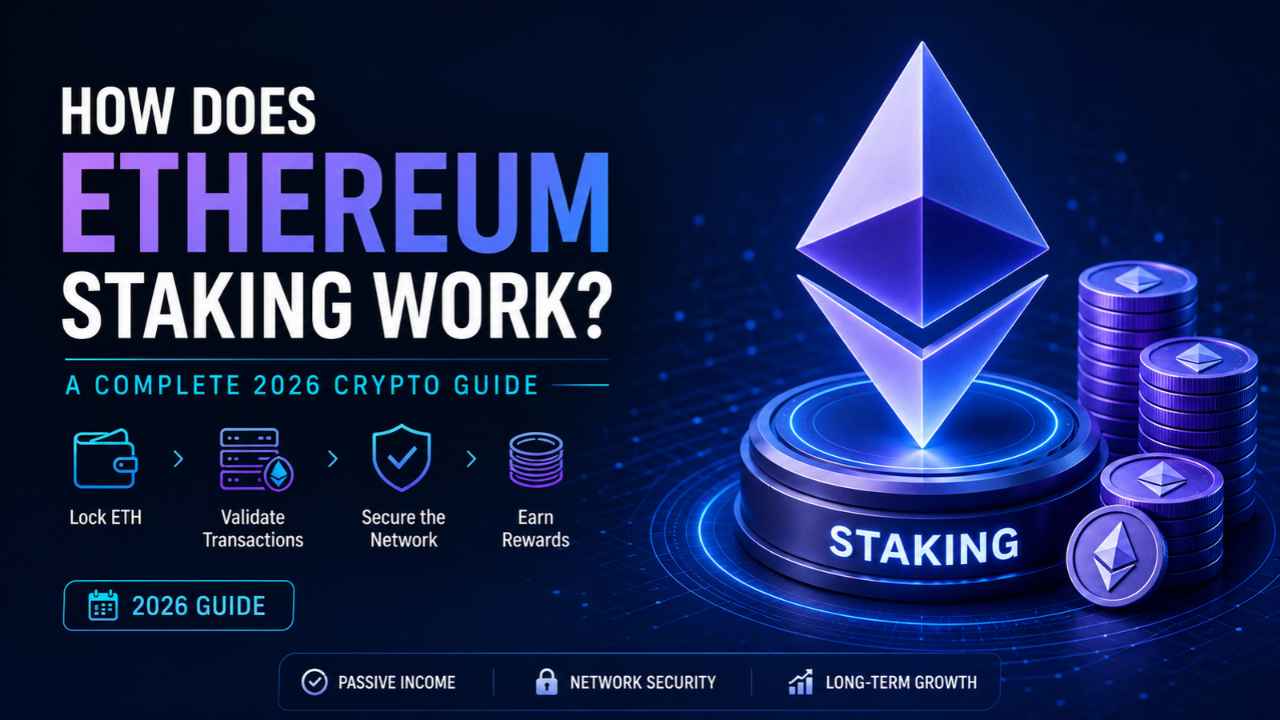
Ethereum stopped running on miners back in September 2022. Since then, the network has been secured by people locking up ETH instead of burning electricity on mining rigs. That process is called staking, and by mid 2026 close to 39.7 million ETH, roughly a third of the entire supply, sits locked in the system. If you have ever wondered how does Ethereum staking work and whether it is worth doing with your own coins, this guide walks through the mechanics, the rewards, and the risks in plain language.
What Is Ethereum Staking
Staking means depositing ETH into Ethereum’s proof of stake system so it can be used as collateral to validate transactions. In return for locking up that capital, you earn newly issued ETH plus a slice of network fees. Think of it as putting down a security deposit. Behave honestly and validate blocks correctly, and you get paid. Act maliciously or go offline too often, and part of that deposit can be taken away.
Related Readings
How Ethereum Staking Actually Works
At the center of everything sits the validator. To run one, you commit exactly 32 ETH to Ethereum’s deposit contract. That stake becomes your economic skin in the game. Once activated, your validator gets randomly assigned to propose new blocks or attest to blocks proposed by others, confirming they follow the rules.
Every validator runs three pieces of software: an execution client such as Geth or Nethermind, a consensus client such as Lighthouse or Prysm, and a validator client that handles the actual signing duties. Honest, consistent participation earns rewards. Missed attestations bring small penalties. Serious violations, like signing two conflicting blocks, trigger slashing, where a portion or all of your staked ETH gets destroyed.
New validators do not join instantly. Ethereum rate limits how many can activate per day to protect network stability, so deposits wait in an entry queue. In May 2026 that queue swelled past 3.5 million ETH with waits over two months, a sharp reversal from earlier in the year when there was barely any wait at all. Exiting works the same way, through a queue rather than an instant withdrawal.
Ethereum Staking Rewards in 2026
This is the part most people actually care about. Base staking yield in 2026 sits around 2.7 to 2.8 percent annually, down noticeably from the 4 percent plus rates seen back in 2023. That decline is not random. Ethereum’s issuance curve scales inversely with the square root of total ETH staked, so every new wave of validators shrinks everyone’s individual slice of rewards.
Validators running MEV-Boost, which connects them to block builders competing for the most valuable transaction ordering, typically pick up another 0.5 to 1 percent on top of the base rate. That pushes realistic solo staking returns into the 3.1 to 3.3 percent range across a full year. It is not the flashy triple digit yield you see advertised on some altcoin farms, but it comes with none of that farming risk.
There is also a policy shift worth watching. Ethereum Foundation researcher Justin Drake and others proposed EIP 8361 in August 2026, aiming to taper issuance as staking participation climbs past current levels. If adopted, projected annual yield could compress from around 2.6 percent toward 1.2 percent over an 18 month transition, which would matter a lot to anyone planning long term staking income.
Ways to Stake ETH
Not everyone has 32 ETH sitting around, and that is fine. There are several paths into staking depending on how much capital and technical patience you have.
Solo staking means running your own validator with the full 32 ETH. You keep 100 percent of rewards and full control, but you also handle hardware, uptime, and slashing risk yourself. Since the Pectra upgrade, a single validator can hold up to 2,048 ETH, letting larger operators consolidate many validators into one.
Liquid staking lets you deposit any amount of ETH into a protocol like Lido, which pools deposits and runs validators on your behalf. You receive a token such as stETH representing your staked ETH plus rewards, and you can trade or use that token across DeFi while still earning yield. Lido alone controls close to 62 percent of the liquid staking market and charges a 10 percent fee on rewards.
Exchange staking through platforms like Coinbase or Binance is the simplest option. You click a button, the exchange handles validator operations, and you earn a share of rewards minus a fee that often runs higher than liquid staking protocols, sometimes around 25 percent.
Staking pools and staking as a service sit somewhere in between, letting smaller holders combine funds toward a validator or pay a provider to run dedicated infrastructure for them.
| Method | Minimum ETH | Typical Fee | Control | Liquidity |
|---|---|---|---|---|
| Solo staking | 32 ETH | None | Full | Locked until exit queue clears |
| Liquid staking (Lido, Rocket Pool) | Any amount | 10-14% | Low | High, tokens tradeable |
| Exchange staking | Any amount | Up to 25% | None | Depends on platform |
| Staking pools | Small amounts | Varies | Shared | Moderate |
Risks Involved in Ethereum Staking
Staking is safer than active trading, but it is not risk free. Slashing can cost you ETH if your validator misbehaves or if infrastructure is misconfigured, though in practice most slashing events come from operator mistakes rather than intentional attacks. Withdrawal queues can also stretch out during periods of mass exit, meaning your ETH is not always instantly liquid.
Liquid staking tokens carry their own smart contract risk, since you are trusting the protocol’s code alongside the validators it runs. Centralization is another concern worth naming honestly. Lido’s dominant share of staked ETH has sparked ongoing debate about how much of the network’s security should rest with any single protocol.
Is Ethereum Staking Worth It in 2026
That depends on what you are comparing it to. A 2.7 to 3.3 percent yield will not make anyone rich overnight, but for holders who already believe in ETH long term, staking turns idle coins into a small, steady income stream instead of letting them sit doing nothing. Institutional demand backs this up. Yield distributing spot ETH ETFs and corporate treasuries have been steadily adding staked positions through 2026, treating validator rewards as a genuine yield product rather than a side bet.
If you need your ETH liquid on short notice, or you are chasing high yield farming style returns, staking probably is not the right fit. If you are holding for the long run anyway, it is close to the lowest risk way to put that ETH to work.
FAQ
How much ETH do I need to stake? Solo staking requires exactly 32 ETH to activate a validator. Liquid staking and exchange staking have no real minimum, letting you stake any amount.
Is Ethereum staking safe? It carries real but manageable risks, mainly slashing for validator misbehavior and smart contract risk on liquid staking platforms. Choosing reputable providers reduces most of that exposure.
Can I unstake ETH anytime? Yes, since the Shapella upgrade in April 2023 staked ETH can be withdrawn anytime, though you enter an exit queue first and wait times vary with network demand.
What is the current Ethereum staking APY? Base yield runs around 2.7 to 2.8 percent in 2026, with MEV rewards adding roughly 0.5 to 1 percent for validators running MEV-Boost.
What is liquid staking? Liquid staking lets you stake any amount of ETH through a protocol and receive a tradeable token, such as stETH, representing your staked position plus rewards.
Sources: beaconcha.in, Dune Analytics (hildobby dashboard), KuCoin Research, Datawallet, Staking Rewards, ultrasound.money