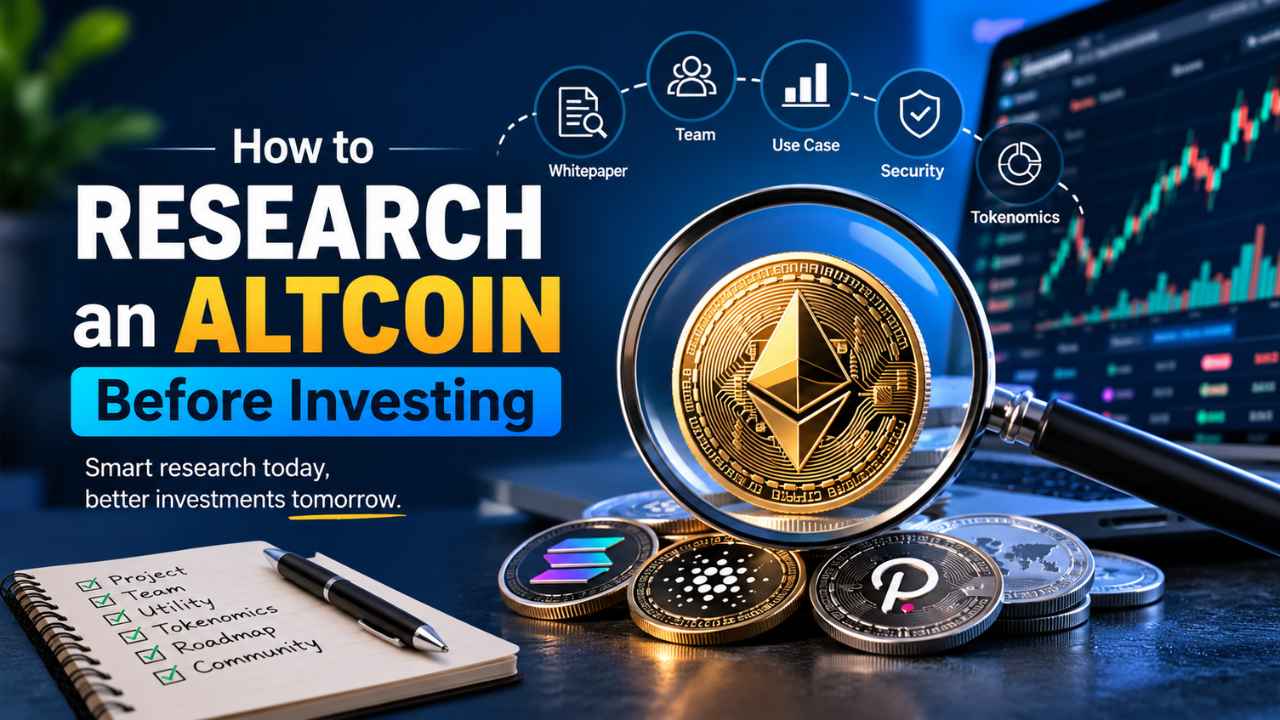
You saw the chart. Green candle after green candle, some coin you’d never heard of last week is suddenly up 400 percent, and your group chat is losing its mind over it. Your thumb is already hovering over the buy button.
Stop for a second. Just one second.
That feeling, the fear of missing the next big thing, is exactly what separates people who build real portfolios from people who fund somebody else’s exit liquidity. And in 2026, with thousands of new tokens launching every single month across a dozen chains, that gap between the two only gets wider.
Here’s the good news. Researching an altcoin before you put money into it isn’t complicated. It doesn’t require a finance degree or a Bloomberg terminal. It requires about twenty minutes, a handful of free tools, and the discipline to actually use them before you click confirm. That’s it. This guide walks you through exactly what to check, in what order, and why each step matters.
Why This Matters More Than It Used To
Let’s be honest about where we are right now. According to DappRadar’s 2025 report, rug pulls actually dropped 66 percent year over year compared to 2024. That sounds like good news, and in a way it is. But the same report found that since the start of 2025, the crypto industry has lost nearly 6 billion dollars to rug pulls, with a staggering 92 percent of that tied to a single collapse, the Mantra OM token. Fewer scams, bigger damage per scam. That’s the trend line you’re investing into.
Add to that an altcoin market where Bitcoin dominance has been sitting around 58 to 60 percent through much of 2026, and the Altcoin Season Index bouncing in the 30 to 35 range, meaning capital hasn’t fully rotated into smaller coins yet. When that rotation does happen, and it always eventually does, thousands of altcoins will be fighting for attention, and a lot of them will be junk dressed up in a slick website and a Telegram full of bots.
So no, this isn’t fear mongering. It’s just the terrain. And once you know the terrain, walking through it gets a lot less scary.
There’s also something worth saying plainly. Most of the people who lose money on altcoins aren’t unlucky. They skipped steps. They saw a chart moving, felt that pull in their stomach, and bought before checking a single thing about the project underneath the ticker symbol. Research won’t make you immune to a bad market. It will make you far less likely to hand your money to someone who was never planning to build anything in the first place.
Step One: Read the Whitepaper Like You Mean It
I know, nobody wants to read a 40 page PDF. But you don’t need to read all 40 pages. You need answers to three questions. What problem does this token actually solve? Does that problem already have five other projects solving it better? And does the token itself need to exist for the product to work, or is it just bolted on so there’s something to sell?
A lot of altcoins fail this last test quietly. The product could run fine without the token. That’s usually a sign the token exists to raise money, not to power anything.
Step Two: Investigate the Team Before You Investigate the Chart
Anonymous teams aren’t automatically a red flag, plenty of legitimate projects started that way. But anonymous plus no doxxed advisors plus no verifiable track record plus aggressive marketing? That combination should make you pause.
Search the founders’ names. Check if they’ve built anything before, and how that project ended. Look at LinkedIn, GitHub commit history, and whether the same people have been connected to previous coins that quietly died. A team that’s been building in public for two years carries a different risk profile than one that appeared six weeks ago with a countdown timer on their homepage.
Also pay attention to how the team talks. Real builders tend to talk about roadmaps, partnerships, and technical tradeoffs. Teams running a slow motion exit tend to talk almost exclusively about price targets, exchange listings, and how early you still are. If every update reads like a sales pitch and none of them read like an engineering log, that’s information too.
Step Three: Check the Tokenomics Before You Check the Price
This is where most retail investors skip straight past and go back to staring at the candles. Don’t. Tokenomics tell you who actually controls the coin and what’s coming to crush the price later.
Pull up the token distribution. What percentage sits with the team and early investors? Anything above 20 to 25 percent combined should raise your eyebrows. Then check the vesting schedule. Are those tokens locked for a year, or can insiders dump the moment the token lists? Also look at total supply versus circulating supply. A coin with a billion token supply and only 40 million circulating can look artificially cheap per unit while insiders sit on a mountain ready to unload.
Step Four: Read the Smart Contract, or Have Someone Read It for You
You don’t need to be a Solidity developer for this. Free tools like GoPlus Security, Token Sniffer, and De.Fi Scanner scan a contract in seconds and flag the scary stuff automatically, things like hidden mint functions that let the owner print unlimited tokens, honeypot code that lets you buy but never sell, or blacklist functions that can freeze your wallet specifically.
If the project has a paid audit from a recognized firm such as CertiK, Hacken, or PeckShield, read the summary, not just the badge on the website. Some teams display an audit badge from an audit that flagged serious issues they never fixed. The badge alone means nothing without the actual findings behind it.
One more thing worth ten seconds of your time, check who actually owns the contract. If the deployer wallet still holds owner privileges months after launch, with no timelock or multisig protecting it, one signature is all it takes to change the rules on everyone holding the token. Renounced ownership isn’t a guarantee of good intent, but combined with the other checks here, it removes one entire category of risk from the table.
Step Five: Follow the Liquidity
This is the step people skip most often, and it’s often the one that actually saves your money. Liquidity is what lets you sell the token later. If it’s thin or, worse, controlled entirely by the team, you could end up holding a coin that technically has a price but practically has no exit.
Check whether liquidity pool tokens are locked, and for how long, using something like Unicrypt or Team Finance. A three month lock on a coin claiming to be a long term project should tell you something. Also glance at trading volume on DeFiLlama or DexScreener. A coin with a 50 million dollar market cap and 8,000 dollars of daily volume is a coin you might not be able to sell when you actually want to.
Step Six: Read the Community, Don’t Just Join It
Hype is loud on purpose. A Telegram group with 40,000 members and constant rocket emojis feels exciting, but excitement isn’t due diligence. Look closer. Are real questions getting answered, or deleted? Are the same five accounts posting price predictions every ten minutes? Check X and Reddit for organic mentions from accounts that aren’t obviously paid shills. Genuine communities argue with each other sometimes. Fake ones only ever agree.
Green Flags vs Red Flags Checklist
| Signal | Green Flag | Red Flag |
|---|---|---|
| Team | Doxxed, verifiable history | Anonymous with no track record |
| Token allocation | Under 20% to team/insiders | Over 25% to team/insiders, no vesting |
| Contract | Verified, audited, no mint function | Unverified, hidden owner privileges |
| Liquidity | Locked 6+ months, healthy volume | Unlocked or team controlled, thin volume |
| Community | Organic discussion, honest criticism allowed | Bot heavy, criticism deleted |
| Marketing | Focused on product and use case | Focused purely on price predictions |
Tools Worth Bookmarking
You don’t need a paid research desk in 2026. A free toolkit gets you most of the way there. CoinGecko and CoinMarketCap for basic metrics and supply data. DeFiLlama for liquidity and protocol revenue. Etherscan or BscScan for on chain contract details. GoPlus Security or Token Sniffer for automated contract scans. Nansen or Arkham for wallet tracking if you want to see whether insiders are quietly moving tokens around before an announcement.
A Simple Pre Investment Checklist
Before you commit money to any altcoin, run through this quickly.
- Read the whitepaper and confirm the token is actually necessary for the product.
- Verify the team’s identity and past projects.
- Check token distribution and vesting schedules.
- Scan the smart contract for mint functions, honeypots, and blacklist code.
- Confirm liquidity is locked and trading volume is realistic.
- Read community discussion for organic, honest conversation.
- Only invest an amount you’d be fine losing completely.
That last point isn’t a throwaway line. Altcoins, even well researched ones, carry real volatility. Research reduces the odds of getting scammed. It doesn’t eliminate market risk.
Frequently Asked Questions
How long should altcoin research take before investing? For most retail investors, 20 to 30 minutes covering the steps above is enough for smaller positions. Larger allocations deserve a few hours, including reading the audit report in full and cross checking the team’s history.
Is it safe to invest in an altcoin with an anonymous team? It carries more risk, not automatically disqualifying risk. Weigh it against other factors like liquidity locks, audit quality, and how long the project has operated without incident.
What’s the biggest red flag in altcoin research? A combination of unlocked liquidity and heavy insider token allocation. That single combination has been behind some of the largest losses in crypto history.
Do audited contracts guarantee safety? No. Audits catch known vulnerability patterns but can’t guarantee a team won’t act maliciously later, or that new exploits won’t surface. Treat an audit as one data point, not a guarantee.
Where can I check if a token’s liquidity is locked? Platforms like Unicrypt and Team Finance display lock details publicly for most tokens built on Ethereum, BNB Chain, and similar networks.