
A trader I know needed to pull 40,000 dollars off Arbitrum during a market swing in March. He clicked withdraw, watched the transaction confirm on his end almost instantly, and then found out the money wasn’t actually touching Ethereum mainnet for another seven days. He’d assumed “confirmed” meant “final.” On a rollup, those are two very different things, and which flavor of rollup you’re using decides how far apart they sit.
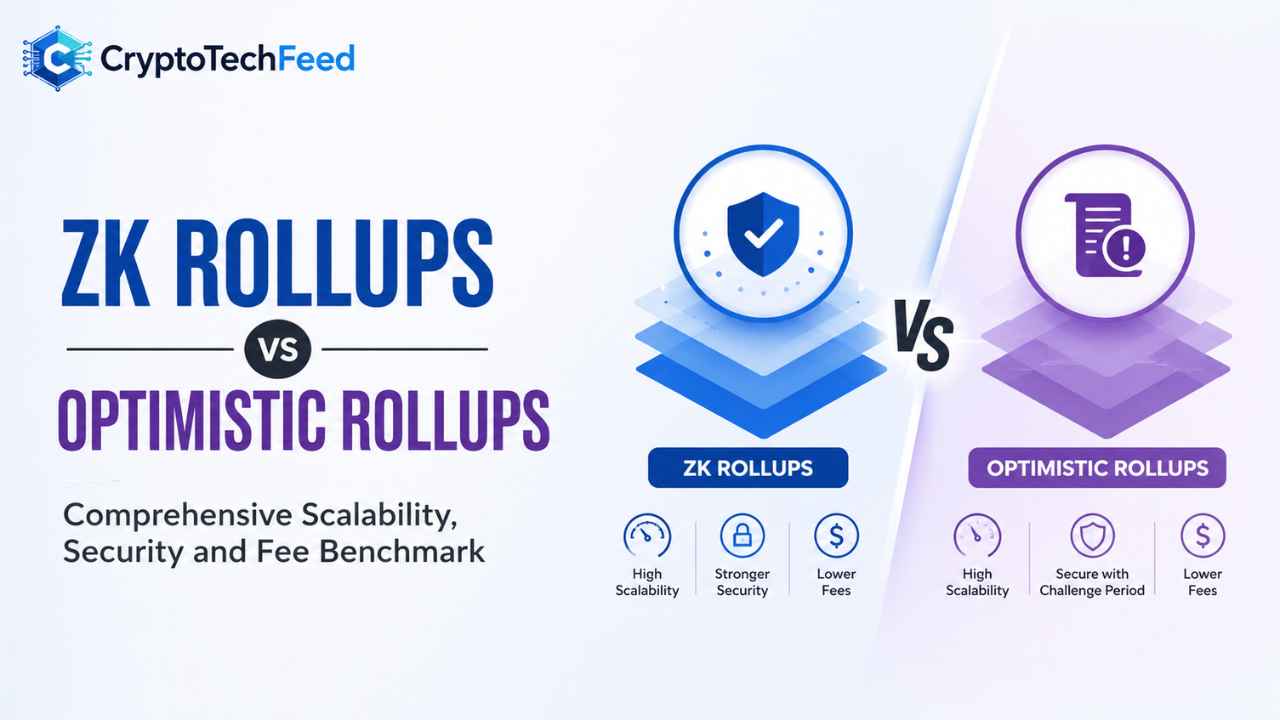
That gap is really what the zk rollups vs optimistic rollups debate comes down to. Not which one is “better” in the abstract, but which one makes a different trade between speed, cost, and how quickly your funds actually become unquestionably final on Ethereum. Let’s break down the mechanics, then benchmark two of the biggest names on each side, Arbitrum and zkSync, against real numbers instead of marketing pages.
Quick Refresher: What a Rollup Actually Does
Both rollup types exist to solve the same problem. Ethereum mainnet is secure but slow and expensive when every single transaction has to be processed and verified by every validator. Rollups move the actual transaction execution off to a separate layer, batch thousands of transactions together, and then post a compressed summary back to Ethereum. Ethereum never re-executes each transaction individually. It just needs a way to trust that the batch is correct, and that’s exactly where optimistic and ZK rollups part ways.
How Optimistic Rollups Work
Optimistic rollups run on a trust first, verify later model. A sequencer processes transactions off chain, bundles them, and posts the batch to Ethereum along with a claim that everything in it is valid. Ethereum accepts that claim by default, no proof required upfront, which is exactly where the “optimistic” name comes from.
To keep that trust in check, every batch enters a challenge window, typically seven days on networks like Arbitrum and OP Mainnet. During that window, anyone running a full node can submit a fraud proof if they spot an invalid transaction slipped into the batch. If a fraud proof succeeds, the bad batch gets reverted and the sequencer that submitted it gets penalized. If nobody challenges it, the batch is treated as final once the window closes.
This design is cheap to compute since nobody has to generate a cryptographic proof for every batch, and it’s also why Arbitrum and Base run near full EVM compatibility so easily, since the execution environment doesn’t need to be reengineered around proof generation. The trade off is that seven day withdrawal window, and it exists purely so honest actors have enough time to catch fraud before it’s locked in permanently.
Zero Knowledge Rollups Explained
ZK rollups take the opposite approach. Instead of assuming a batch is valid and giving people a week to prove otherwise, a ZK rollup proves the batch is valid before it ever reaches Ethereum. A prover generates a cryptographic validity proof, usually a zk-SNARK or zk-STARK, that mathematically demonstrates every transaction in the batch followed the rules correctly. Ethereum verifies that proof directly, and once verified there’s nothing left to dispute. The math already settled the argument.
This is where zero knowledge rollups explained gets genuinely elegant. A validity proof doesn’t just claim correctness, it constitutes correctness. There’s no challenge period because there’s nothing to challenge. The catch is that generating these proofs takes real computation, which historically made ZK rollups slower and more expensive to run, and full EVM equivalence was hard to achieve because not every operation compresses cleanly into a provable circuit. Networks like zkSync Era, Scroll and Linea have spent the last two years closing that gap with zkEVM designs, but they’re still earlier in that maturity curve than the optimistic side.
ZK Rollups vs Optimistic Rollups: The Security Model Difference
Security on both sides ultimately traces back to Ethereum, but the assumptions differ in a way that matters. Optimistic rollups depend on liveness, meaning at least one honest, well resourced watcher has to actually notice fraud and submit a proof within the challenge window. In practice that’s a reasonable assumption on mature networks with active watchtower services, but it’s still an assumption about human behavior, not pure math.
ZK rollups depend on the soundness of cryptography instead. As long as the proof system itself isn’t broken, an invalid batch mathematically cannot pass verification, full stop. Nobody needs to be watching. That’s a stronger theoretical guarantee, though it shifts the risk elsewhere, into the correctness of the circuit design and the prover software itself, which is exactly why audits and formal verification matter so much more on the ZK side.
Neither model is naive security theater at this point. L2Beat’s stage system tracks this maturity directly, and as of 2026 several optimistic rollups including Arbitrum One sit at Stage 1 with permissionless fraud proofs live, while most ZK rollups including zkSync Era remain at Stage 0, meaning a security council can still override the system in an emergency. That’s improving fast, but it’s a real, checkable difference today, not a permanent architectural gap.
Layer 2 Finality Time: Where the Real Difference Shows Up
This is the number that actually changes how you use these chains day to day. Layer 2 finality time comes in two flavors people constantly confuse. Soft finality is how fast a transaction confirms on the L2 itself, and on both rollup types that’s typically near instant, often under a couple of seconds. Hard finality is when that transaction becomes irreversible on Ethereum mainnet, and that’s where optimistic and ZK rollups diverge hard.
On Arbitrum and OP Mainnet, hard finality for withdrawals back to Ethereum takes the full seven day challenge window, no matter how fast the L2 itself feels. On zkSync Era, Linea and similar ZK rollups, hard finality typically lands within one to four hours, sometimes faster, since the validity proof settles the question the moment Ethereum verifies it. Some networks offer fast bridges that front you liquidity instantly for a fee, which is how a lot of people never notice the underlying delay until they try to withdraw without one.
If you’re an active trader moving size in and out of L2 frequently, that finality gap is a real cost, either in time or in third party bridge fees. If you’re parking long term DeFi positions, it barely matters.
Arbitrum vs zkSync: The 2026 Benchmark
Numbers make this concrete. As of April 2026, Arbitrum One holds roughly 13.8 to 16.9 billion dollars in TVL, the largest of any rollup, running Stage 1 optimistic architecture with permissionless fraud proofs live. Median transaction fees sit around 4 cents, throughput handles roughly 40 to 60 TPS under real load, and daily transaction volume runs around 4.3 million.
zkSync Era, by comparison, holds roughly 4.1 billion dollars in TVL as a Stage 0 ZK rollup. Median fees run close to 5 to 7 cents, marginally higher than Arbitrum despite the ZK label, mostly because proof generation still carries real computational overhead that gets passed through in gas costs. Throughput sits lower in practice, closer to 28 TPS under current load.
So arbitrum vs zksync isn’t really a story of ZK being cheaper or faster in 2026, post Dencun upgrade fee compression flattened almost all of that advantage across every major L2. It’s a story of Arbitrum having a multi year head start on liquidity, ecosystem depth and security decentralization, against zkSync’s faster hard finality and a cryptographic security model that doesn’t depend on anyone watching the chain.
Fee and Finality Snapshot, 2026
| Network | Type | Median Fee | Withdrawal Finality | L2Beat Stage | TVL (Apr 2026) |
|---|---|---|---|---|---|
| Arbitrum One | Optimistic | ~$0.04 | 7 days | Stage 1 | $13.8-16.9B |
| OP Mainnet | Optimistic | ~$0.03 | 7 days | Stage 1 | ~$5.6B |
| zkSync Era | ZK (SNARK) | ~$0.05-0.07 | 1-4 hours | Stage 0 | ~$4.1B |
| Starknet | ZK (STARK) | ~$0.03-0.19 | 1-4 hours | Stage 1 | ~$1.5B |
| Linea | ZK (SNARK) | ~$0.04-0.09 | 1-24 hours | Stage 0 | ~$3.4B |
Which One Should You Actually Use
Neither side wins outright, and pretending otherwise isn’t honest analysis. If you want the deepest DeFi liquidity, the widest protocol selection and the most battle tested fraud proof system currently live, Arbitrum’s ecosystem depth is hard to match right now. If you move funds in and out frequently and hate waiting a week to get your own money back, or you specifically want a security model that doesn’t rely on someone else noticing fraud, a ZK rollup like zkSync or Starknet fits better even at a marginally higher fee.
The honest middle ground answer is that most active DeFi users end up holding positions across both types anyway, since bridges and aggregators have made moving between them fairly painless. The architecture matters far more for developers deciding what to build on, and for anyone parking serious size who actually needs to understand what “final” means before they need to move fast.
FAQ
What is the main difference between ZK rollups and optimistic rollups? Optimistic rollups assume transactions are valid and allow a challenge window, usually seven days, for anyone to submit fraud proofs. ZK rollups generate a cryptographic validity proof before the batch is even posted, so there’s no dispute period needed.
Is Arbitrum a ZK rollup or an optimistic rollup? Arbitrum is an optimistic rollup. It relies on fraud proofs and a seven day challenge window rather than cryptographic validity proofs.
Why does zkSync have faster finality than Arbitrum? zkSync’s validity proofs are verified directly by Ethereum, so once the proof is confirmed there’s nothing left to challenge. Arbitrum has to wait out its full fraud proof window regardless of how the L2 itself performs.
Are ZK rollups actually cheaper than optimistic rollups in 2026? Not by much anymore. Post Dencun fee compression brought most major L2s within a few cents of each other, and proof generation overhead on ZK rollups often offsets any theoretical cost advantage.
Which is more secure, ZK or optimistic rollups? ZK rollups rely on cryptographic soundness that doesn’t require anyone to actively watch the chain, which is a stronger theoretical guarantee. But maturity matters too, several optimistic rollups have reached L2Beat Stage 1 with permissionless fraud proofs, while most ZK rollups are still at Stage 0 with a security council override in place.




