A friend of mine builds smart contracts for a living, and a few weeks back he sent me a screenshot that made him stop scrolling. He’d just sent a transaction on a rollup, and the block explorer showed the transaction settling on Ethereum, while the actual transaction data sat on something called Celestia. Same transaction, two different chains doing two different jobs. He asked me, half joking, “wait, is my transaction living in two places at once?”
Kind of, yeah. And that confusion is exactly why modular blockchains are worth understanding right now. For years, a blockchain was just one machine doing everything at once. That’s changing fast, and it’s changing the way rollups, layer 2 networks, and even new layer 1s are being built in 2026.
What is a Modular Blockchain? (Quick Definition)
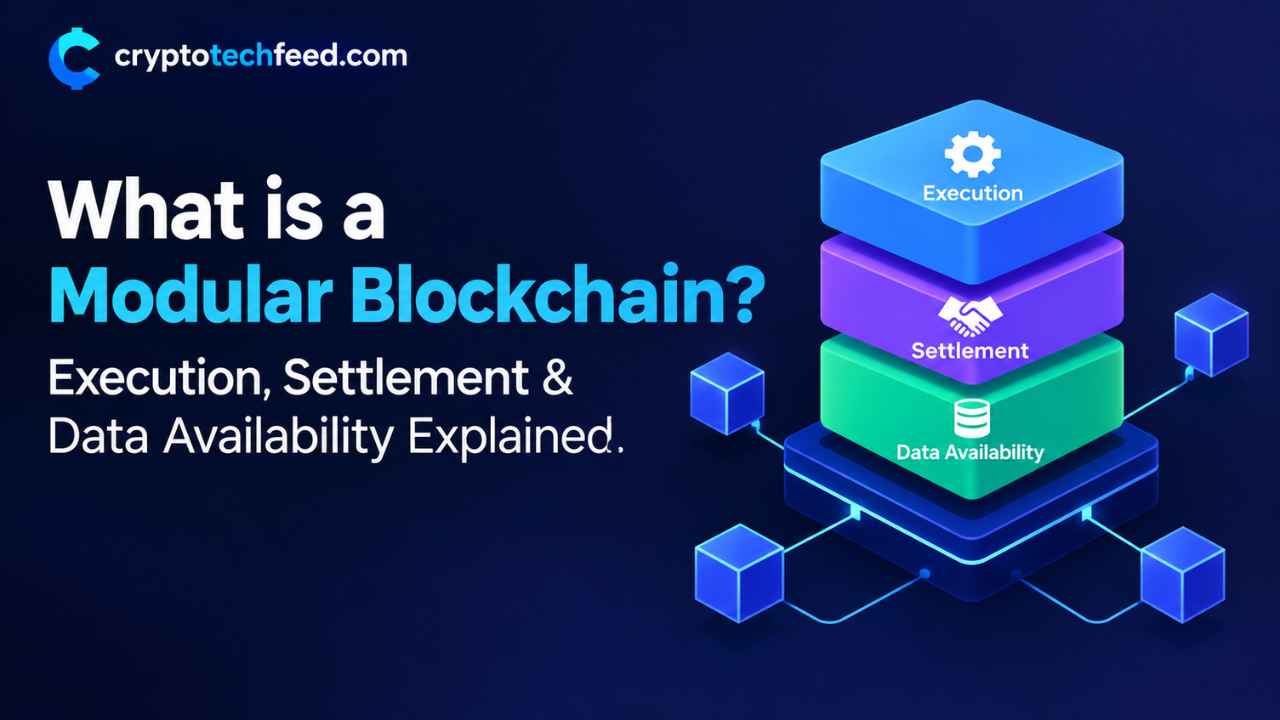
A modular blockchain is a blockchain that splits its core functions, execution, settlement, consensus, and data availability, across separate specialized chains instead of handling everything on one network. Each layer focuses on doing one job well, then hands off to the next layer, the way a factory assembly line splits work across stations instead of asking one worker to build the whole product alone.
That’s the whole idea in one sentence. Everything else in this piece is just unpacking what those four layers actually do, and why splitting them apart turned out to matter so much.
Modular vs Monolithic Blockchain: What Actually Changed
Bitcoin and early Ethereum are what people now call monolithic blockchains. One chain, one set of validators, and every single node has to download, verify, and store everything. Execution happens there. Settlement happens there. Data availability happens there. Consensus happens there. It’s simple, and it’s secure, but it doesn’t scale well. As more people use the chain, every node needs more storage, more bandwidth, and more computing power just to keep up. That’s the bottleneck that made gas fees spike on Ethereum for years.
Modular design breaks that single job into pieces and lets specialized networks compete on each one. A rollup can focus purely on execution, running thousands of transactions cheaply, while leaning on other chains for the parts it doesn’t want to handle itself. Nobody has to be good at everything anymore. Here’s the comparison side by side.
| Factor | Monolithic Blockchain | Modular Blockchain |
|---|---|---|
| Core functions | All handled by one chain | Split across specialized layers |
| Scalability | Limited by single chain’s capacity | Each layer scales independently |
| Node requirements | High storage and bandwidth for all nodes | Lower requirements per specialized layer |
| Examples | Bitcoin, Solana, early Ethereum | Rollups plus Celestia, EigenDA, Ethereum settlement |
| Security model | Self contained validator set | Often borrowed or shared across layers |
| Flexibility | Hard to upgrade one function alone | Layers can be swapped or upgraded independently |
Neither model is simply better in every case. Solana bet on monolithic design with a powerful single chain and it’s paid off in raw throughput. But for the Ethereum ecosystem specifically, modular architecture became the practical answer to scaling without ripping up the base layer’s security guarantees.
The Four Layer Architecture, Broken Down
Every modular stack, whether it’s built on Ethereum rollups or an entirely new chain, is really just answering four questions. Who runs the computation. Who confirms it’s final. Who agrees on the order of events. And who stores the raw data so anyone can check it later. Those four questions map onto four layers.
Execution Layer
This is where the actual computing happens. Smart contracts run here, transactions get processed here, and user activity lives here. In a modular stack, the execution layer is usually a rollup, something like Arbitrum, Optimism, or a custom app chain built with a rollup framework. Execution layers are optimized for speed and low fees because they’re not also responsible for storing data forever or finalizing consensus. They just crunch the numbers and pass the results downstream.
Settlement Layer
The settlement layer is where disputes get resolved and where finality actually gets anchored. Think of it as the referee. When a rollup posts its transaction results, the settlement layer is what verifies those results are legitimate, either through a fraud proof window in optimistic rollups or a validity proof in ZK rollups. Ethereum is currently the dominant rollup settlement layer, because rollups inherit Ethereum’s security and decentralization instead of building their own validator set from zero. This is also why rollup fees are tied so closely to what’s happening on Ethereum mainnet.
Consensus Layer
Consensus is simply about agreement, getting a network of validators to agree on the order of transactions and that a block is valid. In a modular stack this can live on the settlement layer, on a dedicated data availability network, or on its own separate chain entirely, depending on the design. Celestia, for example, handles consensus and data availability together, deliberately leaving out execution so it can stay lightweight and let other chains build on top of it.
Data Availability Layer
This is the layer that quietly makes the whole thing trustworthy. Data availability just means the raw transaction data behind a rollup is published somewhere and anyone can access it to verify the chain’s state independently. Without this, a rollup operator could theoretically hide data and nobody could catch fraud. This layer used to be baked into Ethereum itself, and publishing data there can eat up a huge share of a rollup’s total costs. That’s the exact problem Celestia data availability was built to solve.
Celestia and the Rise of Dedicated Data Availability
Celestia launched its mainnet back in October 2023 as the first blockchain built purely to handle consensus and data availability, nothing else. No smart contracts, no execution environment. By 2026 that bet has clearly paid off. Celestia is now serving over 56 live rollups, has processed more than 160 GB of rollup data, and holds roughly half the entire data availability market. Every major rollup framework out there, Arbitrum Orbit, the OP Stack, Polygon CDK, now supports Celestia as a standard DA option.
The network kept iterating too. The Matcha upgrade in January 2026 pushed block capacity up to 128 MB while cutting node storage requirements by around 77%, which is the kind of upgrade that sounds boring until you realize it means more rollups can post more data for less cost, without pricing smaller node operators out of running the network. Celestia’s pricing sits around $0.001 per megabyte, which is why rollups that used to publish data directly to Ethereum have been migrating over in droves. It’s not a loyalty thing. It’s just cheaper.
EigenLayer Shared Security: Borrowing Trust Instead of Building It
Here’s a problem every new blockchain faces on day one. Security isn’t free. You need a big enough set of validators staking enough value that attacking the network costs more than any possible reward. Building that from scratch takes years and a lot of capital most new projects don’t have.
EigenLayer’s answer is restaking. Ethereum validators who’ve already staked ETH can opt to restake that same ETH to secure additional services, called Actively Validated Services, or AVS. Instead of a new project bootstrapping its own validator set, it can rent Ethereum’s existing economic security. By early 2026, EigenLayer had crossed somewhere around $15 to $18 billion in restaked value across close to 1,900 active operators, making it the largest shared security marketplace in crypto by a wide margin.
The most important AVS to come out of this so far is EigenDA, EigenLayer’s own data availability service, which competes directly with Celestia by using restaked ETH instead of a standalone token to secure the network. Worth being honest here though, not every AVS built on EigenLayer has found real demand yet. Public reporting through 2026 has pointed out that only a handful of AVS, EigenDA and a couple of others, actually generate meaningful fee revenue, while a longer tail of registered services runs mostly on token emissions rather than paying customers. Shared security is a genuinely useful primitive. It’s just not a guarantee that every service built on top of it succeeds.
Why Any of This Actually Matters
If you’re just holding crypto or trading on an exchange, none of this changes your day to day much. But if you’re building anything, or even just trying to understand why your rollup transaction fee dropped to a fraction of a cent while Ethereum gas stayed roughly the same, this is the reason. Modular architecture let execution get cheap and fast without Ethereum’s base layer having to compromise on decentralization to make that happen. Each layer gets to specialize, compete, and improve on its own timeline instead of everything being locked to one chain’s roadmap.
It’s also worth remembering this is still a young design pattern. Fee markets between execution, settlement, and DA layers are still shifting. Ethereum itself has responded to losing DA business to Celestia by expanding its own blob capacity and cutting its own data costs, so competition is already reshaping who wins which layer. None of that instability makes the model wrong. It just means the stack is still being fought over, which is usually a sign something real is at stake.
Frequently Asked Questions
What is a modular blockchain in simple terms? A modular blockchain splits the four core jobs of a blockchain, execution, settlement, consensus, and data availability, across separate specialized networks instead of one chain doing everything, similar to how a factory divides labor across stations.
What is the difference between modular and monolithic blockchains? Monolithic blockchains like Bitcoin or Solana handle execution, settlement, consensus, and data availability all on a single chain. Modular blockchains split those jobs across separate layers, letting each one scale and improve independently.
What does Celestia actually do? Celestia is a modular blockchain that handles only consensus and data availability. It doesn’t run smart contracts. Rollups post their transaction data to Celestia, and Celestia guarantees that data is available for anyone to verify.
What is a rollup settlement layer? A settlement layer is the chain that verifies a rollup’s transaction results and anchors its final state. Ethereum is the most widely used rollup settlement layer today, since rollups inherit its security instead of building their own validator set.
What is EigenLayer shared security? EigenLayer lets Ethereum validators restake their already staked ETH to secure additional services called Actively Validated Services, so new projects can borrow Ethereum level security instead of bootstrapping their own from scratch.
Is a modular blockchain more secure than a monolithic one? Not automatically. Security depends on which layer is doing the securing. A rollup settling on Ethereum inherits strong security, but a chain relying on a newer or smaller data availability network takes on that network’s specific risks instead.