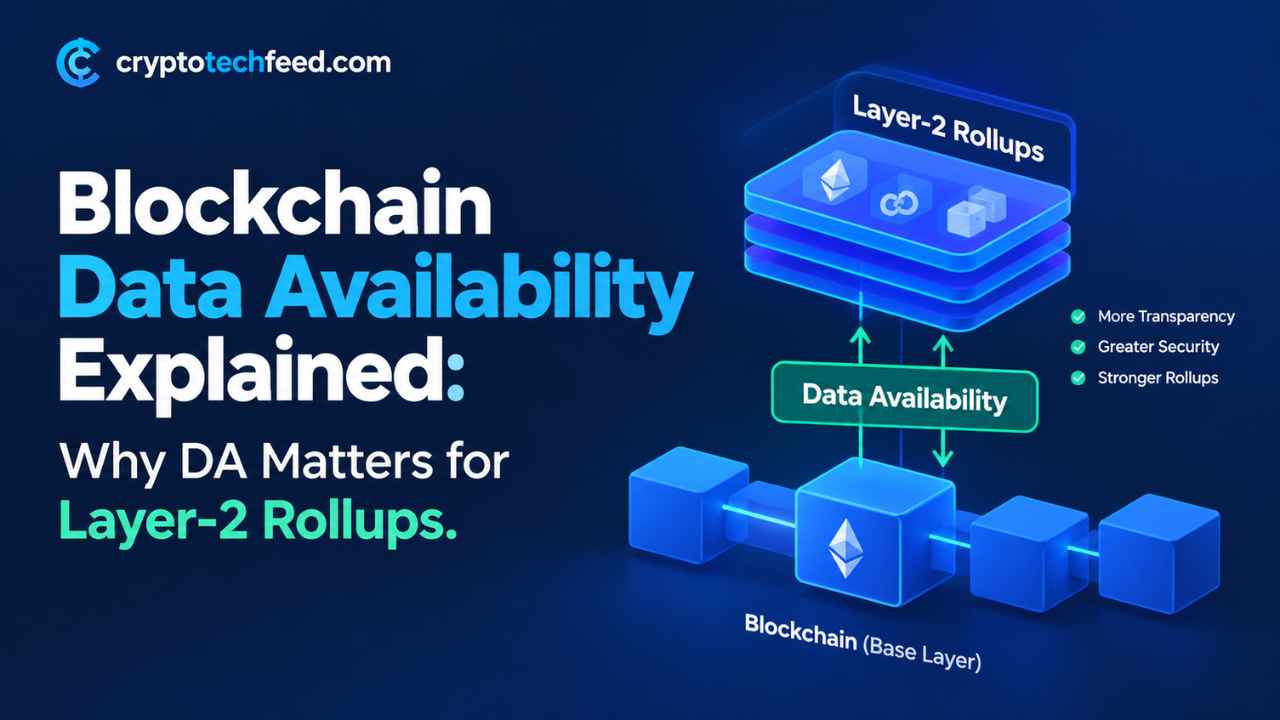
A friend messaged me at 1am last month, half panicking. An L2 he had funds on had gone quiet. Sequencer down, block explorer frozen, and a rumor going around that nobody could reconstruct what had actually happened on chain. His question was simple. If the data is gone, is his money gone too.
That question is basically the entire data availability problem in one sentence. Rollups promise you cheap, fast transactions. But that promise only holds if the data behind every transaction stays available for someone, anyone, to check. Lose the data and you lose the ability to prove anything. This piece breaks down what data availability actually means, how sampling makes it checkable without downloading everything, and how Celestia, EigenDA, and Ethereum blobs compare as the three main ways rollups solve it in 2026.
What Is Blockchain Data Availability
Blockchain data availability is the guarantee that the raw transaction data behind a block has actually been published and can be downloaded by anyone who wants to verify it. It is not the same as data correctness. A block can contain perfectly valid transactions and still be a problem if nobody can access the underlying data to check that validity. Data availability is the plumbing that makes fraud proofs and validity proofs possible at all. Without it, a rollup operator could theoretically post a state update, hide the data behind it, and there would be no way for anyone to challenge whether that update was honest.
Think of it like a restaurant handing you a receipt total without the itemized list. You can see the number, but you can not check whether it is correct. Data availability is the itemized list. It does not tell you the total is right on its own, but it means somebody, somewhere, can add it up and catch a mistake or a lie.
Why DA Matters So Much for Layer 2 Rollups
Rollups like Arbitrum, Optimism, Base, and zkSync execute transactions off Ethereum and only post compressed results back to the main chain. That compression is what makes fees cheap. But cheap only stays safe if the data behind that compressed result is available long enough for the network to verify it.
Optimistic rollups depend on this directly. Their entire security model rests on a challenge window, usually seven days, during which anyone can download the posted data, recompute the result, and file a fraud proof if something does not match. If the data was never actually available, that challenge window is meaningless. Nobody can prove fraud they can not see.
Zero knowledge rollups need it too, just differently. A validity proof confirms the math checks out, but users and exchanges still need the underlying data to reconstruct account balances, build merkle proofs for withdrawals, and let new nodes sync the chain’s true state from scratch.
Data Availability Sampling Explained
This is the part that actually makes modern DA scalable, and it is worth slowing down for. Data availability sampling, or DAS, lets a node verify that data is available without downloading the whole thing. That sounds almost too convenient to be true, so here is the trick behind it.
The data first gets erasure coded, meaning it is mathematically extended with redundancy so the original can be rebuilt from any large enough subset of the pieces, not all of them. Reed Solomon style coding is the common choice. That extended data then gets arranged into a two dimensional matrix and split into columns, each one a small slice of the whole. A node does not need every column. It just grabs a handful at random.
Here is why that works statistically. If even a meaningful chunk of the data was withheld, a random sample would very likely land on a missing piece and the check would fail. Sample enough columns and pass every time, and you have strong probabilistic confidence the entire dataset is genuinely available, even though you personally touched a small slice of it.
Ethereum’s version of this, called PeerDAS, went live with the Fusaka upgrade on December 3, 2025. Under it, each node subscribes to roughly eight column subnets, meaning it downloads about one sixteenth of the extended data, while nodes backing large validator stakes act as full custody supernodes covering all 128 columns and healing gaps for everyone else. The result was roughly an 85 percent cut in the bandwidth a regular node needs to carry, which is what let Ethereum raise its blob target toward 14 per block by early 2026 without turning every home validator into a data center operator.
Proto Danksharding and EIP 4844, Plainly
Before sampling could even be worth building, Ethereum needed somewhere cheap to put rollup data in the first place. That is what EIP 4844 did. Activated with the Dencun upgrade on March 13, 2024, it introduced a new transaction type carrying blobs, roughly 128 KB chunks of data that live in the consensus layer rather than permanent execution storage. Blobs get pruned after about 18 days, which is fine, because rollups only need the data around long enough for proofs to settle, not forever.
Each blob comes with a KZG polynomial commitment, a compact 48 byte cryptographic fingerprint that lets anyone verify a piece of the blob without pulling the whole thing. Smart contracts can read that commitment through the BLOBHASH opcode, but they can not touch the raw blob bytes directly. That separation is deliberate. Keep blobs out of permanent state and the cost stays low.
The name proto danksharding matters because EIP 4844 was always meant as a stepping stone. It shipped the transaction format and fee market first, with full sampling added later through PeerDAS. Fees dropped close to 90 percent the day Dencun activated, and Pectra doubled blob capacity again in May 2025. By early 2026, the combination of a higher blob target and PeerDAS sampling had pushed block utilization down to a comfortable 20 to 30 percent of capacity, a sign the fee market had actually caught up with demand instead of spiraling.
Celestia vs EigenDA vs Ethereum Blobs
This is where rollup teams actually have to make a choice, and the honest answer is that none of the three is objectively best. They trade off cost, throughput, and trust in different directions.
Celestia is a purpose built, sovereign DA blockchain. It uses light client sampling natively, so verification is trustless in the same way Ethereum’s own consensus is. Its January 2026 Matcha upgrade doubled block size to 128 MB while cutting node storage needs by 77 percent, and it now processes roughly 160 gigabytes of rollup data while holding close to half the DA market by usage. Pricing sits around a tenth of a cent per megabyte on the base tier, occasionally cheaper with batching.
EigenDA takes a different bet entirely. Built on EigenLayer’s restaking infrastructure, it is not a public blockchain in the same sense, it functions closer to a data availability committee where economic security comes from staked ETH and EIGEN tokens rather than open sampling by anyone. What it buys in exchange is raw speed. Mainnet throughput has climbed from an initial 10 to 15 MB per second toward 100 MB per second, with MegaETH’s January 2026 stress test using it to sustain 35,000 transactions per second across a seven day run. Cost lands in the low cents per megabyte range at volume.
Ethereum blobs remain the most conservative option. There is no separate trust assumption since the same validator set securing consensus also secures the data. That safety carries a price. Blob costs can spike sharply under demand, at times running well above ten dollars per megabyte during congestion, though PeerDAS and the higher blob targets have pulled typical rollup posting costs down toward twenty to thirty cents per transaction on busy chains.
| Factor | Ethereum Blobs | Celestia | EigenDA |
|---|---|---|---|
| Trust model | Ethereum validator set, most conservative | Sovereign chain, native light client DAS | Restaked ETH and EIGEN, DAC style |
| Typical cost | Variable, spikes under demand | Roughly $0.001 to $0.01 per MB | Low cents per MB at volume |
| Throughput | Rising toward 1 GB per second target | 128 MB blocks post Matcha | 15 to 100 MB per second |
| Best fit | Rollups wanting Ethereum grade settlement trust | Cost sensitive sovereign or app chains | High throughput chains prioritizing speed |
Which DA Layer Should a Rollup Actually Pick
If I am being straight about it, the choice usually comes down to what a team is optimizing for rather than which layer is technically superior. A rollup settling meaningful value that wants to inherit Ethereum’s own security assumptions without a second trust layer will lean toward blobs, even paying more for it during busy periods. A team chasing rock bottom cost per transaction, especially for an app chain or a gaming rollup with huge data volume and lower per user value, tends to land on Celestia. A chain chasing raw throughput above almost everything else, the MegaETH situation, ends up at EigenDA because nothing else currently matches its speed ceiling.
None of this is static either. Blob capacity keeps climbing, Celestia keeps compressing its pricing, and EigenDA keeps scaling toward its stated 100 MB per second and beyond target. The DA layer a rollup picks in 2026 is not necessarily the one it is still using in 2028.
FAQ
What is blockchain data availability in simple terms? It is proof that the data behind a block was actually published so anyone can download it and check the block is honest, separate from whether the transactions themselves are valid.
Why can not a rollup just skip publishing its data? Because fraud proofs and validity proofs both depend on someone being able to access the underlying data. Skip publishing it and there is no way to catch a dishonest state update or let new nodes sync accurately.
Is data availability sampling actually secure? Yes, with the right erasure coding and enough random samples, the probability of missing a withheld data problem drops to a vanishingly small number, which is why Ethereum, Celestia, and Avail all build on some form of it.
Do all Layer 2 rollups need a separate DA layer? Not always. Many still post to Ethereum blobs directly. Others deliberately choose Celestia or EigenDA to cut costs or raise throughput, accepting a different trust tradeoff in return.