
Somewhere around $2.5 billion has walked out the back door of crypto bridges since 2021. Not through some elaborate 51% attack. Not through a market crash. Through code. A missing check here, a leftover permission there, a validator key sitting on a laptop that got phished on a random Tuesday.
If you have ever sat there hovering over the confirm button, moving your ETH to Arbitrum or your USDC to Solana, wondering if the thing you are trusting with your money actually deserves that trust, this one is for you. We are going to break down how bridges work, then walk through three hacks that reshaped how the industry thinks about bridge security, and end with a checklist you can actually use before your next transfer.
What a Cross Chain Bridge Actually Does
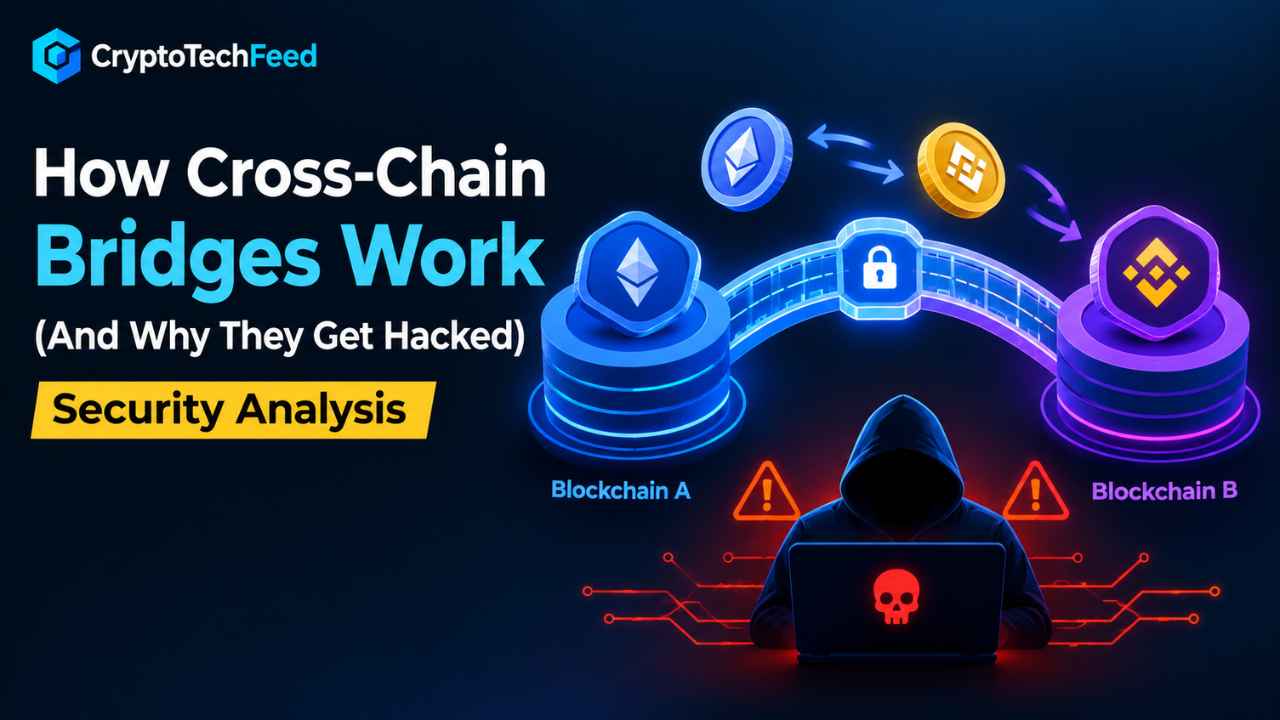
Blockchains do not talk to each other natively. Ethereum has no idea Solana exists. A bridge is the translator sitting in between, and it usually works one of two ways.
The first is lock and mint. You send your ETH to a smart contract on Ethereum, the contract locks it up, and the bridge mints an equivalent token on the destination chain. That new token is called a wrapped token, wrapped ETH or wETH being the classic example. It is not actually Ethereum. It is a receipt, a promise backed one to one by the real ETH sitting locked on the other side. When you bridge back, the wrapped token gets burned and your original ETH gets released.
The second model is burn and mint, common for native multichain assets like USDC, where the original token is destroyed on one chain and freshly minted on the other rather than locked and released.
Here is the part that matters for security. That locked pool of assets, sometimes worth hundreds of millions of dollars, sits in one place. And the wrapped tokens floating around on the destination chain only hold value because the market trusts that the lock is real and permanent. Break that trust, fake that lock, and you can mint wrapped tokens against nothing. That single design choice is the root cause behind almost every major bridge hack you are about to read about.
Why Bridges Are Such an Easy Target
Think about what a bridge actually has to do. It has to watch activity on one chain, verify it happened, then trigger an action on a completely different chain with its own rules, its own validators, its own security model. That handoff point, the moment where trust gets transferred from one system to another, is the weak seam. DeFi protocols that stay on a single chain only have to defend one attack surface. Bridges have to defend two chains and the message passing layer connecting them, and attackers only need to find one crack in any of the three.
Case Study 1: Ronin Bridge, $625 Million, March 2022
Ronin is the sidechain behind Axie Infinity, and its bridge remains the largest hack in crypto history. This is the one people mean when they ask for a ronin bridge exploit breakdown, so let us actually walk through it.
Ronin used a multisignature setup with nine validators, and five signatures were needed to approve any withdrawal. Sky Mavis, the company behind the game, controlled four of those nine. Back in November 2021, when Axie Infinity’s user base exploded and gas fees became unmanageable, Sky Mavis asked the Axie DAO to temporarily let it sign transactions on the DAO’s behalf to help process the load. That access was supposed to be revoked in December 2021. It was not.
Months later, an attacker got into Sky Mavis’s systems through a fake job offer sent to an employee, a targeted phishing attack that delivered spyware. From there they found their way to the gas free RPC node Sky Mavis had set up, and used it to grab the signature for that still active Axie DAO validator. Combine that with the four validators Sky Mavis already controlled, and the attacker had five out of nine signatures. Enough to approve two withdrawals and drain 173,600 ETH and 25.5 million USDC.
Nobody noticed for six days. It only came to light when a user tried to withdraw funds and could not.
The failure here was not cryptography. The keys worked exactly as designed. The failure was operational: a temporary permission that never got cleaned up, a concentration of validator control that made the security threshold far lower than nine signers suggested, and monitoring too thin to catch a nine figure drain for the better part of a week.
Case Study 2: Wormhole, $326 Million, February 2022
Wormhole connects Ethereum and Solana, and its hack happened just a few weeks before Ronin’s. This one lived entirely in the code.
To mint wrapped ETH on Solana, Wormhole’s smart contract needed to verify that a set of guardian signatures had actually approved the mint. That verification relied on a function called load_instruction_at, which was already deprecated by Solana at the time, to confirm that a signature check had genuinely run beforehand. The problem was that this function never actually checked which account was making the call. The attacker created a fake account that mimicked a legitimate one, passed it through the check, and the contract believed a real verification had taken place when nothing of the sort had happened.
That let the attacker mint 120,000 wETH out of thin air, no locked ETH backing it at all, then bridge a large chunk of it over to Ethereum and cash out. Jump Crypto, the firm behind Wormhole, ended up personally replenishing the entire 120,000 ETH within a day to keep the wrapped token backed and the protocol solvent, an extraordinarily expensive save that most projects could never afford to make.
The lesson from Wormhole is blunt. One overlooked deprecated function, one missing account check, and the entire trust model collapses. Bridge contracts are handling the exact logic that decides whether hundreds of millions of dollars in wrapped assets are actually backed. There is no room for a shortcut in that code path.
Case Study 3: Nomad, $190 Million, August 2022
Nomad’s hack is the strangest of the three, because for a few hours it stopped being a hack and turned into a free for all.
During a routine contract upgrade, Nomad’s team initialized a value called the trusted root as zero. That root is what the bridge checks every incoming message against to confirm it is legitimate. Setting it to zero was meant to be a harmless default. Instead it had the side effect of making every single message automatically pass verification, whether or not it had ever actually been proven.
Once someone figured this out, exploiting it required no real technical skill. You just needed to find a transaction that had successfully withdrawn funds, copy its calldata, swap in your own wallet address, and rebroadcast it. Paradigm researcher samczsun called it one of the most chaotic hacks Web3 has seen, and the numbers back that up. Nearly a thousand transactions from hundreds of different wallets drained the bridge from $190 million down to under $2,000 in a matter of hours. Some of the people who grabbed funds turned out to be white hats and returned over $36 million afterward, which is the one small mercy in this story.
The takeaway is that a single misconfigured default value, something that would normally get caught by a routine audit, took down an entire protocol faster than the team could even understand what was happening.
What These Three Hacks Actually Have in Common
Strip away the individual details and a pattern shows up fast. Ronin failed because of centralized validator control and an access permission nobody remembered to revoke. Wormhole failed because of a single unchecked function in signature verification. Nomad failed because of a misconfigured initialization value that nobody caught before deployment. Three completely different root causes, same outcome: the mechanism that was supposed to prove a lock or a message was legitimate turned out to be forgeable.
None of these were sophisticated flash loan attacks or economic exploits. They were fundamental breaks in trust verification, the exact layer that wrapped tokens depend on to hold their value. That is the real lesson buried under all three case studies. Bridge security is not really about smart contract complexity. It is about how rigorously a protocol verifies that the thing on one side of the bridge genuinely matches what it is minting on the other.
Security Checklist: How to Vet a Bridge Before You Use It
You cannot audit the code yourself, but you can look for signals that separate the safest crypto bridges from the ones quietly waiting for their turn.
Check validator decentralization first. A bridge secured by five or six validators controlled by one team is not meaningfully different from a centralized custodian. Look for a wide, independent validator set with a real quorum requirement.
Check audit history and whether it is recent. A single audit from two years ago on a contract that has since been upgraded multiple times tells you almost nothing about current risk.
Check total value locked relative to insurance or reserve funds. A bridge holding $500 million with no backstop is a much juicier target than one with reserves or an insurance protocol layered on top.
Check how long the bridge has operated without an incident, and read the postmortem if it has had one. A team that publishes a detailed, honest breakdown after a hack and ships concrete fixes is a very different signal than one that goes quiet.
Prefer bridges built on newer trust models. Shared security frameworks and native chain messaging protocols that avoid a single locked pool of funds are structurally harder to drain than a classic multisig lock and mint bridge.
And for any amount that actually matters to you, split transfers rather than moving everything through one bridge in one shot. It will not stop a determined attacker, but it limits what a single point of failure can cost you.
FAQ
What is a wrapped token in simple terms? A wrapped token is a stand in for an asset from another blockchain, backed one to one by the real asset locked in a bridge contract. Wrapped ETH on Solana represents real ETH sitting locked on Ethereum.
Why do bridges get hacked more than other DeFi protocols? Because they have to manage trust across two separate chains and the message passing layer between them, giving attackers more surface area than a single chain protocol.
Was any of the stolen bridge money ever recovered? Some, unevenly. Wormhole was fully replenished by its backer Jump Crypto. Nomad recovered over $36 million from white hat participants. Ronin’s funds have mostly never been recovered.
Are cross chain bridges safe to use in 2026? Safer than 2022, since several protocols have moved to wider validator sets and shared security models, but no bridge is risk free. Vetting the specific bridge before every large transfer still matters.




