Picture this. You buy a small box, plug it into your router, and it starts earning you crypto every day just for sitting there and sharing your internet connection with strangers. Sounds like a scam, right. Except it isn’t. It’s a hotspot on the Helium network, and it’s one of thousands of real devices doing real work for a sector called DePIN.
DePIN stands for Decentralized Physical Infrastructure Networks. And honestly, it’s one of the few corners of crypto where the token isn’t just sitting there waiting for someone to hype it up. It’s paying for actual GPUs to render actual video, actual hard drives to store actual files, and actual radios to carry actual phone calls. That’s the pitch anyway. Let’s dig into whether it holds up.
What Is DePIN in Crypto
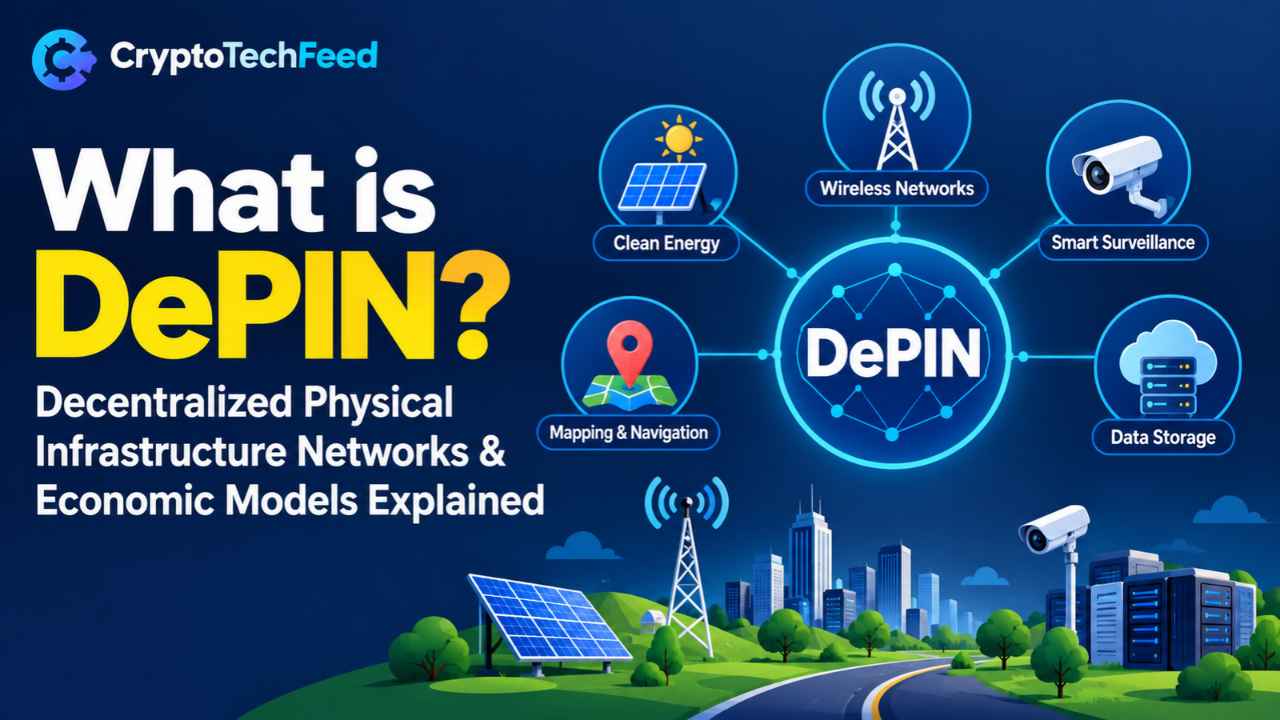
DePIN uses token incentives to get regular people to build and operate physical infrastructure, instead of a single company footing the entire bill. Think wireless coverage, GPU compute, data storage, mapping, energy grids, even weather sensors. A network needs hardware in the real world. Instead of raising billions and buying it all itself, it pays anyone with a spare GPU, a spare hard drive, or a spare rooftop to plug in and contribute.
The term was coined by Messari analyst Sami Kassab back in 2023, though the idea is older. Helium was doing this in 2019 before anyone had a catchy acronym for it. The pitch is simple even if the execution rarely is. Centralized infrastructure is expensive to build and slow to scale because one company has to own every server and every tower. Decentralized infrastructure spreads that capital cost across thousands of independent operators who each just care about their own hardware and their own rewards.
How the DePIN Flywheel Actually Works
Here’s the mechanism, stripped of the jargon. A protocol launches with a token and a reward schedule. Early contributors deploy hardware, mostly betting on future token value since there’s barely any real usage yet. As coverage or capacity grows, actual customers show up and start paying for the service in fiat or stablecoins, which typically gets converted into the native token. That demand supports the token price, which makes contributing hardware more attractive, which pulls in more contributors, which grows the network further.
It’s a nice story when it works. The catch, and DePIN people will tell you this themselves if you push a little, is that most networks get stuck in step one. Plenty of projects have impressive hardware numbers and basically no paying customers. That’s the gap between “660 devices deployed” and “somebody actually needs this.”
The projects that made it past that gap are the ones worth studying closely, because they tell you what real demand for decentralized infrastructure actually looks like.
DePIN Economic Models: How the Tokens Actually Work
This is the part most explainers skip, and it’s honestly the most interesting bit. A DePIN token isn’t just a reward for showing up. It has to solve a genuinely hard economic problem: how do you price a service in a token whose price swings 20% in a week, without either the buyer or the seller getting wrecked.
Burn and Mint Equilibrium (BME)
This is the dominant model in the sector, first floated by Factom back in 2016 and popularized by Helium. Here’s how it plays out. Users don’t pay for network services directly with the volatile token. Instead they burn the native token to create a stable, fiat-pegged credit, and that credit is what actually pays for data transfer, storage, or compute. Helium burns HNT to mint Data Credits at a fixed rate of $0.00001 per credit, so a gigabyte of data always costs roughly the same in dollar terms no matter what HNT is doing on the charts that day.
On the other side, the protocol mints new tokens on a fixed emission schedule to pay contributors for their hardware and uptime. When network usage grows faster than emissions, more tokens get burned than minted, and the supply actually contracts. That’s the equilibrium part. Render switched to this exact model for its RENDER token, and Helium’s Q3 2025 numbers showed Data Credit burns jumping close to 200% quarter over quarter, which is the kind of signal that gets tokenomics nerds genuinely excited.
Work Token Model
The other common approach is simpler but less elegant. Contributors have to stake a certain amount of the native token just to be eligible to provide a service on the network, sort of like putting down a security deposit to get a job. Akash leans on a version of this with AKT, where providers and validators stake tokens to participate in the compute marketplace. The idea is that skin in the game keeps bad actors out and ties token demand directly to how many people want to provide infrastructure, not just how many people want to speculate on the price.
Neither model is perfect. BME can struggle if speculators dominate trading volume and drown out the actual usage signal. Work token models can lock up huge portions of supply without generating any real revenue if adoption stalls. Whichever model a project uses, the question you want answered is boring but essential: is real money changing hands for a real service, or is the token just going in circles between contributors and speculators.
Top DePIN Projects in 2026
The sector’s combined market cap has bounced around the $9 billion to $20 billion range through 2026 depending on which tracker you check and how broadly they define the category, with CoinMarketCap tracking well over 260 DePIN tokens. Here’s who actually matters right now, broken down by what they decentralize.
| Project | Category | What It Does |
|---|---|---|
| Helium (HNT) | Wireless | Decentralized 5G offload and IoT coverage via community hotspots |
| Render (RENDER) | GPU Compute | Distributed GPU rendering and AI inference marketplace |
| Akash (AKT) | Decentralized Compute Networks | Permissionless cloud for CPUs, GPUs and containers, priced well below AWS |
| Filecoin (FIL) | Storage | Decentralized data storage with cryptographic proof of retrievability |
| io.net | GPU Compute | Aggregates idle GPU clusters for AI training and inference |
| Bittensor (TAO) | AI/Compute | Incentivized subnet marketplace for machine learning models |
| Hivemapper | Mapping | Crowdsourced street-level mapping via dashcams |
| IoTeX (IOTX) | IoT Sensors | Infrastructure connecting real-world sensors and devices to blockchain |
Helium: The Network That Started It All
Helium is still the poster child, and it’s earned that spot. By 2026 the network was routing millions of phone connections daily for major mobile carriers doing Wi-Fi offload in dense cities, with subscriber counts that grew from a few hundred thousand to well past the half-million mark in about a year. Every gigabyte carried through a Helium hotspot burns HNT for Data Credits, which is about as direct a link between usage and tokenomics as you’ll find anywhere in crypto.
Render: Rendering Meets the AI Boom
Render started as a way to get idle GPUs rendering 3D graphics and animation faster and cheaper than centralized render farms. Then AI happened, and suddenly every spare GPU on the network became valuable for inference and training workloads too. That pivot is a big reason RENDER’s market cap sits comfortably among the sector’s largest, and it’s a decent case study in how DePIN projects that decentralize compute networks are riding the same AI wave that’s lifting everything else in tech right now.
Akash: The Anti-AWS
Akash is the one to know if you care about decentralized compute networks specifically. It’s a permissionless marketplace where anyone with spare CPU, GPU, RAM or disk can list capacity, and buyers spin up workloads using the same Docker and Kubernetes tooling they’d already use on a centralized cloud. Prices on Akash typically run 60 to 80% below equivalent AWS instances, which is a genuinely compelling pitch for anyone training AI models on a budget, and usage has climbed noticeably as more AI workloads have found their way onto the network.
DePIN Categories Beyond Wireless and Compute
It’s not just Helium, Render and Akash. Filecoin has quietly become one of the largest storage networks in crypto, holding more paid enterprise data than most people realize, with customers ranging from research archives to genomics labs. Hivemapper pays drivers to mount a dashcam and map streets that Google Maps hasn’t bothered updating in years. IoTeX focuses on connecting physical sensors, everything from air quality monitors to smart locks, to on-chain verification. Energy DePIN projects are earlier stage but growing, aiming to decentralize things like EV charging networks and residential solar sharing.
The common thread across all of them is the same flywheel: pay people for hardware first, attract paying customers second, let real usage take over from token incentives over time.
Risks and Challenges Facing DePIN
DePIN sounds great on a pitch deck, but a few problems keep showing up across the sector. Hardware gaming is a real issue, where operators fake location data or usage stats to farm rewards without providing genuine coverage. Token price volatility can wreck a network’s economics fast, since contributors deploying expensive hardware need some confidence the rewards will still be worth something in a year. And plenty of networks still generate far more in token emissions than they do in actual customer revenue, which is the DePIN version of a company burning venture capital with no path to profit.
The projects worth paying attention to are the ones publishing real revenue numbers, not just device counts. Sector-wide on-chain revenue from paying customers crossed roughly $150 million in a single month earlier in 2026 according to industry trackers, which is real progress. It’s still a small fraction of the total addressable market, but it’s the number that actually matters more than device counts or subscriber totals.
Frequently Asked Questions
What is DePIN crypto in simple terms? DePIN crypto refers to blockchain projects that pay everyday people in tokens for contributing physical hardware, like GPUs, storage drives, or wireless hotspots, to build real-world infrastructure networks.
Is DePIN the same as decentralized compute networks? Decentralized compute is one category within the broader DePIN sector. Projects like Akash, Render and io.net fall under decentralized compute, while Helium covers wireless and Filecoin covers storage.
What is the difference between Helium, Render and Akash? Helium decentralizes wireless connectivity through community-run hotspots. Render decentralizes GPU rendering and AI compute. Akash decentralizes general-purpose cloud compute, competing directly with providers like AWS on price.
How do DePIN tokens make money for holders? Most DePIN tokens rely on either a burn and mint equilibrium model, where usage burns tokens and creates deflationary pressure, or a work token model, where contributors stake tokens to participate and earn rewards for verified hardware contribution.
Is DePIN a good investment in 2026? DePIN tokens carry the same volatility and regulatory uncertainty as the rest of crypto, plus execution risk specific to physical hardware deployment. This is not financial advice. Anyone considering DePIN tokens should research a project’s actual paying customer revenue, not just its device count, before investing.