
A friend sent me an old transaction receipt a few weeks back. January 2024, a simple swap on an Optimistic rollup, and the gas cost more than the swap itself. He wasn’t complaining exactly. He was just confused. He’d made the same kind of trade last month and paid a fraction of a cent.
Same chain family. Same type of transaction. Completely different world.
That gap has a name. EIP 4844. Most people know it as proto danksharding, and it’s the single biggest reason layer 2 gas fees stopped being a punchline. This piece breaks down what it actually does, how the blob fee market works, and where Ethereum’s scaling roadmap goes from here.
What Is EIP 4844 (Proto Danksharding), Exactly?
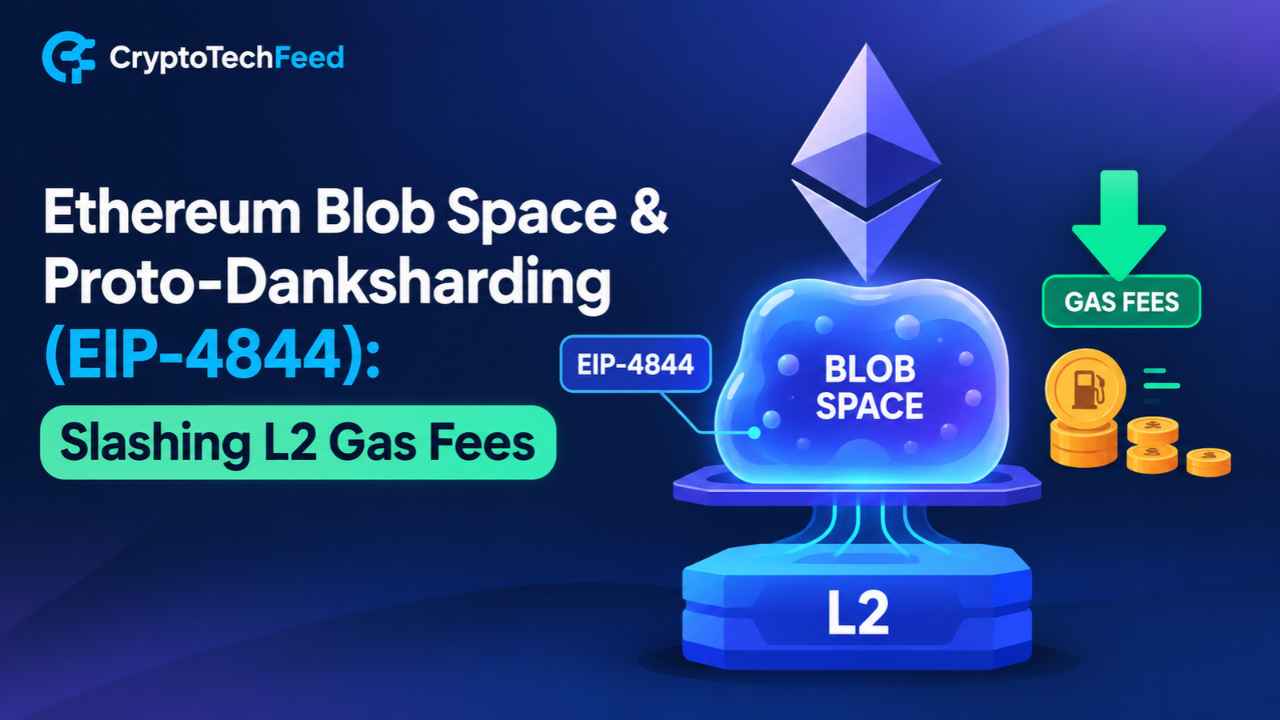
In one line: EIP 4844 gave Ethereum a cheap, temporary storage lane called blob space, built specifically for rollups to post their data without competing for the same gas as everything else on the network.
It went live on March 13, 2024, as part of the Dencun upgrade. Before that date, rollups posted their transaction data as calldata, sitting inside regular Ethereum blocks forever, paid for at full mainnet gas prices. After Dencun, that same data moved into blobs. Same security guarantee. A tenth of the cost, sometimes less. The name comes from Danksharding, the long term scaling design proposed by researcher Dankrad Feist, and proto because this is the first working piece of it, not the whole thing.
The Problem Blobs Were Built to Fix
Here’s the thing nobody explains well. Rollups like Arbitrum and Optimism don’t just process transactions off chain and call it a day. They still have to post proof of that data back to Ethereum mainnet. That’s what makes them secure. Anyone can verify what happened.
blockchain data availability explained (why DA matters for layer 2 rollups)
Before 2024, that posting happened through calldata, a permanent storage field inside Ethereum blocks. Permanent meant expensive, because every full node stores calldata forever. Rollups were paying mainnet execution gas prices for data that only needed to stick around for a couple weeks. It was like renting a bank vault to store your grocery list.
By late 2023, L2 networks were spending over 15,000 ETH a month, worth tens of millions of dollars, just writing data back to Ethereum. That cost got passed straight to users. A five dollar NFT mint could carry a two dollar gas fee. People noticed.
How Blob Transactions Actually Work
Blobs solve this by being deliberately temporary. Think of them as a separate lane next to the highway, built for cargo that doesn’t need to be there forever.
A few mechanics worth knowing:
- Each blob holds about 128 KB of data, attached to a special type 3 transaction.
- Blobs are not stored in the regular execution layer. Consensus clients handle them separately.
- Validators only need to keep blobs around for roughly 18 days, then they get pruned automatically.
- A cryptographic commitment to the blob’s contents stays on chain forever, so anyone can still verify the data was correct even after it’s gone.
- Rollups download the blob while it’s live, reconstruct their state, and move on.
That pruning window is the whole trick. Eighteen days is plenty long enough for every honest participant, from rollup operators to fraud provers to average users checking a receipt, to grab the data they need. After that, the network just doesn’t bother storing it. Cheaper data, same trust.
Ethereum Blob Transaction Fees: How the Market Actually Prices Them
This is where it gets genuinely clever, and it’s the part most explainers skip. EIP 4844 didn’t just make blob space cheap. It gave blob space its own entirely separate fee market, running in parallel to the normal gas market.
what is a modular blockchain, execution settlement and data availability explained
Before Dencun, every transaction competed for the same pool of gas, whether it was a token swap, an NFT mint, or a rollup posting a data batch. A busy afternoon of DeFi trading could spike fees for everyone, rollups included. That coupling was a real problem. Layer 2 users were getting hit by layer 1 congestion they had nothing to do with.
Now blob gas and execution gas are priced independently, using an EIP 1559 style formula for each. A few things worth knowing about how that pricing behaves:
- Each block has a target number of blobs and a hard maximum.
- If blocks consistently carry more blobs than the target, the blob base fee rises.
- If demand drops below target, the fee falls back toward its floor of one wei, which is close to free.
- Blob fees get burned, same as regular base fees under EIP 1559, adding a small deflationary pressure to ETH supply.
For most of 2024, blob demand actually sat below target, so blob fees floated near that floor almost the entire time. Rollups were posting data for pennies.
Before vs After: What Actually Changed for L2 Users
Numbers make this land better than description does.
| Metric | Before Dencun (early 2024) | After Dencun and Fusaka (2026) |
|---|---|---|
| Typical L2 transaction fee | $0.50 to $3.00 | $0.005 to $0.02 |
| L2 data posting cost | Full mainnet calldata gas | Blob gas, often near the 1 wei floor |
| Blob target per block | Not applicable | 14, after the Fusaka era BPO upgrades |
| Blob capacity per block | Not applicable | Roughly 2.7 MB, up from 768 KB at launch |
| Fee coupling to L1 activity | Direct, rollups paid mainnet congestion prices | Decoupled, separate blob fee market |
Rollups with the highest transaction volume, Base and Arbitrum among them, captured the biggest absolute savings simply because they were posting the most data. But even smaller rollups benefited, since blob pricing scales with total network demand rather than any single chain’s traffic.
Layer 2 Data Availability: Why This Matters Beyond Fees
Cheaper transactions get the headlines. The real story is about data availability, and it’s worth slowing down on.
A rollup’s entire security model rests on one guarantee: the data behind every transaction has to actually be available for someone to check. If a rollup operator could post a batch and then hide the underlying data, users would have no way to verify their balances were correct, or to challenge a fraudulent state if something went wrong.
Calldata solved this by brute force. Store everything, forever, on every full node. Blobs solve it more efficiently. Store everything for exactly as long as anyone plausibly needs it, then let it go. Layer 2 data availability didn’t get weaker under EIP 4844. It got cheaper without getting weaker, which is the actual engineering achievement here. Full Danksharding, still ahead, pushes this further using data availability sampling, where nodes verify blobs are available without downloading every byte themselves.
The Danksharding Roadmap: From Proto to Full
EIP 4844 was always framed as step one, not the destination. Here’s how the path has actually unfolded, and where it’s headed.
- Dencun, March 2024: Proto danksharding ships. Blob target starts at 3 per block, max 6.
- Pectra, 2025: Blob capacity doubles. Target rises to 6, max to 9.
- Fusaka, December 2025: PeerDAS arrives via EIP 7594, letting nodes verify data availability by sampling instead of downloading full blobs. This is the piece that makes scaling blob count further actually safe for decentralization.
- BPO1, mid December 2025: Target rises to 10, max 15, using a lighter weight upgrade mechanism called Blob Parameter Only forks that don’t require a full network hard fork.
- BPO2, January 2026: Target hits 14, max 21. Per block blob capacity crosses roughly 2.7 MB, up from 768 KB at Fusaka’s start.
- Glamsterdam, planned late 2026: Further blob scaling alongside layer 1 execution improvements, with core developers eyeing a long term target as high as 128 blobs per block.
That last number is the one to watch. At 128 blobs per block, Ethereum’s data availability capacity starts rivaling dedicated data availability layers built outside the base chain. Full Danksharding is the point where this scaling stops needing new hard forks altogether and blob capacity can grow on something closer to a rolling schedule.
What This Actually Means If You Build or Use L2s
For builders, cheap and predictable blob costs change what’s economically viable. Microtransactions, on chain gaming, social apps with high transaction counts. None of that penciled out when every interaction carried a dollar plus gas fee. Now it does.
For everyday users, the honest answer is you don’t need to think about blobs at all. You just notice your Arbitrum or Base transaction costs less than a cent instead of a few dollars. That’s the point. The best infrastructure upgrades are the ones nobody has to think about while using them.
A few practical takeaways worth remembering:
- Blob fees are separate from your wallet’s regular gas fee display, but they’re baked into what your L2 charges you indirectly.
- If you’re checking why an L2 transaction suddenly cost more, blob demand spiking network wide is a more likely culprit than anything specific to that chain.
- Rollups with higher transaction volume generally pass on the biggest fee savings, since they’re spreading blob costs across more users.
FAQ
What is EIP 4844 in simple terms? It’s the Ethereum upgrade that created a cheap, temporary data storage type called blobs, so layer 2 rollups can post their transaction data without paying full mainnet gas prices.
Is proto danksharding the same as full danksharding? No. Proto danksharding, shipped through EIP 4844, is the first phase. Full danksharding adds data availability sampling at much larger blob capacity, letting the network scale further without every node downloading every byte.
Why did ethereum blob transaction fees drop so much after Dencun? Blobs moved rollup data out of expensive, permanently stored calldata into a temporary storage lane that gets pruned after about 18 days, priced through its own separate fee market instead of competing with regular Ethereum gas.
How long do blobs stay on Ethereum? Roughly 18 days, or 4096 epochs. After that they’re pruned from consensus clients, though a cryptographic commitment proving the data was correct stays on chain permanently.
What’s next on the danksharding roadmap? Glamsterdam, expected late 2026, continues scaling blob capacity toward a long term target of 128 blobs per block, moving Ethereum closer to full danksharding.