
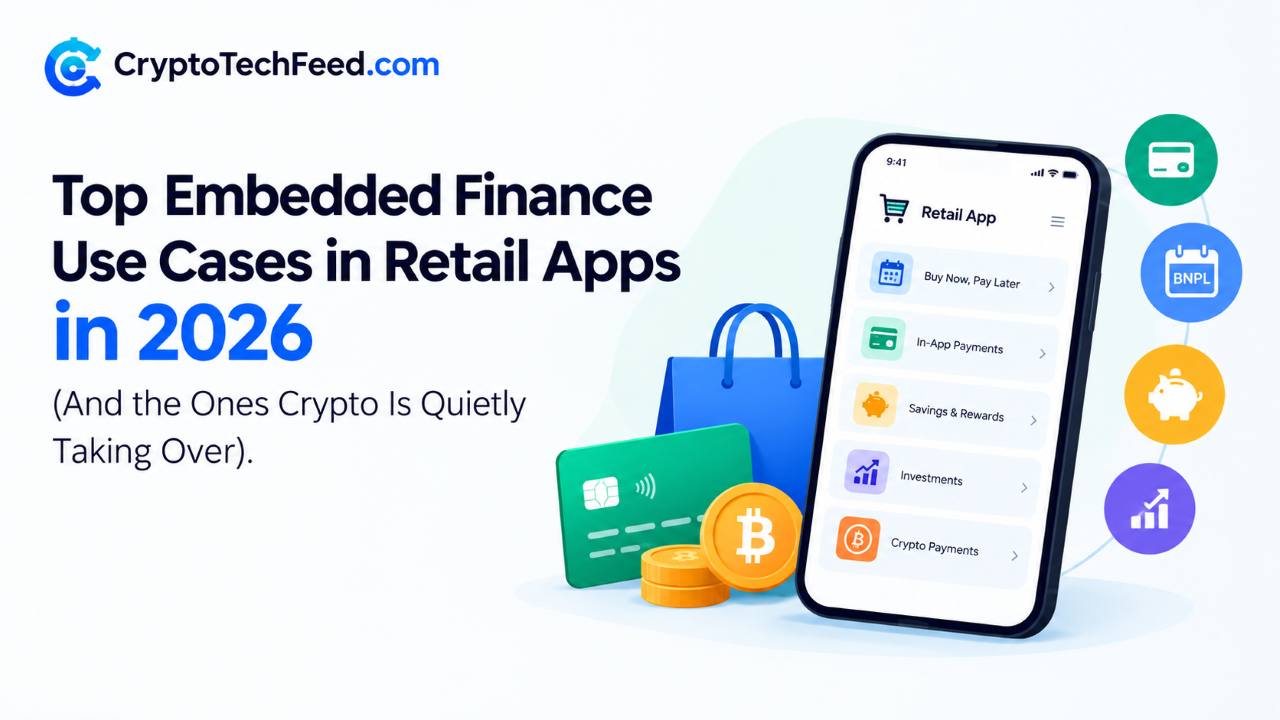
A friend who runs operations at a mid sized skincare brand sent me a screenshot last month. It was not a sales chart. It was her Shopify settings page, with a new toggle sitting right next to Visa and Mastercard: pay with USDC. No separate crypto app. No new vendor onboarding. Just a line item in the same checkout she has used for five years. That one toggle tells you more about where embedded finance is headed in retail than any market research deck does.
Embedded finance stopped being a buzzword a while back. It is now the quiet infrastructure layer sitting inside the apps people already use to shop, and in 2026 a meaningful share of that layer runs on crypto rails, not just bank partnerships. This piece breaks down the use cases that are actually generating volume right now, not the ones still stuck in a pitch deck.
What Embedded Finance Actually Means for Retail Apps Right Now
Embedded finance is simply financial services delivered inside a non financial app, so the retailer becomes the front end for lending, payments, insurance or wallets without the customer ever visiting a bank’s website. Mordor Intelligence puts the global embedded finance market at roughly 156 billion dollars in 2026, climbing to an estimated 454 billion dollars by 2031, a 23.84 percent annual growth rate, with retail and e commerce named as the single largest segment driving that number. Juniper Research’s earlier forecasts flagged buy now pay later as the category that would carry more than half of total embedded finance revenue. That forecast held up, but it is no longer the whole story.
Why Crypto Suddenly Has a Seat at This Table
Three years ago, crypto in retail meant a handful of niche merchants accepting Bitcoin as a gimmick. That framing is outdated. Stablecoins changed the economics. A card transaction carries interchange costs in the low single digits, while settling the same transaction in a stablecoin like USDC can cost a fraction of that, and it settles in minutes instead of days. Shopify integrated USDC directly into its core payments stack in March 2026, built with Stripe and Coinbase, letting merchants accept digital dollars right alongside cards with zero new vendor relationships. Checkout.com followed two months later for more than a thousand enterprise merchants. That is not a crypto experiment anymore. That is payments infrastructure quietly getting rebuilt underneath retail apps that never mention the word blockchain to their customers.
The Top Embedded Finance Use Cases in Retail Apps
1. Stablecoin Checkout and Settlement
This is the use case with the most real volume behind it today. Retail apps are embedding stablecoin acceptance directly into existing checkout flows rather than bolting on a separate crypto payment page, which is exactly what made the Shopify and Checkout.com integrations notable. The appeal for merchants is straightforward economics plus speed, especially for cross border sellers dealing with high card decline rates. The appeal for shoppers is less obvious today since most are still card loyal, but the merchant side incentive is strong enough to pull this forward on its own.
What retailers are gaining from stablecoin checkout right now:
- Settlement in minutes instead of the typical two to three day card cycle
- Materially lower processing costs on cross border and high value transactions
- Fewer failed payments from international customers whose cards get declined by fraud filters
- A direct payout option in either fiat or on chain stablecoins, chosen by the merchant
2. Embedded Crypto Wallets Inside the Shopping App Itself
Instead of asking a customer to install MetaMask or manage a seed phrase, retail apps are now spinning up a self custodied wallet automatically the moment someone logs in with an email or Google account. Coinbase’s embedded wallet infrastructure, now generally available, is built for exactly this, abstracting away the crypto complexity so a loyalty program, a marketplace or a gaming app can issue, hold and let users spend on chain assets without the user ever feeling like they left the retail app. This matters because wallet friction has been the single biggest reason mainstream shoppers never touched crypto rewards before.
3. Tokenized Loyalty Points That Customers Actually Own
Traditional loyalty points live and die inside one retailer’s database, non transferable, often worthless the moment a program shuts down. Tokenized loyalty flips that, issuing rewards as programmable on chain tokens a customer can hold in their embedded wallet, trade, gift, or redeem across a partner network instead of a single storefront. Retailers choosing low cost chains like Polygon or Avalanche for high frequency reward issuance are seeing this as a genuine retention lever, not a gimmick, because portability and ownership are the two things static points programs never offered.
Where tokenized loyalty is gaining traction fastest:
- Multi brand retail groups that want shared reward currency across subsidiaries
- Direct to consumer brands competing for Gen Z attention with gamified ownership
- Marketplaces where third party sellers want a shared incentive layer
4. Crypto Enabled Buy Now Pay Later and Embedded Lending
Buy now pay later is still the single largest revenue segment inside embedded finance, and crypto is starting to feed into it from two directions. Some lenders are using stablecoin liquidity pools to fund short term installment credit faster than traditional warehouse financing allows, cutting the capital cost that gets passed on to merchants. Others are letting shoppers collateralize crypto holdings to access point of sale credit without liquidating their positions. Neither approach has mainstream scale yet, but both solve a real cost of capital problem that traditional BNPL providers are increasingly exposed to as funding costs rise.
5. Embedded Insurance at the Point of Sale
Embedded insurance premiums are projected to climb past 10 billion dollars globally in 2026, more than double their 2021 level, driven by high value e commerce purchases bundling protection into checkout. The crypto angle here is newer and smaller, mostly parametric coverage for digital assets, NFTs, or crypto denominated purchases, settled automatically on chain when a triggering condition is verified rather than through a manual claims process. It is a narrower use case than stablecoin checkout, but it is the one most likely to expand as more retail transaction value itself becomes on chain.
6. Cross Border Payments and Remittance Rails Built Into the App
For retailers selling internationally, embedded finance increasingly means routing payouts and supplier payments through stablecoin rails instead of SWIFT. The cost gap is significant. The World Bank’s Remittance Prices Worldwide report put the global average remittance fee at 6.36 percent, while stablecoin corridors for routes like US to Philippines or UAE to India routinely settle for a fraction of that cost. Retail apps with global supply chains or marketplace sellers in emerging markets are embedding this quietly on the back end, invisible to the shopper but material to the merchant’s margin.
How the Use Cases Compare
| Use Case | Primary Benefit | Maturity in 2026 | Best Fit For |
|---|---|---|---|
| Stablecoin checkout | Lower fees, faster settlement | Early mainstream | Cross border and high AOV retailers |
| Embedded crypto wallets | Zero friction onboarding | Growing fast | Loyalty, gaming, marketplace apps |
| Tokenized loyalty | Portable, ownable rewards | Early adopter stage | DTC brands, multi brand groups |
| Crypto enabled BNPL | Cheaper capital, asset backed credit | Pilot stage | Lenders and larger merchants |
| Embedded insurance (crypto) | Automated, parametric claims | Niche | Digital asset and NFT purchases |
| Stablecoin cross border rails | Cut remittance and FX cost | Scaling quietly | Global sellers, marketplaces |
What Retailers Should Actually Weigh Before Adopting Any of This
None of these use cases are free lunches, and treating them that way is how retail finance teams end up with a feature nobody asked for sitting unused in the app.
- Regulatory exposure still varies sharply by jurisdiction, and stablecoin revenue is taxable at time of receipt in most markets including the US
- A buyer without a funded crypto wallet simply cannot complete a stablecoin checkout, so this only replaces card volume at the margin for now
- Crypto settlements are irreversible, which removes the chargeback safety net merchants are used to leaning on
- Tokenized loyalty programs that launch without clear utility tend to see the same low engagement that killed the points programs they replaced
The merchants getting real value out of this are the ones solving a specific cost or friction problem, cross border fees, slow settlement, disposable loyalty points, not the ones adding crypto because it sounds forward looking on an investor call.
Where This Is Heading Next
Merchant stablecoin acceptance sits at roughly 6 percent in the US today, but the infrastructure for a much faster breakout is already live across Stripe, Shopify and Circle’s payment network. Analysts tracking this space expect at least one major US retailer to formally announce stablecoin checkout before the next holiday shopping season, which would do more to normalize the category than any whitepaper. The pattern to watch is not whether crypto shows up in retail apps. It already has. The pattern to watch is whether it stays invisible, a cheaper settlement rail working quietly underneath a checkout button that still just says pay, which is exactly how infrastructure usually wins.
FAQ: Embedded Finance Use Cases in Retail Apps
What is embedded finance in a retail app? It is any financial service, payments, lending, insurance or a wallet, built directly into a retail app’s existing experience, so the customer never has to leave the app or visit a separate financial provider to use it.
Is stablecoin checkout the same as accepting Bitcoin? No. Bitcoin payments expose merchants to price volatility between the sale and settlement. Stablecoins like USDC are pegged to the US dollar, so merchants get the speed and cost benefits of crypto rails without the price risk.
Do shoppers need a crypto wallet to use these features? For stablecoin checkout, yes, unless the retailer offers a fiat to stablecoin conversion option at the point of payment. For embedded wallet features like tokenized loyalty, no, the wallet is created automatically in the background using a normal email or social login.
Is crypto embedded finance regulated the same way as traditional embedded finance? Largely yes at the consumer protection level, but stablecoin specific rules, tax treatment and licensing requirements are still evolving by jurisdiction, which is why most retailers are piloting this through established payment partners rather than building it in house.
Which embedded finance use case is growing fastest in retail right now? Stablecoin checkout and settlement, driven by major platform integrations from Shopify, Stripe and Checkout.com through 2026, has the clearest merchant side economics and the fastest real world adoption curve of the group.




