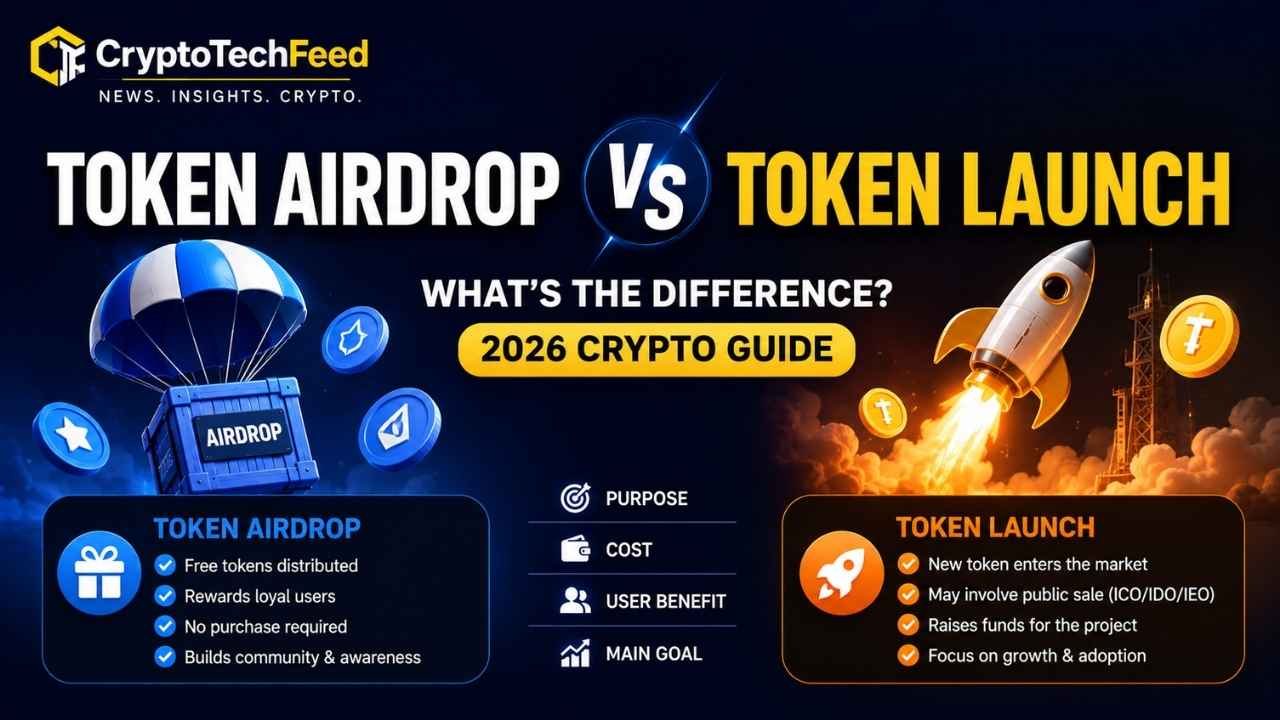
Your phone buzzes twice in the same week. First notification: a project you interacted with months ago just dropped tokens into your wallet, no purchase needed, nothing to sign. Second notification: that same project is now selling tokens through a public sale, and you need to connect your wallet, pick an amount, and pay.
Same project. Same token. Two completely different events. And if you don’t know which one you’re looking at, you can end up either missing free money or handing your wallet to a scammer who copied the second event down to the pixel.
That confusion is exactly why “token airdrop vs token launch” keeps showing up in search bars every week. People assume they’re roughly the same thing wearing different names. They’re not. One is a gift. The other is a sale. And once you understand what separates them, you’ll also understand why so much of 2026’s crypto crime happens in that exact gap.
Full Coverage on Token Launch at CryptoTechFeed.
What Is a Token Airdrop?
A token airdrop is a free distribution of tokens, usually sent directly to wallets that meet some eligibility criteria the project decided on beforehand. You don’t pay for the tokens. You don’t sign a purchase transaction. In most cases, the tokens just appear, or you claim them through a simple interface that checks whether your wallet qualifies.
Eligibility usually comes down to something you already did. Maybe you swapped tokens on a decentralized exchange before a certain date. Maybe you held a specific NFT. Maybe you bridged funds through a protocol during its early months, back when almost nobody was paying attention. Uniswap’s September 2020 airdrop is still the textbook example. Anyone who had used the protocol before the snapshot received 400 UNI, worth roughly $1,200 at the time and well over $17,000 at UNI’s later peak, simply for having shown up early.
Airdrops exist because projects want two things at once: decentralize ownership and reward the people who took a chance on something unproven. Give away enough tokens to enough real users and you build a community with skin in the game, not just a market of speculators.
What Is a Token Launch?
A token launch is the moment a project’s token becomes available to buy and trade, whether through a public sale, an initial coin offering, or a straight listing on an exchange. Unlike an airdrop, you’re putting money in. You’re choosing to buy at whatever price or terms the launch sets, and you’re taking on the risk that comes with any new asset entering the market for the first time.
Launches can take a few different shapes. A direct exchange listing just opens trading and lets the market set the price. An ICO sells tokens to investors ahead of that, often at a fixed price or through a bidding structure, before the token is tradeable anywhere else. A Token Generation Event, or TGE, is the broader term covering the moment supply actually comes into existence and starts moving, whether that’s through a sale, an airdrop, or both happening on the same day.
And that overlap is where a lot of the confusion starts. A single project can run an airdrop and a launch in the same week, sometimes the same hour. OpenSea’s SEA token is a good live example heading into 2026: more than half the supply is earmarked for an initial airdrop claim, while the rest moves through the platform’s revenue and buyback mechanics tied to the broader launch. Hyperliquid did something similar with HYPE, handing out 31% of supply to users, an unusually generous share compared to most airdrops, while the token itself launched into open trading around the same window.
The Core Difference, in One Line
An airdrop gives you tokens for something you already did. A launch asks you to spend money for something you’re choosing to do now. Everything else, timing, risk, purpose, follows from that one distinction.
Airdrop vs Launch: Side by Side
| Factor | Token Airdrop | Token Launch |
|---|---|---|
| Cost to participate | Free (may need gas to claim) | You pay to buy in |
| What triggers it | Past on-chain activity or eligibility snapshot | Public sale, ICO, or exchange listing going live |
| Financial risk | Low, you never had capital at stake | Real, price can move against you immediately |
| Typical purpose | Reward early users, decentralize ownership | Raise capital, create a tradeable market |
| Common scam target | Fake claim pages, wallet drainers | Fake presale contracts, rug pulls |
| Example | Uniswap UNI, Hyperliquid HYPE | OpenSea SEA ICO, Kraken/Coinbase-hosted token sales |
Why 2026 Is Changing the Picture
Airdrops aren’t going anywhere, but they’re not the default distribution method anymore either. ICOs faced a brutal crackdown after 2018, and for years projects avoided them entirely in favor of airdrops and points programs. That’s reversing. Coinbase and Kraken have both built out ICO infrastructure this year, and projects like Plasma and MegaETH ran early-stage sales that pulled in demand strong enough to make founders rethink the airdrop-only playbook.
Part of the shift comes down to Sybil farming, bad actors splitting one person’s activity across thousands of wallets to inflate their airdrop share. A sale doesn’t have that problem the same way. If you’re paying real money, splitting yourself into a thousand wallets just multiplies your gas bill, not your allocation.
So expect more hybrid launches going forward: a smaller, tightly gated airdrop for loyal early users, paired with a public sale or ICO for everyone else. MetaMask’s Rewards program points toward exactly this, tracking on-chain activity with a likely token conversion tied to a Q3 or Q4 2026 launch window.
Where the Scams Live: Fake Airdrop Scam Tactics You’ll Actually See
Here’s the uncomfortable part. Scammers love this exact confusion, because “free tokens” and “buy in now” both sound plausible depending on how a message is framed, and both create urgency that shuts down careful thinking.
Onchain scam losses hit $14 billion in 2025 according to Chainalysis, up from $12 billion the year before. CertiK logged $370 million from phishing and social engineering in January 2026 alone, which tells you the pace isn’t slowing down as the year goes on.
A fake airdrop scam usually starts with a message claiming you’re eligible for tokens from a project you recognize, which makes it feel legitimate. The link leads to a claim page that looks correct in every visible way. What it’s actually doing is requesting a wallet connection and then a signature, not a purchase, not an obvious transfer of funds. Just a signature.
That signature request is often where a malicious Permit2 approval comes in. Permit2 is a real Uniswap-built standard letting you approve multiple token interactions with one off-chain signature instead of a separate on-chain transaction for every token and protocol. Genuinely useful, also exploitable, because a signature doesn’t trigger the wallet warnings a normal transaction does. A disguised permit message can hand a scammer standing approval to move your tokens whenever they want. One trader lost roughly $1 million to exactly this setup, a single Permit2 signature on a page built to look like Uniswap’s own interface.
This whole category of theft is called ice phishing, where nothing is technically “hacked.” You sign something you shouldn’t have, and the theft happens later, sometimes days later, when the attacker finally uses the permission you already granted. There’s no dramatic hack moment to notice. Just a quiet, delayed withdrawal from a wallet you thought you’d secured.
Discord adds another layer. A Discord crypto hack usually starts with a compromised admin account or a cloned bot posting an “official” airdrop or launch announcement in a server you already trust because you joined it for a legitimate project. Because the message comes from a role or account with admin permissions, it reads as credible in a way a random DM never would. The link behaves the same way as the fake claim page above, requesting a signature rather than a transaction, which is exactly what makes it harder to catch.
How to Tell Real From Fake
| Signal | Real Airdrop or Launch | Likely Scam |
|---|---|---|
| Where you heard about it | Project’s official site, verified socials | Random DM, unsolicited Discord ping |
| What it asks for | Wallet connection to check eligibility | Immediate signature or “verification” transaction |
| Urgency | Claim windows run for weeks | “Expires in 2 hours” pressure |
| Domain | Matches the project’s known URL exactly | Off by one letter, different extension |
| Signature request | Clearly labeled, matches expected action | Vague, unreadable, or oddly generic wording |
A Practical Pre-Claim Checklist
- Confirm the announcement on the project’s official website or verified X account, not just a link someone sent you.
- Type the URL manually or use a bookmark instead of clicking a shared link.
- Read the exact wording of any signature request before approving it. If your wallet shows something you don’t fully understand, stop.
- Use a separate, low-balance wallet for claiming airdrops and testing new launches, never your main holdings wallet.
- Check your existing token approvals periodically using a revocation tool and cancel anything you don’t recognize, including old Permit2 permissions.
- Never enter a seed phrase to “verify” eligibility for anything. No legitimate airdrop or launch ever needs it.
The Ethereum Foundation’s Clear Signing standard, introduced in May 2026, is a step toward making wallet signature prompts actually readable instead of a wall of hex code, which should help over time. Until wallets and browser extensions catch up everywhere, the checklist above is still your main defense.
India Context: Tax Treatment Differs Too
The distinction matters for your tax filing as well. Airdropped tokens are generally treated as income at the fair market value on the date you receive them, taxed under Section 115BBH at the flat 30% crypto rate, with any later sale triggering tax again on the gain from that value. Tokens you buy through a launch or ICO are taxed only when you sell, again at the flat 30% rate, with no separate income event at the point of purchase. Either way, Section 194S TDS at 1% typically applies when you transact through an Indian exchange, so keep records of both the claim date and the purchase date separately.
FAQ
Is a token airdrop the same as a token launch? No. An airdrop is a free distribution to eligible wallets. A launch is when a token becomes available to buy, whether through a sale or an exchange listing. Projects can run both around the same time, but they’re separate events with separate risks.
Do I need to pay for an airdrop? You don’t pay for the tokens themselves, though you may need a small amount of the network’s gas token to complete the claim transaction.
Why do scammers target airdrops more than launches? Because “free tokens” lowers people’s guard faster than “buy this token” does. A purchase feels like a decision. A claim feels like a formality, which is exactly the gap ice phishing and fake claim pages are built to exploit.
What is Permit2 and why is it risky? Permit2 is a legitimate approval standard that lets you authorize multiple token interactions with one signature instead of several transactions. It’s convenient, but a malicious version of that same signature request can hand an attacker standing access to your tokens without you noticing until they use it.
How do I know a Discord airdrop announcement is real? Cross-check it against the project’s official website or verified X account before clicking anything. Compromised admin accounts and cloned bots are one of the most common ways fake announcements spread inside servers people already trust.