You have probably seen it happen. A coin nobody was talking about a week ago suddenly shows up on Binance or CoinDCX, and within hours it is trending, pumping, and flooding your Twitter feed. It looks random from the outside. It is not. Every new listing is the end result of a process that can run for months, involve legal teams on both sides, and cost a project anywhere from nothing to a few million dollars. This guide walks through exactly how that process works, stage by stage, and what it means for the person just trying to figure out why a token showed up on their app today.
What “Getting Listed” Actually Means
Listing sounds simple. A token gets added, people can now buy and sell it, done. But before that moment, the token exists only on its own blockchain or inside a decentralized pool somewhere, with no real order book and thin, unreliable pricing. A centralized exchange listing is what turns that into a proper market. It means the exchange has agreed to host trading pairs for the token, plug it into its wallet infrastructure, and put its own name behind the project, at least implicitly. That last part is why exchanges do not take the decision lightly. Their reputation is on the line every time they say yes.
New Cryptocurrencies Listed RecentlyStep 1: The Application Nobody Talks About
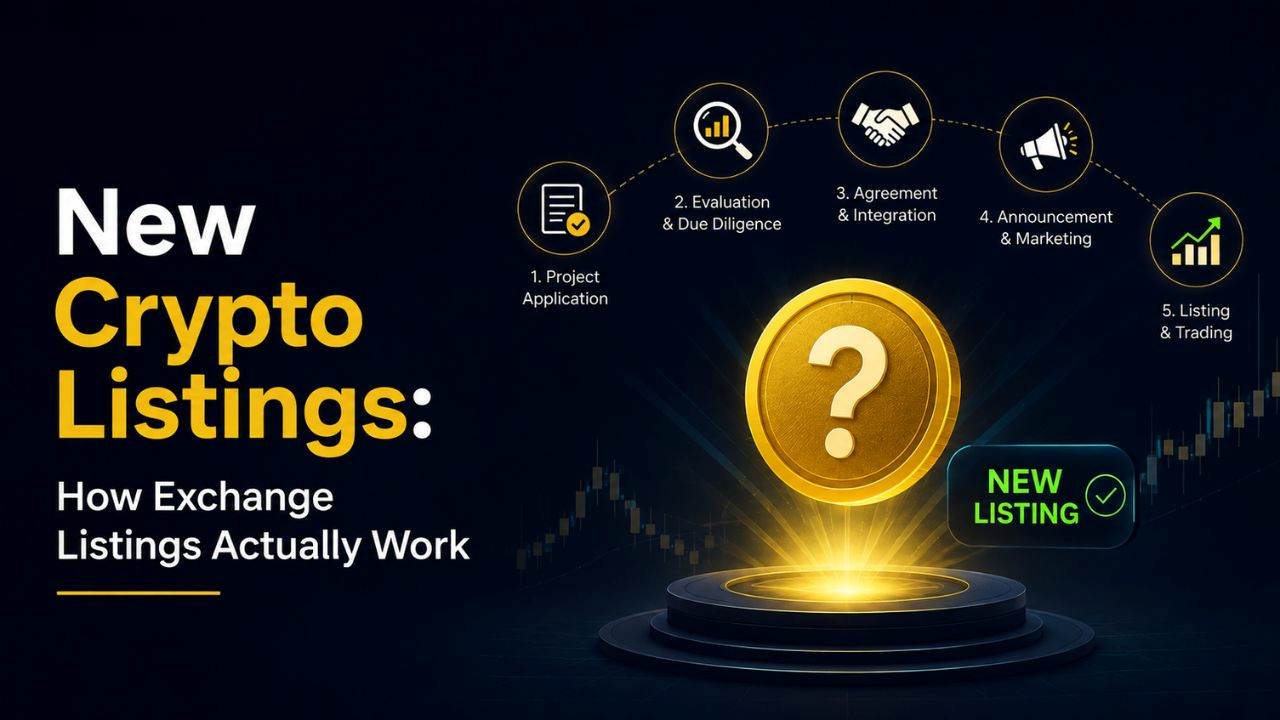
Most people never see this part. A project fills out a listing application, and depending on the exchange, that form can run anywhere from 15 to 70 questions, with Binance sitting at the tougher end and frequently asking for a signed NDA before talks go further. The application covers the basics, team background, tokenomics, supply distribution, vesting schedules, and increasingly, proof that the community is real rather than bought. This is also where most projects get quietly rejected. Not because the token is bad, necessarily, but because the paperwork is sloppy, the token supply looks centralized, or the team will not disclose who they actually are.
Step 2: Due Diligence and the Compliance Check
Once an application clears the first filter, the real scrutiny starts. Exchanges run smart contract audits through firms like CertiK or Hacken, check whether the token could be classified as a security in the jurisdictions they operate in, and increasingly use AI tools to flag wash trading or inflated social numbers before a human even looks at the file. Regulation has tightened this considerably through 2026. In the US, the CLARITY Act now separates digital commodities from payment stablecoins, and CFTC data shows over 450 tokens meeting the criteria for commodity status. That clarity has made compliance review faster in some ways, but stricter in others.
Step 3: Technical Integration Before Anyone Sees a Ticker
Passing legal review does not mean the token goes live tomorrow. Engineering teams still have to wire the token into hot wallets, cold storage systems, and withdrawal infrastructure, and test all of it under load. Coinbase actually splits this into visible stages rather than doing it behind closed doors. Once a token clears its internal review body, it moves through transfer only, post only, limit only, and finally full trading, each stage opening up more functionality. Deposit and withdrawal timing gets tested, gas fees get checked, and only after all of that holds up does the exchange schedule an announcement.
Tier 1, Tier 2 and Tier 3: Where a New Coin Actually Lands First
Not every listing is a Binance or Coinbase listing, and most tokens never get one. The exchange landscape is split into tiers, and understanding where a coin lands tells you a lot about how far along it is.
| Exchange Tier | Examples | Review Rigor | What It Signals |
|---|---|---|---|
| Tier 1 | Binance, Coinbase, Kraken | Very high, months long | Institutional credibility, deep liquidity |
| Tier 2 | Gate.io, MEXC, LBank, XT, Bitmart | Moderate, weeks | Solid mid cap visibility |
| Tier 3 | Weex, BingX, Biconomy, Ascendex, P2B | Lower, days | Early stage exposure, thinner liquidity |
Tier 1 platforms offer far more visibility and access to a larger trading audience but demand a formal review of technology, tokenomics and legal structure, while Tier 2 exchanges are generally more accessible with lower costs and shorter approval timelines. A lot of projects treat Tier 2 or Tier 3 as a stepping stone rather than a final destination.
What Listing Actually Costs
This is the part projects rarely discuss openly, and exchanges are not exactly transparent about it either. Fees vary wildly depending on the platform, the token category, and honestly, how much negotiating leverage the project has. Some exchanges do not charge an application fee at all. Others expect a substantial deposit. Binance says publicly it charges no listing fee, but has reportedly required deposits in its own BNB token running as high as five million dollars, refundable only after a clean delisting. Add in market maker retainers, ecosystem fund commitments, and marketing obligations, and the real cost of a top tier listing can climb well beyond what founders expect going in.
CEX or DEX First: The Route Most New Projects Actually Take
The old playbook was to chase a Binance listing on day one. That is not really how it works anymore. Most projects in 2026 launch first on a decentralized exchange like Uniswap, build a few months of organic trading history and a real holder base, then use that on chain data to negotiate with a Tier 3 or Tier 2 centralized exchange. It is cheaper, it proves actual demand instead of manufactured hype, and it gives the team something to point to when a bigger exchange finally does start asking questions. A Coinbase listing specifically still carries outsized weight, with projects there commanding meaningfully higher valuations than tokens trading only on smaller venues.
What This Means If You Are Investing From India
For Indian retail investors, the listing itself is only half the story, because where you trade it matters just as much. Sticking to FIU registered platforms like CoinDCX or Mudrex keeps you within India’s compliance framework, and it matters more than most new investors realize. Every crypto trade in India is taxed at a flat 30 percent under Section 115BBH, with 1 percent TDS deducted under Section 194S the moment you sell, regardless of whether the exchange is domestic or offshore. A brand new listing on an international Tier 1 exchange might not even be accessible with INR pairs, so checking whether a token has landed on a registered Indian platform is usually the more practical question to ask first.
Why New Listings Move Price, and Why That Is Risky
A fresh listing on a major exchange almost always triggers a price spike, sometimes a dramatic one, because supply that was previously locked in a small pool suddenly meets a much larger pool of buyers. That is the appeal, and it is also the trap. Thin order books right after listing mean wide spreads, and anyone trying to exit a large position can move the price far more than they expected. The listing announcement is the easy part to see coming. What happens to liquidity in the weeks after is the part that actually decides whether the token holds its gains or gives them all back within days.
Frequently Asked Questions
How long does it take for a crypto to get listed on an exchange? It ranges from days on a smaller Tier 3 platform to several months for a Tier 1 exchange like Binance or Coinbase, depending on how much due diligence and technical integration is required.
Do exchanges charge a fee to list a new coin? Some do, some claim they do not while requiring large refundable deposits instead. Costs vary enormously by exchange and are rarely disclosed publicly.
Can a project get listed without any exchange application at all? Yes, on a decentralized exchange. Creating a liquidity pool on a platform like Uniswap is largely permissionless and requires no formal review.
Does a new listing guarantee the token’s price will go up? No. It usually causes a short term spike from increased visibility and liquidity, but thin order books right after listing can just as easily lead to a sharp price drop.
Are new international listings automatically available to Indian investors? Not always. INR trading pairs depend on the specific platform, so Indian investors should check whether a token is available on an FIU registered exchange before assuming it is tradable locally.