

A compliance officer at a mid sized AI company got an email last quarter. An EU regulator wanted proof of where 40 percent of a training dataset actually came from. She pulled the cloud logs. Then someone on the legal team asked a simple question. Can your cloud provider edit those logs. The honest answer was yes. That single question is why AI data provenance blockchain solutions stopped being a niche research topic and became a real budget line item this year.
What AI Data Provenance Actually Means
Data provenance is just a record of where data came from and what happened to it. Who collected it. When. Under what license. What filtering or cleaning touched it before it hit a training run. For years this lived in spreadsheets and internal wikis. Nobody outside the AI lab could check it. Nobody inside the lab could fully trust it either, since logs sitting on a company’s own servers can quietly be altered by anyone with admin access.
That gap is now a legal problem, not just a trust problem. Under Article 10 of the EU AI Act, providers of high risk AI systems must document training data governance, including origin, processing steps, and quality measures. Article 53 pushed this further. Starting August 2025, providers of general purpose AI models had to publish a public summary of the content used to train those models. Penalties for the most serious violations run up to 7 percent of global annual revenue. Gartner expects 1,000 to 2,000 AI related legal claims worldwide by the end of 2026.
US regulators are moving in the same direction. FINRA’s 2026 Annual Regulatory Oversight Report and the SEC’s 2026 examination priorities both explicitly ask firms to demonstrate provenance of training and review data. This is not a Europe only story anymore.
Why Blockchain Fits This Specific Problem
A database can log where data came from too. So why reach for blockchain at all. Three properties matter here and a normal database cannot offer all three at once:
- Tamper evidence. Once a record is anchored on chain, changing it after the fact is either impossible or immediately detectable.
- No single administrator. Nobody, including the company that built the AI model, can quietly rewrite the history.
- Independent verification. A regulator, an auditor, or a rights holder can check a claim without asking the AI company for permission first.
None of this proves the underlying data is high quality or unbiased. It proves the record of where that data came from has not been quietly rewritten. That distinction matters and any credible vendor will tell you the same thing.
How These Systems Work Under The Hood
Most serious implementations do not put raw training data on chain. That would be slow, expensive, and often illegal under privacy rules. Instead they follow a pattern that shows up across nearly every project below:
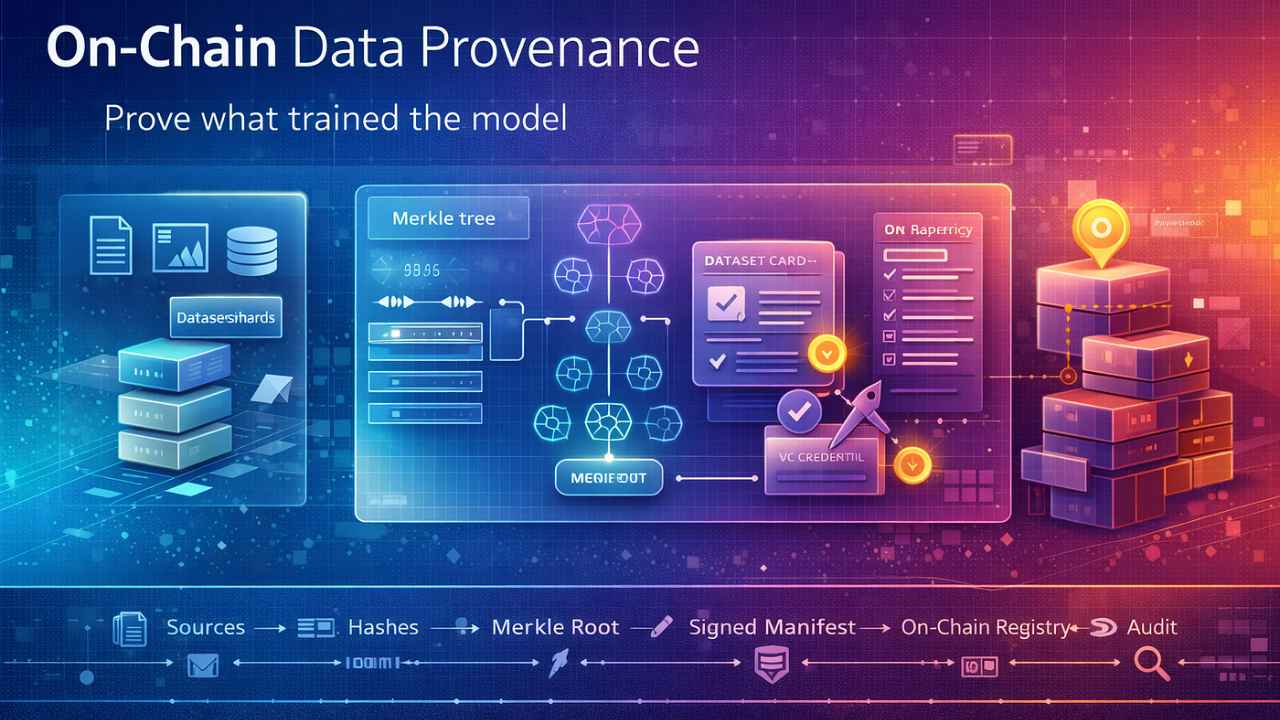
- Raw data stays in normal storage, often IPFS or a private repository.
- The system generates a cryptographic hash, frequently structured as a Merkle tree, summarizing the dataset.
- Only that hash, a timestamp, and light metadata get written to the blockchain.
- Anyone can later re hash the same dataset and compare it against the on chain record.
- A mismatch means the data changed since it was registered.
This keeps costs low and storage light while still giving an unforgeable fingerprint. It is the same logic behind timestamping services, just applied to AI training pipelines instead of documents.
Top Blockchain Solutions For AI Data Provenance
1. OriginTrail
OriginTrail runs the oldest and most enterprise tested project on this list. Its Decentralized Knowledge Graph turns datasets, documents, and IoT streams into what it calls Knowledge Assets, each one anchored on chain for verification. The V10 upgrade of the DKG went live on Base, Gnosis, and OriginTrail’s own NeuroWeb chain in late June 2026. The TRAC token, capped at 500 million supply, handles staking, collateral, and data publication fees. OriginTrail started in supply chain tracking years before AI became the headline use case, which is exactly why its provenance tooling is more battle tested than most newer entrants.
2. Sahara AI
Sahara is building a full stack AI native Layer 1 rather than bolting provenance onto an existing chain. Sahara Chain registers datasets as ERC 721 tokens, handles licensing terms, and automates royalty payouts back to data contributors. The project raised 43 million dollars from Binance Labs, Polychain Capital, and Matrix Partners, and had crossed 780,000 testnet users by mid 2026. Its pitch is direct: solve the data attribution gap by making provenance and payment the same transaction, not two separate systems that need reconciling later.
3. Story Protocol, Now DATA Foundation
On June 25, 2026, Story Protocol rebranded as the DATA Foundation and shifted its focus almost entirely toward AI training data. Its new registry, called Trace, is an append only index of training inputs, licensing terms, and provenance events. The pivot narrows what was previously a broad intellectual property tokenization platform into something purpose built for AI labs that need a defensible audit trail for what went into a model. It is the newest entrant here and the one to watch for how quickly it can sign real AI lab customers.
4. Vana
Vana takes a different angle. It treats personal data as something individuals should own and get paid for, using Data Liquidity Pools where users contribute data and a Proof of Contribution mechanism verifies and scores it before it reaches an AI training pipeline. Data DAOs govern each pool. This makes Vana less of a pure audit tool and more of a consent and compensation layer that happens to produce a provenance trail as a side effect. For consumer facing AI products that need to show user data was contributed knowingly, this is a strong fit.
5. Ocean Protocol
Ocean Protocol is the veteran of tokenized data markets, running since 2013. It wraps datasets as data NFTs paired with datatokens that gate access. Since launching Ocean Nodes in August 2024, the network has grown past 1.4 million nodes across more than 70 countries, onboarded over 35,000 datasets, and facilitated more than 100 million dollars in data transactions. Every publish, purchase, and consumption event gets recorded on chain, creating what the team calls a tamper proof audit trail by default rather than as an add on feature.
Quick Comparison
| Project | Core Mechanism | Native Token | Best Fit For |
|---|---|---|---|
| OriginTrail | Decentralized Knowledge Graph, Merkle anchoring | TRAC | Enterprise and supply chain linked AI data |
| Sahara AI | AI native L1, ERC 721 dataset registry | SAHARA | Dataset licensing and royalty automation |
| DATA Foundation (Story) | Trace append only registry | Story tokens | AI labs needing a training data audit trail |
| Vana | Data Liquidity Pools, Proof of Contribution | VANA | Consumer data consent and compensation |
| Ocean Protocol | Data NFTs plus datatokens | OCEAN | Open data marketplaces with built in provenance |
The Market Behind The Hype
The numbers explain why so much capital is chasing this niche right now. The blockchain AI market overall was valued near 1.56 billion dollars in 2026 and is projected to reach 11.7 billion dollars by 2032, a 39.7 percent compound annual growth rate. Zoom into just AI training datasets and one estimate puts that market at 7.48 billion dollars in 2026, climbing to 52.41 billion dollars by 2035. Data acquisition and annotation already eat up to 80 percent of many machine learning project budgets. Provenance tooling is becoming the receipt that proves that spend was legitimate.
Where This Still Falls Short
No project on this list has fully solved the problem, and being upfront about that matters more than the marketing decks suggest:
- The oracle problem. A hash proves data has not changed since registration. It does not prove the data was accurate or lawfully collected in the first place.
- Off chain dependency. Raw data almost always lives off chain in centralized storage, which reintroduces a single point of failure the blockchain layer cannot fix.
- Early stage adoption. Most AI labs still are not using any of these systems, so provenance claims often cover a fraction of a model’s actual training corpus.
- Cost and speed tradeoffs. Anchoring at scale across millions of data points still costs real gas fees, pushing teams toward batching that can blur granularity.
A Practical Way To Choose
Match the tool to the actual problem you are trying to solve, not the loudest marketing claim:
- Need to prove a specific dataset has not been altered since a fixed date. Look at OriginTrail or Ocean Protocol’s anchoring model.
- Need to pay contributors automatically as their data gets used. Sahara AI or Vana fit better.
- Need a defensible answer ready for an EU AI Act audit request. DATA Foundation’s Trace registry is purpose built for exactly that scenario.
- Building a consumer product where users expect to see and control their own contributed data. Vana’s Data DAO structure was designed around that expectation from day one.
Frequently Asked Questions
Does blockchain make AI training data trustworthy on its own? No. It makes the record of where the data came from tamper evident. Data quality, bias, and lawful sourcing still require separate checks alongside the provenance layer.
Is this only relevant for companies operating in the EU? No. US regulators including FINRA and the SEC have already stated similar provenance expectations for 2026 examinations, and enterprise buyers globally are starting to demand it as a procurement requirement.
Which project has the longest track record? Ocean Protocol and OriginTrail both predate the current AI provenance wave by years, having originally built their infrastructure for broader data marketplace and supply chain use cases.
Do these solutions store the actual training data on chain? Almost never. Most anchor a cryptographic hash of the dataset on chain while the raw data stays in off chain storage such as IPFS, keeping costs low while preserving verifiability.
Is investing in these tokens the same as adopting the technology? No. Token price reflects market speculation and does not guarantee enterprise adoption. Evaluate the underlying network activity, real customers, and audit history separately from price action.




