
You buy a token on Solana because it is cheap and fast. Three days later you find out the real opportunity, the yield farm everyone is talking about, only lives on Arbitrum. You cannot just wire your Solana tokens over to Ethereum like a bank transfer. The two chains do not speak to each other. They were never designed to.
This is the exact problem a blockchain bridge solves. It is also, uncomfortably, the exact problem that keeps losing people hundreds of millions of dollars every year.
By June 2026, PeckShield had already tracked over 340 million dollars stolen across fourteen separate bridge exploits, in a year that was not even half over. If you move money across chains, and in 2026 almost everyone eventually does, you need to understand what a bridge actually does, why it breaks, and how the modular stack built around players like Celestia and EigenLayer is trying to fix it.
What Is a Blockchain Bridge, Really
Blockchains are islands. Bitcoin has no idea Ethereum exists. Ethereum has no idea Solana exists. Each one keeps its own ledger, runs its own validators, and speaks its own language at the protocol level. There is no native way for a token that lives on one chain to just walk over to another.
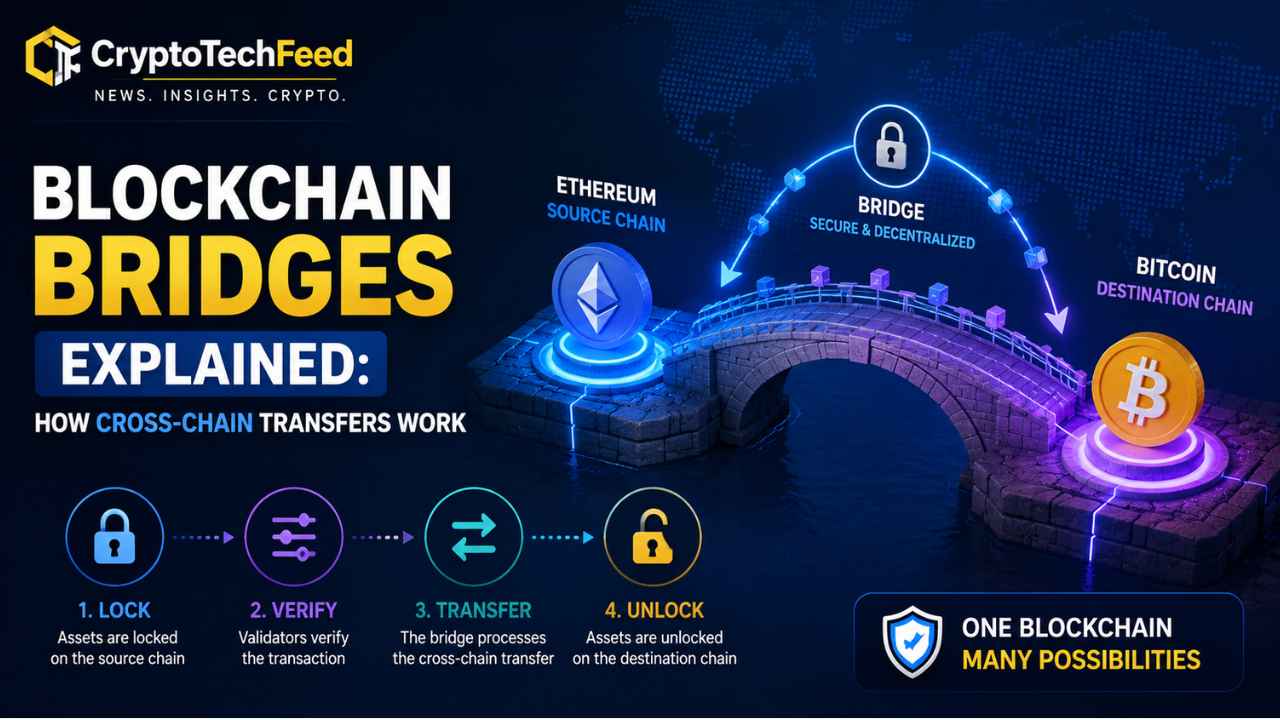
A bridge is the workaround. It is software, usually a set of smart contracts on each side plus a messaging system in between, that lets you move value or data from Chain A to Chain B without a centralized exchange sitting in the middle.
You are not actually teleporting your token, though. In most designs you are locking it up on the chain you started on, and a matching, wrapped version gets minted on the destination chain. Your original asset sits in a vault. What you are holding on the other side is a receipt that claims you can redeem it later.
How Cross Chain Transfers Actually Work
There are a few different models bridges use, and the differences matter.
Lock and mint. You deposit the real asset into a smart contract on the source chain. The bridge locks it there. On the destination chain, an equivalent wrapped token gets minted for you. Want your original asset back? You burn the wrapped token and the lock releases. This is how most big general purpose bridges work, including the ones behind wrapped Bitcoin on Ethereum.
Burn and mint. Some newer designs skip the vault entirely. The token gets burned on the source chain and a native version, not a wrapped IOU, gets minted directly on the destination chain. Circle’s approach for native USDC transfers works roughly this way, and it avoids the fragmented liquidity problem where you end up with five different wrapped versions of the same stablecoin floating around.
Liquidity network bridges. Instead of locking and minting, these rely on liquidity pools on both chains. You deposit on one side, a solver pays you out from the pool on the other almost instantly, and the protocol settles the difference later. Faster, but it depends on enough liquidity parked on both ends.
Underneath all three models sits the part that decides whether a bridge is safe, the verification layer. Something has to confirm a deposit really happened on the source chain before funds get released. That confirmation can come from a small multisig committee, a network of independent validators, light client proofs, or an optimistic system that assumes messages are valid unless proven otherwise within a challenge window. This one design choice, how a bridge verifies messages, is where almost every major hack in 2026 has happened.
Why Bridges Keep Getting Hacked
Bridges are the single most dangerous piece of infrastructure in crypto right now, and the data backs that up hard.
The April 2026 Kelp DAO incident is the one to understand. An attacker did not break any smart contract code and did not steal a private key. They convinced the bridge’s messaging layer that a transaction had happened on the source chain when it had not, and the bridge obediently released 292 million dollars worth of restaked ether. No bug in the traditional sense. Just a system trusting a message it should not have trusted.
That is not an isolated story. PeckShield’s running 2026 tally puts cross chain bridge losses above 340 million dollars across fourteen major incidents by June, with bridges accounting for the largest single share of all DeFi losses that year. Recovery rates are brutal too, only about 14 percent of stolen funds ever make it back to victims.
Why does this keep happening when everyone knows the risk. A bridge, by design, concentrates the collateral of dozens of chains behind a single verification mechanism. Break that mechanism and you drain everything routed through it. It is the classic single point of failure problem, dressed up in newer technology.
Modular vs Monolithic Blockchain, and Why It Matters Here
To understand where bridges are heading, look at the architecture shift happening underneath them, modular versus monolithic design.
A monolithic blockchain, think early Bitcoin or early Ethereum, handles everything itself. Execution, running the actual transactions. Consensus and data availability, agreeing on what happened and keeping that data public. Settlement, finalizing disputes and acting as the ultimate source of truth. All three jobs, one chain, one validator set.
A modular blockchain splits those jobs apart and lets specialized layers each do one thing well. Rollups handle execution off the base chain. A dedicated data availability layer holds the transaction data so anyone can verify it. A settlement layer resolves disputes and anchors everything back to a trusted root. Specialization scales better than asking one chain to do all three jobs at once.
Celestia and the Data Availability Layer
This is where Celestia comes in, genuinely one of the more interesting pieces of 2026 crypto infrastructure. Celestia does not run smart contracts at all. Its entire job is data availability, guaranteeing that the transaction data behind a rollup’s blocks was actually published so anyone can download it and check the math.
It does this through data availability sampling, where light nodes confirm data is available by checking small random pieces rather than downloading entire blocks. That sounds technical, but the payoff is simple. Rollups that would otherwise need to post data to expensive Ethereum blockspace can post it to Celestia instead, cheaper and just as verifiable.
By mid 2026, Celestia was supporting more than 56 rollups, with over 160 gigabytes of rollup data processed through the network and roughly half the entire data availability market to itself. That is production infrastructure a growing share of the rollup world quietly depends on.
The Rollup Settlement Layer
Here is the piece people mix up constantly. A rollup executes transactions off the main chain, sure, but it still needs somewhere to settle. The settlement layer is where a rollup posts its final state and where disputes get resolved if someone claims the rollup cheated.
For most Ethereum rollups today, Ethereum itself is still the settlement layer, the base of trust everything else gets anchored to, even while data availability duties get outsourced to Celestia or EigenDA. Execution happens on the rollup. Data gets stored wherever is cheapest and safe enough. Settlement stays on the chain with the deepest security. Splitting these jobs is the whole modular thesis in one sentence.
EigenLayer and Shared Security
Now add restaking into the picture, because this is where bridges and modular design start overlapping directly.
EigenLayer lets people who already staked ETH to secure Ethereum reuse that same capital to help secure other services too, things like data availability networks, oracles, and cross chain bridges. These external services are called Actively Validated Services, or AVSs. Instead of every new AVS recruiting and paying its own validator set from zero, it can rent Ethereum’s existing economic security.
The scale here moved fast and then corrected hard. Restaked TVL peaked near 20 billion dollars in 2024 before points farming incentives wound down and slashing risk got repriced more honestly, settling into a wide range through 2026 depending on the source and month. Even after that correction, EigenLayer still commands the large majority of the entire restaking market, well ahead of competitors like Symbiotic and Karak.
The pitch for bridges specifically is compelling on paper. A bridge that outsources verification to an AVS is backed by billions in restaked ether with real slashing penalties for misbehavior, instead of a small multisig a well funded attacker could plausibly compromise. Whether that stops the next 292 million dollar exploit is still an open question. The mechanism is too new to have been battle tested against a determined attacker yet.
How to Actually Vet a Bridge Before You Use One
None of this theory matters if you still lose money clicking the wrong button. A few things worth checking before routing funds through any bridge, especially around a newly listed cryptocurrency where liquidity is thin and scrutiny is low.
Check the verification model first. Does the bridge rely on a small trusted committee, a light client proof, or a restaked AVS with real economic security behind it. Fewer trusted parties generally means fewer ways to break it.
Look at how long it has been live and how much volume it has processed without incident. New bridges attached to brand new tokens are exactly where attackers concentrate, the same way scammers target freshly listed coins with no track record yet.
Check whether the bridge has been audited, and whether that audit covered the messaging layer, not just the token contracts. Most of 2026’s biggest hacks happened in the messaging and verification logic.
And honestly, just move smaller amounts first. Bridge it, confirm it landed correctly, then move the rest. It costs a few minutes and has saved plenty of people from six figure mistakes.
FAQ
What is the safest type of blockchain bridge to use in 2026? There is no universally safe option, but bridges secured by decentralized validator networks or restaked EigenLayer AVSs generally carry less single point of failure risk than bridges controlled by a small multisig.
Why do wrapped tokens exist if bridges are risky? Wrapped tokens let assets like Bitcoin function inside ecosystems like Ethereum where they otherwise could not exist. Every wrapped token depends on the bridge holding the original asset safely, which is exactly the trust assumption attackers target.
Is Celestia a competitor to Ethereum? Not really. Celestia does not run smart contracts and is not trying to be a settlement layer. It focuses purely on data availability, and many Ethereum rollups use it alongside Ethereum.
Does EigenLayer make bridges completely safe? No. It changes who backs the security, but slashed ether after an exploit does not undo the exploit. It is risk mitigation, not risk elimination.
How is this different from using a centralized exchange to move between chains? An exchange handles the chain switch internally, which removes bridge risk but adds counterparty risk. Bridges keep you non custodial, at the cost of taking on verification risk yourself.




