
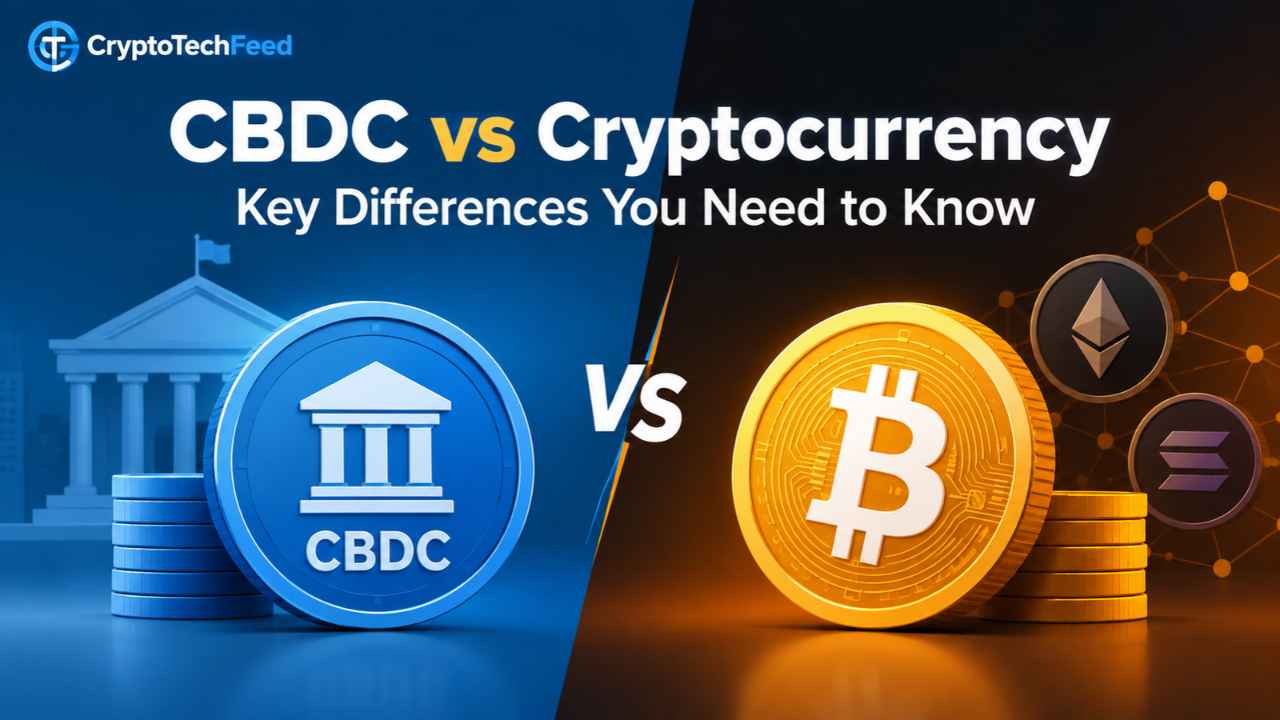
Your grandfather kept cash under the mattress. You keep Bitcoin in a wallet app you can’t even show him without a twenty minute explanation. And somewhere in between sits a third thing that governments keep talking about but almost nobody has actually used: the central bank digital currency, or CBDC.
Here’s the confusion that keeps showing up in comment sections and group chats. People hear “digital currency” attached to both CBDCs and crypto and assume they’re basically cousins. They’re not. They’re closer to being opposites wearing the same costume. One is issued by a state and answers to a central bank. The other was built specifically so no one has to answer to anyone.
Let’s actually sort this out, with real numbers, not just theory.
What Is a CBDC, in Plain Terms
A central bank digital currency is a digital version of a country’s official money, issued directly by that country’s central bank. It’s not a new currency. It’s your existing rupee, dollar or yuan, just represented digitally instead of as paper or a coin.
Think of it as digital cash with the full backing of the state, rather than a private bank’s IOU sitting in your savings account. That backing is the whole point. A CBDC is a direct liability of the central bank, same as physical currency. The money in your regular bank account, by contrast, is a liability of that commercial bank, which is why deposit insurance exists in the first place.
As of 2026, this isn’t some far off concept anymore. According to the Atlantic Council’s CBDC Tracker, 134 countries representing about 98% of global GDP are exploring some form of CBDC, up from just 35 countries in 2020. Only three have actually gone fully live with a retail version: the Bahamas with its Sand Dollar, Jamaica with Jam Dex, and Nigeria with the eNaira. China’s e-CNY remains the largest pilot on earth, having crossed several trillion yuan in cumulative transaction volume, and India’s digital rupee sits as the second biggest pilot globally.
What Is Cryptocurrency, Quickly
Cryptocurrency is digital money that runs on a blockchain, without a central issuer controlling it. Bitcoin was the first, built in 2009 explicitly as a response to the 2008 financial crisis and the idea that banks and governments shouldn’t be the only ones who get to decide what money is or how much of it exists.
No single company or government controls Bitcoin’s supply, its ledger, or who gets to use it. That’s decentralization in practice, not just a buzzword on a pitch deck. Ethereum, Solana and thousands of other coins followed the same basic logic, even if they compromise on decentralization to different degrees.
CBDC vs Cryptocurrency: The Core Comparison
This is really where the whole debate lives. Same word, “digital currency,” attached to two systems built on opposite philosophies.
| Feature | CBDC | Cryptocurrency |
|---|---|---|
| Decentralization | Fully centralized, issued and controlled by a central bank | Decentralized, run by a distributed network of nodes and validators |
| Privacy | Transactions are traceable to the central bank or its authorized intermediaries | Pseudonymous on public chains, fully anonymous with privacy coins |
| Legal Tender | Yes, backed by government and usually legal tender by law | No, not legal tender in almost every country (El Salvador and the Central African Republic are rare exceptions with Bitcoin) |
| Programmability | Government-controlled programmability, can restrict spending, add expiry dates | Open programmability through smart contracts, controlled by code and community governance, not a single authority |
| Issuer | Central bank | No single issuer, protocol-based issuance |
| Volatility | Stable, pegged 1:1 to the national currency | Highly volatile, price set by open markets |
| Supply | Controlled by monetary policy, can be expanded at will | Often capped or algorithmically defined (Bitcoin’s 21 million cap being the clearest example) |
Look at that table for ten seconds and the real story jumps out. A CBDC is government money wearing a digital coat. Crypto is an attempt to build money that doesn’t need a government at all. Everything else, the privacy debate, the programmability debate, the “will this replace cash” debate, flows downstream from that one structural difference.
CBDC Privacy Concerns: The Part Nobody Glosses Over
This is the argument that actually derailed America’s own CBDC plans, so it’s worth sitting with.
A CBDC, by design, gives the central bank visibility into transactions in a way that physical cash never allowed. Cash is anonymous. Nobody at the Fed knows you bought coffee with a ten dollar bill. A retail CBDC, depending on how it’s architected, can change that entirely.
Here’s what critics in the US Congress specifically flagged when they pushed the Anti-CBDC Surveillance State Act through the House in July 2025:
- A CBDC could let a central bank track every transaction an individual makes, not just aggregate flows
- It could theoretically be used to freeze funds or restrict what money gets spent on, similar to what some critics pointed to in China’s social credit adjacent financial tools
- It removes the option of a genuinely private, cash like transaction for digital payments
- It centralizes financial data in a single government controlled ledger, which is itself a juicy target for hackers
President Trump signed Executive Order 14178 in January 2025, explicitly barring federal agencies from advancing a CBDC. Congress followed with the Anti-CBDC Surveillance State Act, and by mid 2026 the ban on the Federal Reserve issuing a retail CBDC got extended through December 31, 2030 as part of the 21st Century ROAD to Housing Act, which passed the Senate 85 to 5. That’s about as close to bipartisan consensus as Washington gets on anything these days, and privacy was the headline reason.
Not every country sees it the same way, though. The European Central Bank is designing the digital euro with privacy protections built in for smaller offline transactions, arguing a well designed CBDC can actually protect privacy better than the current mess of private payment processors that already track everything you buy. Whether that promise survives contact with an actual government rollout is the real open question.
Digital Dollar Pros and Cons
Since the US debate gets so much attention, it’s worth breaking down honestly, without picking a side for you.
Potential pros of a digital dollar:
- Faster, cheaper cross border payments and settlement, cutting out several layers of correspondent banking
- Better financial inclusion for people who are currently unbanked or underbanked
- More efficient distribution of government payments, like stimulus checks, directly to citizens
- Reduced reliance on private stablecoin issuers to provide dollar liquidity globally
Potential cons of a digital dollar:
- Serious surveillance and privacy risk, since every transaction could theoretically be traceable to an individual
- Disintermediation risk for commercial banks, since people could hold money directly with the Fed instead of a bank, pulling deposits out of the banking system during a crisis
- A single point of technical failure and a much bigger cyberattack target than today’s distributed banking system
- Political risk of a future administration using programmable restrictions on how citizens are allowed to spend their own money
For now, the US has picked its answer. No Fed issued digital dollar through at least 2030, with private, regulated stablecoins under the GENIUS Act filling that role instead. Whether that stays the policy long term is genuinely unclear, and depends entirely on who’s in Washington a few years from now.
Central Bank Digital Currency vs Bitcoin: The Sharpest Contrast
If you want the single cleanest comparison, put a CBDC next to Bitcoin specifically, not crypto broadly.
Bitcoin has a hard cap of 21 million coins, no CEO, no headquarters, and a network of miners and nodes spread across the planet that nobody can shut down with a single phone call. A CBDC is the exact opposite on every one of those points. It has unlimited potential supply set by monetary policy, a very specific headquarters, and a central bank that can adjust, freeze or reprogram it whenever policymakers decide to.
People who hold Bitcoin as an asset often frame it as a hedge against exactly the kind of monetary control a CBDC represents. People who build CBDCs frame Bitcoin as an unregulated, volatile threat to monetary sovereignty. Both framings are honestly a bit self serving, but they tell you everything about why these two systems keep getting compared even though they’re trying to solve completely different problems.
Programmable Money, Explained Without the Jargon
Programmable money means a currency that can carry rules built directly into how it moves. Not rules enforced by a bank teller after the fact, rules baked into the money itself.
With crypto, this shows up as smart contracts. You can build a stablecoin that only releases funds when a delivery is confirmed, or a DeFi loan that automatically liquidates collateral if a price falls below a threshold. Nobody has to manually approve it. The code is the enforcement.
With a CBDC, programmability works differently, and this is exactly where the privacy fears connect back in. A government could, in theory, issue a CBDC that expires after a certain date to force spending during a recession, or one that can’t be used to buy certain restricted goods. China’s e-CNY pilots have already experimented with expiry dates on some promotional digital yuan distributions. That’s not a hypothetical anymore, it’s a live feature being tested.
The difference that matters here: crypto’s programmability is opt in and governed by whoever deploys the smart contract, usually visible and auditable by anyone. A CBDC’s programmability is decided top down by the issuing authority, and ordinary users have basically no say in it.
So Which One Actually Matters to You
Honestly, that depends on what you’re trying to solve for.
If you’re a retail investor or trader, none of this changes your day to day much yet. Most countries, including the US, are years away from any live retail CBDC, and crypto keeps operating in its own parallel lane regardless of what central banks decide.
If you care about payment speed and government efficiency, CBDCs promise real upside, especially for cross border settlement between countries. Projects like mBridge, connecting China, Hong Kong, Thailand, the UAE and Saudi Arabia, are already settling real wholesale transactions between central banks in seconds instead of days.
If you care about financial privacy and control over your own money, crypto, especially self custodied Bitcoin, remains the tool built specifically for that job. A CBDC was never designed to compete on that front, and honestly, it was never meant to.
FAQ
Is a CBDC a cryptocurrency? No. A CBDC uses digital technology but is centralized and issued by a government, while cryptocurrency is decentralized and issued through a protocol with no single controlling authority.
Can a CBDC replace Bitcoin? No, they serve different purposes. A CBDC is designed to be stable, government backed digital cash. Bitcoin is designed as a decentralized, scarce asset independent of any government. One doesn’t functionally replace the other.
Does the US have a digital dollar in 2026? No. The Federal Reserve is barred by law from issuing a retail CBDC through at least December 31, 2030, following the Anti-CBDC Surveillance State Act and the ROAD to Housing Act’s CBDC ban provision.
What’s the difference between retail and wholesale CBDC? A retail CBDC is issued directly to the general public for everyday payments. A wholesale CBDC is used only between banks and financial institutions for interbank settlement, which is actually where most current global CBDC activity is happening.
Are CBDCs safe from hacking? No system connected to a network is immune, and a centralized CBDC ledger is arguably a more attractive single target than a distributed blockchain network, which is one of the core security concerns critics raise.




