A friend of mine spent three weekends trying to launch a DAO for his gaming community. Not because the idea was bad. Because he kept getting stuck between two extremes online. One camp told him to just deploy a token and vote on everything forever. The other buried him in legal jargon about beneficial ownership reports and jurisdiction shopping. He gave up for a month before he wrote a single line of governance rules.
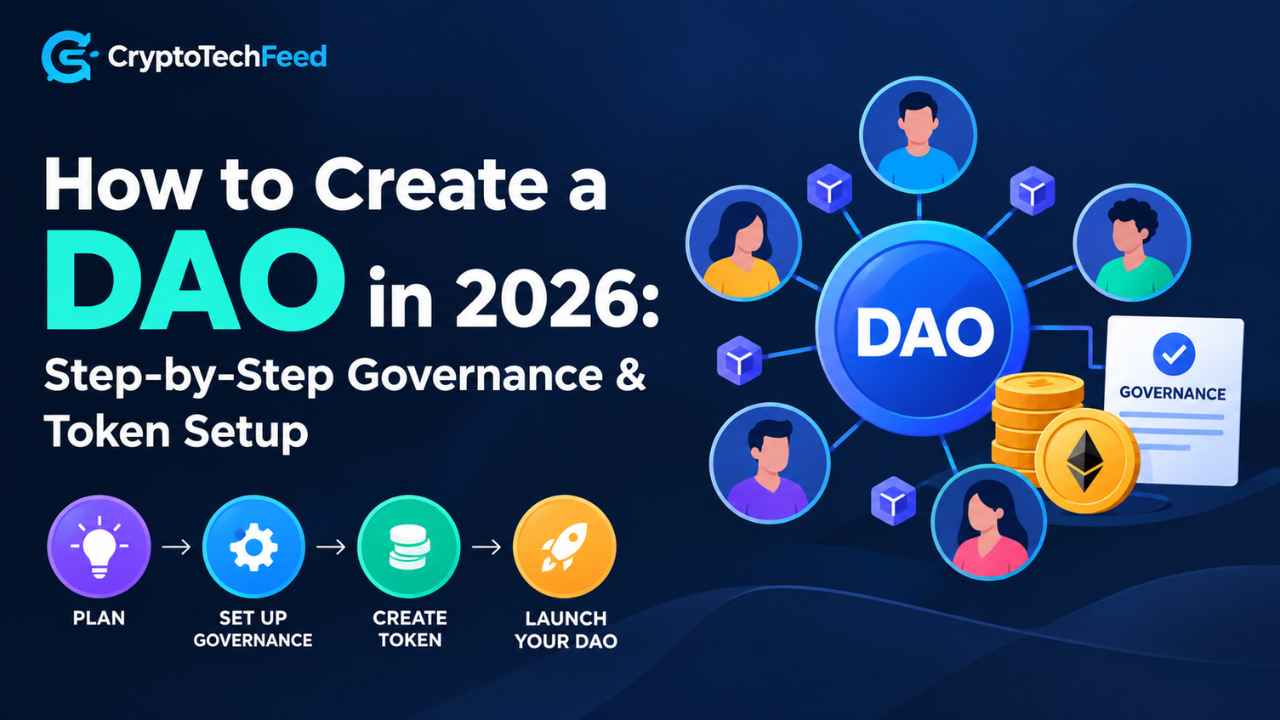
That gap between “just do it” and “hire three lawyers first” is where most people freeze when they try to figure out how to create a DAO. Here’s the version I wish someone had handed him. A practical roadmap, the tools people actually use in 2026, and the legal groundwork that keeps a treasury from turning into a personal liability nightmare.
What Creating a DAO Actually Means Right Now
There are more than 13,000 DAOs on chain today, but the honest number that matters is smaller. Only around 220 hold more than a million dollars in their treasury, and fewer than 80 are considered genuinely active by treasury analysts. Total DAO treasury value across the ecosystem sits between 26 and 28 billion dollars, heavily concentrated. Uniswap’s DAO alone controls close to 4.8 billion, mostly in its own governance token.
What that tells you is simple. Most DAOs don’t fail because the tech breaks. They fail because founders skip the boring parts: a governance process people can actually follow, a treasury that isn’t sitting in one person’s wallet, and a legal wrapper that stops every member from being personally liable if something goes wrong. Fix those three and you’re already ahead of most of the field.
The 5 Step Roadmap
Step 1: Define Your Governance Model Before You Touch Code
Write this down before anything else. Who can vote, how much power does each vote carry, and what happens when nobody shows up to vote at all. Most DAOs go with token weighted voting, one token equals one vote, because it’s simple and it lines up ownership with decision making. Some communities use reputation based or quadratic models instead, especially when they want to stop a handful of whales from steering every decision.
how to set up a multisig wallet on Ethereum: Safe/Gnosis Safe guide
You also need real numbers here, not vibes. A proposal threshold, how many tokens someone needs to submit a proposal. A quorum, the minimum participation required for a vote to count. And a passing threshold, simple majority or a supermajority for anything touching the treasury. Get these three numbers wrong and you’ll either have a DAO that can’t pass anything or one where five wallets push through whatever they want.
Step 2: Design the Token and Distribution
If your DAO runs on token weighted governance, the token itself is the whole ballgame. Use an ERC 20Votes template so it natively supports on chain and off chain vote counting without extra plumbing. Then plan the split honestly. A common structure looks like 60 percent to the community, 20 percent to the founding team, 15 percent to early investors, and 5 percent held in treasury reserve, with team and investor allocations locked behind vesting, usually a one year cliff followed by a multi year linear release.
Skipping vesting is one of the fastest ways to torch community trust. If your own team can dump tokens the week after launch, nobody is going to take your governance votes seriously six months in.
Step 3: Set Up Governance Tooling, Snapshot Is Where Most DAOs Start
This is the part people overthink. For your first governance layer, Snapshot is genuinely the default choice, and here’s the snapshot voting setup in plain terms. Grab an ENS domain for your DAO, something like yourdao.eth, which usually runs five to a hundred dollars a year depending on the name length. Connect your wallet at snapshot.org and create your space. From there you configure a voting strategy. Most spaces start with a straight ERC 20 balance count, though Snapshot supports over 400 strategies you can layer, say 70 percent weight from token balance and 30 percent from staked LP positions.
Then set your rules. Voting periods typically run about seven days. Quorum is commonly set around 5 percent of total token supply, though plenty of DAOs tune this as they grow. The appeal of Snapshot is that voting is gasless, voters just sign a message instead of paying a transaction fee, which is a big reason its turnout runs noticeably higher than fully on chain alternatives.
The tradeoff is that Snapshot votes are off chain by default. They don’t execute themselves. That’s where the next tool comes in.
Step 4: Build the Multisig Treasury on Safe
Once a Snapshot vote passes, someone has to actually move the funds. This is where a lot of early DAOs quietly mess up by leaving treasury control with one founder’s personal wallet. Don’t do that. Set up a Safe, formerly known as Gnosis Safe, which has become the de facto standard for multi sig treasury Gnosis Safe setups across the DAO world. It’s live across 15 plus chains and secures a meaningful share of all on chain treasury value.
The concept is straightforward. You pick a threshold, say 3 of 5 or 4 of 7 signers, meaning that many separate wallets have to approve a transaction before anything moves. For a small team treasury, 2 of 3 is common. For a larger, more distributed core group, 3 of 5 or 4 of 7 gives real redundancy without making every transfer painfully slow. You can also connect Safe to Snapshot through a module called SafeSnap, so a passed governance vote triggers treasury execution without a manual step in between.
One caution worth repeating. In February 2025, roughly 1.5 billion dollars moved out of a Safe wallet in the Bybit hack, and the postmortem showed the multisig cryptography itself wasn’t broken. The signing interface was spoofed, and a signer approved a transaction that looked different than what it actually said. The lesson isn’t to avoid Safe. It’s to verify every transaction on a hardware device screen, not just the browser, before signing anything that touches treasury funds.
Step 5: Pick a Legal Structure for Your DAO
This is the step people skip most often, and it’s the one that can hurt the most. Without a legal wrapper, a DAO is usually treated by default as an unincorporated general partnership, meaning every member can be personally, jointly liable if the DAO gets sued or a smart contract gets exploited. That’s not a theoretical risk anymore.
Two frameworks dominate the legal structure for DAO conversations in 2026. The Wyoming DAO LLC, created under Senate File 38 and effective since July 2021, lets a DAO register as a limited liability company with pass through taxation, member managed or run algorithmically through smart contracts. Wyoming also introduced the DUNA in mid 2024, a nonprofit unincorporated association structure, but it requires at least 100 members and locks you into nonprofit treatment, so it fits large community DAOs better than small working groups.
The other major option is the Marshall Islands DAO LLC, built from the ground up for decentralized entities rather than adapted from a normal company structure. There’s no board, physical office, or local representative requirement, smart contracts are recognized as legally binding governing documents, and members can largely stay pseudonymous with just one verified beneficial owner on file. Over 300 DAOs and web3 projects, including Pyth and Plume, have registered through it. If your DAO is EU facing, keep an eye on MiCA too, which is pushing larger DAOs toward more formal compliance requirements as the framework matures.
Setup costs for either path typically run somewhere between 5,000 and 25,000 dollars depending on complexity and legal counsel, which sounds like a lot until you compare it to the cost of one lawsuit with no liability shield at all.
Tooling Stack: Snapshot, Aragon, Safe, and Tally
Here’s how these four actually fit together instead of competing head to head.
Snapshot handles gasless, off chain voting and proposal discussion. It’s where you go first because it’s free, flexible, and has the highest voter turnout of the group.
Aragon, specifically its OSx framework, is for DAOs that want fully on chain, modular governance with plugin based permissions covering treasury, tokenomics, and custom voting logic. It’s been securing assets since 2017 and now underpins tens of billions across more than ten thousand launched organizations, for protocols that want governance baked into their contracts rather than layered on top.
Tally is the go to frontend if your DAO already runs on Governor style contracts, the OpenZeppelin or Compound pattern. It’s built for fully on chain proposal and voting flows, so voters pay small gas fees, but you get stronger censorship resistance since nothing can be silently reversed off chain.
Safe isn’t really a competitor to any of the three. It’s the execution and custody layer underneath all of them, the multisig that actually holds and moves the funds once governance says yes.
A common real world stack looks like this: Snapshot for proposals and community voting, Safe for treasury custody, and SafeSnap stitching the two together so votes translate into on chain action. DAOs that want everything trustless and on chain from day one lean toward Aragon or Tally instead, accepting the gas costs in exchange for stronger execution guarantees.
Common Mistakes Worth Avoiding
Founders often set quorum too high early on, so no proposal ever passes because the community is still small. Others centralize the treasury in a single wallet because a multisig feels like extra friction on day one, then regret it later. And a lot of DAOs delay their legal wrapper until after they’ve raised funds, which is backwards. It’s cheapest and easiest before there’s meaningful money to protect.
FAQs
How much does it cost to create a DAO in 2026? Tooling itself, Snapshot, Safe, and community platforms, is largely free. Legal formation through a Wyoming DAO LLC or Marshall Islands DAO LLC typically runs 5,000 to 25,000 dollars depending on complexity.
Do I need a lawyer to start a DAO? Not to launch the tooling, but you should involve legal counsel before you form a legal wrapper, since jurisdiction choice affects liability, taxation, and how your DAO can operate internationally.
What’s the best DAO governance tool for beginners? Snapshot, because it’s gasless, requires no smart contract deployment to start voting, and is the most widely used off chain governance layer in the ecosystem.
Should governance be on chain or off chain? Most DAOs start off chain with Snapshot for speed and cost, then move higher stakes decisions, especially treasury transfers, through a multisig like Safe or a fully on chain system like Aragon or Tally as the DAO matures.
Do I need a token to run a DAO? Not always. Some DAOs use reputation based or contribution based voting instead of a tradable token, but token weighted governance remains the most common model because it’s simple to implement and audit.