
Your phone just got smarter and you probably didn’t notice.
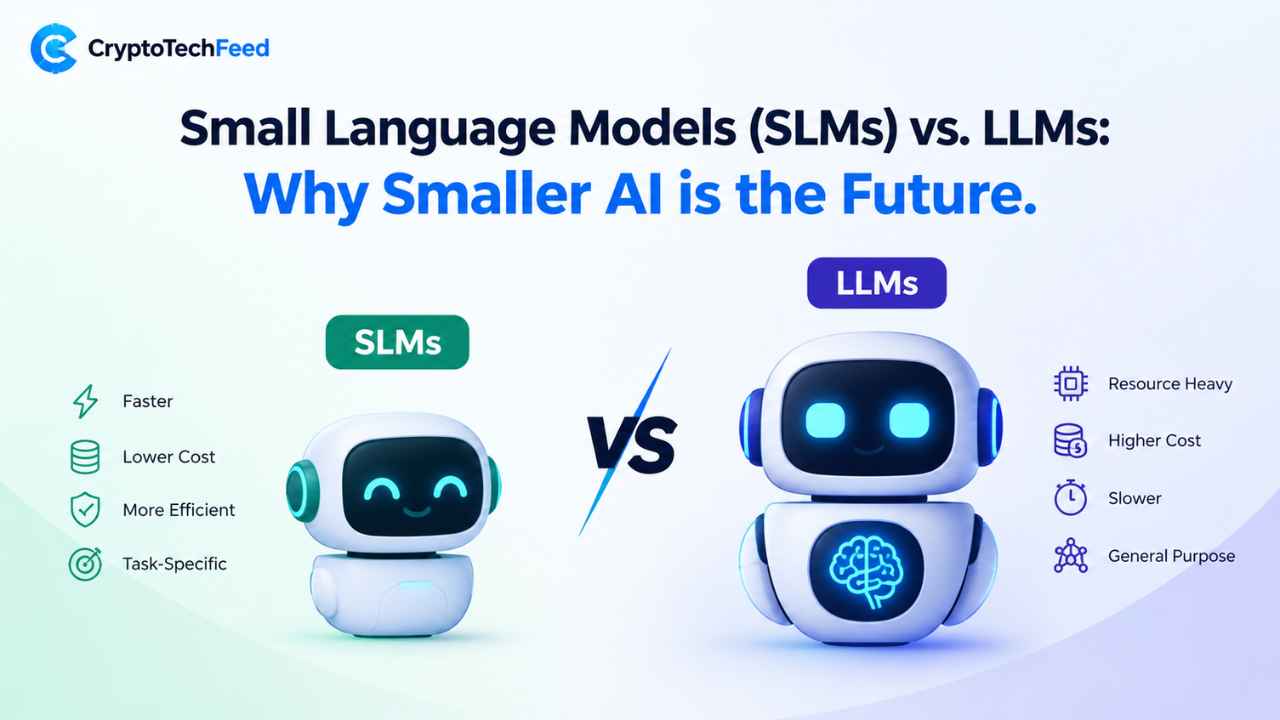
That’s the weird part about this whole shift. While everyone was busy arguing about whether GPT 5 or Gemini’s newest flagship model is “better,” a quieter revolution was happening in the background. Models that fit on your laptop. Models that run without an internet connection. Models small enough to live inside a smartwatch and still hold a conversation.
We’re talking about small language models, or SLMs. And honestly, they’re not the consolation prize everyone assumed they’d be.
For the longest time, the AI conversation was basically an arms race. Bigger model, more parameters, more compute, better answers. GPT 4 had somewhere around 1.7 trillion parameters (OpenAI never confirmed the exact number, but that’s the widely cited estimate). It felt like the only direction was up. Then something interesting happened. Researchers started asking a different question. Not “how big can we make this,” but “how small can we make this while keeping it useful.”
Turns out, pretty small.
What Are Small Language Models, Really?
Let’s clear this up first because the term gets thrown around loosely.
Small language models are AI models built with a fraction of the parameters found in massive systems like GPT 4 or Claude. We’re usually talking somewhere between 1 billion and 13 billion parameters, compared to the hundreds of billions (or trillions) packed into frontier LLMs.
But parameter count alone doesn’t tell the whole story. What makes SLMs genuinely interesting is how they’re trained. Instead of just throwing more data at a bigger network, teams like Microsoft’s Phi team and Mistral AI have gotten obsessive about data quality. Curated, textbook style training data. Synthetic datasets designed to teach reasoning instead of just pattern matching. The result is a model that punches way above its weight class.
Think of it like the difference between memorizing a thousand recipes versus actually learning how to cook. A massive LLM has memorized more recipes. A well trained SLM has learned the underlying technique, and that technique generalizes surprisingly well.
That’s the whole premise behind on device AI models too. You don’t need a model that knows everything about everything. You need a model that’s genuinely good at the handful of things you actually ask it to do, running fast, right where you are.
Why the Sudden Obsession With Smaller AI
A few things collided at once to make this moment happen.
First, cost. Running a trillion parameter model isn’t cheap, not for the company hosting it and definitely not for the planet. Every ChatGPT query burns real electricity on real servers somewhere. Multiply that by billions of daily queries and you start to see why companies are desperate for cheaper alternatives that still deliver good answers.
Second, privacy. People are tired of sending their data to someone else’s server just to get a text summarized or an email drafted. Edge AI processing, where the model runs directly on your device instead of a cloud server, keeps your data exactly where it started. On your phone. In your control.
Third, and this one matters more than people give it credit for, speed. Cloud based LLMs have to send your request across the internet, process it on a remote server, then send the answer back. That round trip takes time, and if your connection is spotty, it might not work at all. Running AI on mobile devices cuts that entire loop out. The response happens locally, instantly, no matter where you are.
Put those three things together and you get a genuine reason for smaller models to exist, not just as a budget option, but as the better choice for a huge chunk of real world use cases.

Phi 3 vs Mistral 7B: The Real World Comparison
Since these two keep coming up in every SLM conversation, let’s actually compare them instead of just name dropping.
Microsoft’s Phi 3 family, especially Phi 3 Mini at 3.8 billion parameters, was trained on what Microsoft calls “textbook quality” data. The idea being that a smaller model trained on cleaner, denser information can reason better than a bigger model stuffed with raw internet text. Early benchmarks backed this up. Phi 3 Mini held its own against models several times its size on reasoning and coding tasks.
Mistral 7B, on the other hand, takes a slightly different approach. At 7 billion parameters, it’s a bit larger than Phi 3 Mini, but Mistral AI focused heavily on architecture efficiency, things like grouped query attention, to keep inference fast without ballooning memory use. Mistral 7B has become something of a favorite among developers building open source apps because it’s genuinely open, genuinely fast, and handles general purpose tasks well.
So which one wins? Honestly, it depends on what you’re building. Phi 3 tends to edge out Mistral 7B on structured reasoning and math heavy tasks. Mistral 7B tends to feel more naturally conversational and handles a wider range of general prompts a little more gracefully. If you’re building a coding assistant or a tutoring app, Phi 3 might be your pick. If you want a flexible, chatty assistant that still runs light, Mistral 7B is hard to beat.
The Comparison Table Everyone Actually Wants
Here’s where the numbers speak for themselves.
| Model | Parameter Size | RAM Requirement | Typical Latency | Best Use Case |
|---|---|---|---|---|
| GPT 4 (cloud LLM) | ~1.7 trillion (est.) | Server side, not applicable | 1 to 3 seconds (network dependent) | Complex reasoning, research, enterprise tools |
| Claude Opus (cloud LLM) | Undisclosed, frontier scale | Server side, not applicable | 1 to 3 seconds (network dependent) | Long document analysis, coding, deep reasoning |
| Mistral 7B | 7 billion | 8GB to 16GB (quantized versions run lower) | 200ms to 500ms on device | Chatbots, general assistants, open source apps |
| Phi 3 Mini | 3.8 billion | 4GB to 8GB | 100ms to 300ms on device | Math, coding help, structured reasoning |
| Phi 3 Small | 7 billion | 8GB to 12GB | 200ms to 400ms on device | Balanced reasoning with mobile flexibility |
| Gemma 2B | 2 billion | 2GB to 4GB | Under 200ms on device | Lightweight mobile apps, wearables |
| TinyLlama | 1.1 billion | 1GB to 2GB | Under 100ms on device | Embedded systems, IoT, ultra low power devices |
Notice the pattern. As parameter size drops, RAM needs drop, and latency drops right along with it. That’s not a coincidence, it’s the entire point of edge AI processing. You’re trading a bit of raw reasoning power for something that runs instantly, privately, and doesn’t need a data center behind it.
Where Small Models Actually Shine
This is the part people miss. Smaller isn’t a downgrade, it’s a different tool for a different job.
Say you’re building a customer support chatbot for an app. Most customer questions aren’t asking for a PhD level analysis of geopolitics. They want to know how to reset a password or check a return policy. A small model handles that instantly, offline, without pinging a server every single time.
Or think about running AI on mobile for something like a translation app you use while traveling with no signal. Or a voice assistant baked into your car that needs to respond the second you finish talking, not two seconds later. Or a fitness wearable that needs to process your voice commands using a battery the size of a coin.
None of these need a trillion parameter brain. They need speed, privacy, and reliability. That’s exactly what on device AI models are built for.
Healthcare is another quiet frontier here. Hospitals dealing with sensitive patient data can’t always ship that information to a third party cloud server, no matter how secure the provider claims to be. A small model running locally on hospital hardware lets clinicians get AI assistance without that data ever leaving the building.
The Trade Off Nobody Talks About Enough
Look, small models aren’t magic. They still lose to massive LLMs on genuinely hard, open ended reasoning. Ask a 3 billion parameter model to write a nuanced legal brief comparing conflicting case law across three jurisdictions, and it’s going to struggle in ways GPT 4 or Claude won’t.
But here’s the thing, most of us aren’t doing that most of the time. Most AI use cases are narrow. Summarize this email. Draft this caption. Answer this customer question. Translate this sentence. For all of that, a well tuned SLM running locally on your device is not just adequate, it’s often faster and more private than the giant model would’ve been anyway.
The future probably isn’t SLMs replacing LLMs completely. It’s more likely a split. Big cloud models handling the heavy, complex, high stakes reasoning. Small on device models handling the fast, everyday, personal stuff. Your phone doesn’t need to think like a research scientist to help you write a text message.
FAQ
What are small language models used for? Small language models are used for tasks that need speed, privacy, and offline access, things like mobile assistants, chatbots, translation apps, and wearable devices. They handle narrow, everyday tasks well without needing a constant internet connection.
Can small language models run without internet? Yes. That’s actually one of their biggest advantages. Because on device AI models run locally on your phone or laptop’s hardware, they don’t need to send data to a cloud server, which means they work completely offline.
Is Phi 3 better than Mistral 7B? It depends on the task. Phi 3 tends to perform better on structured reasoning and coding tasks, while Mistral 7B feels more naturally conversational and handles general purpose prompts a bit more smoothly.
How much RAM do small language models need? Most small language models need somewhere between 2GB and 16GB of RAM depending on their size and whether they’re quantized. Smaller models like Gemma 2B or TinyLlama can run on as little as 1GB to 4GB.
Will small language models replace large language models? Probably not entirely. The more likely future is a split, where large cloud based LLMs handle complex reasoning and small on device models handle fast, private, everyday tasks.




