You order a cab, the ride ends, and money just moves. No wallet app opened. No card tapped. No OTP typed in at 2am while the driver waits.
That quiet little moment is embedded finance doing its job so well you never noticed it happened.
Here’s the thing about embedded finance. It’s probably the single biggest shift in how money moves online in the last decade, and most people using it every single day couldn’t tell you what it’s called. That’s kind of the point, honestly. Good embedded finance is invisible. You only really see it when it’s missing, like when a checkout page still makes you fill out sixteen fields to pay for a forty dollar order.
Let’s actually break this down properly. Not the textbook definition. The real one.
What Is Embedded Finance? (Definition)
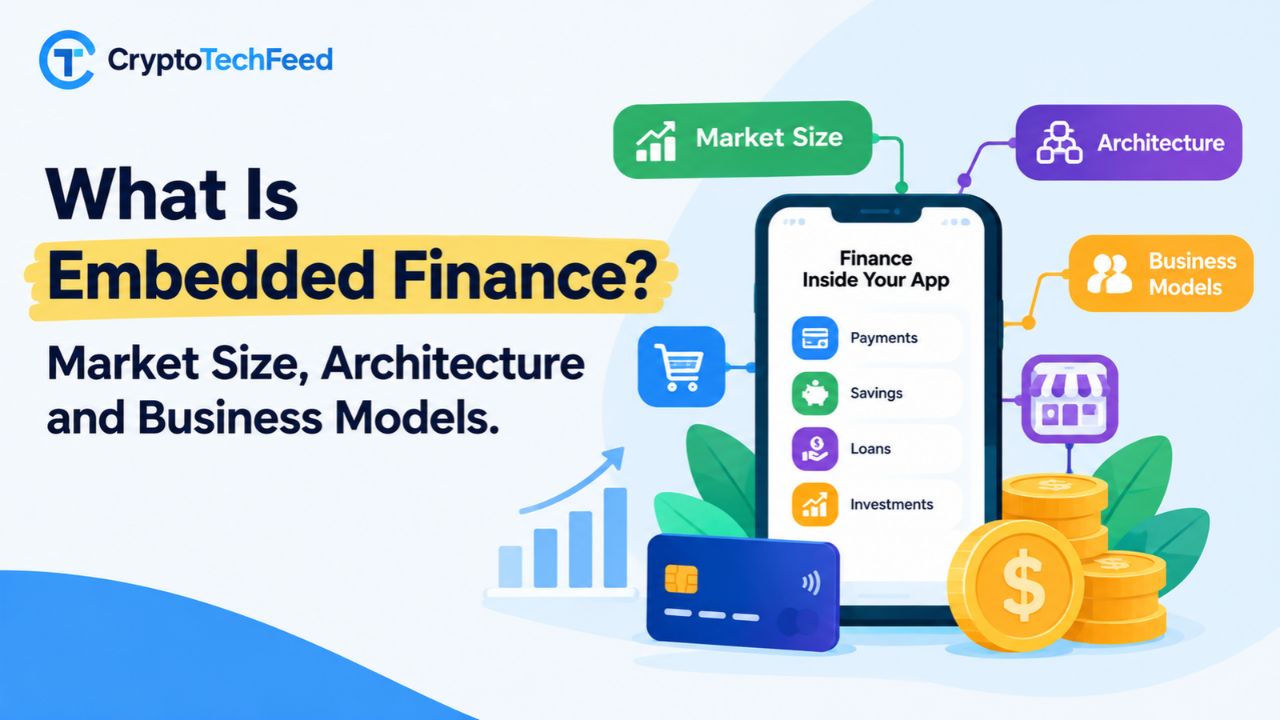
Embedded finance is the integration of financial services such as payments, lending, insurance, banking or investing directly into a non financial company’s app or platform, using APIs, instead of the customer being sent to a separate bank or financial provider to complete the transaction.
In plain words: a brand you don’t think of as a bank quietly becomes the place where a banking type action happens. Uber becomes a wallet. Shopify becomes a lender. Apple becomes a card issuer. The financial product gets stitched into the moment you already need it, instead of living somewhere you have to go find.
That’s really the whole shift. Finance stopped being a destination and became a feature.
Why This Matters Right Now: The Market Size
This isn’t a niche trend anymore. It’s a genuinely large and fast growing slice of global fintech, and the numbers back that up.
Juniper Research’s widely cited forecast put the embedded finance market at over $138 billion in 2026, up from $43 billion in 2021, a jump of more than 215 percent. The same research pointed to APIs as the reason this grew so fast. Easier API integration lowered the barrier to entry for offering financial services, and that opened a real revenue opportunity for whoever moved fast enough to build on it.
Read more at cryptotechfeed.com
Other market trackers frame the number a bit differently depending on what they count as “embedded finance,” but the direction is identical. One widely referenced estimate has the broader embedded finance market growing from roughly $115.8 billion in 2024 to around $251.5 billion by 2029, at close to a 17 percent annual growth rate.
And within that, one category eats the biggest slice of the pie by far. Juniper’s research found that buy now pay later revenue alone was expected to account for just over 50 percent of total embedded finance market value in 2026. Half the market, sitting inside one checkout button. That should tell you something about where the real money is.
A few numbers worth remembering here:
- Embedded finance market value: roughly $138 billion plus in 2026 (Juniper Research)
- Growth from 2021 to 2026: over 215 percent
- BNPL’s share of that market: just over 50 percent
- Underlying banking as a service layer: one widely cited estimate puts BaaS at around $6.7 billion in 2025, growing past $20 billion by 2030 at a CAGR near 26 percent
Notice the gap between those two numbers. Embedded finance is the customer facing outcome. Banking as a service is the plumbing underneath it. They grow together but they aren’t the same thing, and mixing them up is one of the most common mistakes people make when researching this space.
Real World Embedded Banking Examples
Forget the abstract definitions for a second. Here’s where you’ve actually touched embedded finance without realizing it.
Uber. Uber Money lets drivers get paid instantly after a trip ends, straight into a debit card issued through Uber’s app, without waiting for a weekly payout cycle. Uber isn’t a bank. It partnered with banking infrastructure providers to make that debit card and instant payout possible. The rider side has its own version too, with in app wallet balances and saved payment credentials that skip the checkout friction entirely.
Shopify. Shopify Balance gives merchants a business bank account inside their Shopify dashboard. Shopify Capital offers merchants cash advances and loans based on their own store sales data, something a traditional bank would need months of paperwork to underwrite. And Shop Pay’s installment option is a textbook buy now pay later API sitting quietly at checkout, letting a shopper split a payment into four without ever leaving the Shopify page.
Apple. The Apple Card is issued by Goldman Sachs, but Apple owns the entire customer experience: the application, the spending dashboard, the rewards, even the physical titanium card design. Apple Pay Later (in markets where it ran) worked the same way, tucking a short term loan product directly into the Wallet app. You’d be forgiven for thinking Apple is your bank. That’s exactly the illusion embedded finance is built to create, and it works because Apple owns the relationship while a licensed bank quietly owns the regulatory risk.
A few more worth a quick mention, since these get searched a lot too:
- Amazon offering seller financing and Amazon Pay checkout
- Grab and Gojek in Southeast Asia running full digital wallets and micro insurance inside a ride hailing app
- Tesla offering insurance priced off your car’s actual driving data, sold directly in the Tesla app
None of these companies applied for a banking license. They didn’t need to. That’s the entire architecture trick, and it’s worth understanding properly.
The Architecture Behind Embedded Finance
Here’s what’s actually happening under the hood when you tap “pay in 4” on a checkout page. It looks like magic from the front end. It’s really just a well organized stack of four layers talking to each other through APIs.
Layer 1: The brand front end. This is the app or website you’re actually using. Uber, Shopify, Apple Wallet, whatever it is. This layer owns the design, the user experience, and the customer relationship. It has zero banking license and doesn’t need one.
Layer 2: The API and orchestration layer. This is the middleware that connects the brand’s app to actual financial infrastructure. It handles things like identity verification, transaction routing, ledger updates and compliance checks in real time. Companies like Stripe Treasury, Marqeta, Unit and Synctera live here.
Layer 3: The banking as a service provider. This layer holds the technical and regulatory rails: card issuing programs, deposit account infrastructure, lending decision engines. It packages a bank’s actual capabilities into developer friendly APIs so a non bank brand can plug in without building a bank from scratch.
Layer 4: The licensed, chartered institution. Somewhere at the bottom of the stack sits an actual regulated bank holding the banking license, insuring deposits, and answering to regulators. Nothing above this layer is legally a bank. Everything above it just looks and feels like one.
A simplified flow for a buy now pay later transaction looks roughly like this:
Shopper clicks "Pay in 4" at checkout
        |
Brand's checkout front end
        |
BNPL API / embedded lending provider (risk decision, in milliseconds)
        |
Banking as a service layer (ledger entry, account debit/credit rails)
        |
Chartered bank partner (holds the actual loan, regulatory backstop)
        |
Funds settle to merchant instantly, shopper repays over time
That risk decision step is where the real engineering lives. A buy now pay later API has to pull a credit signal, check fraud risk, and approve or deny a loan in under a second, all while the shopper is standing at a digital checkout getting impatient. Miss that window and the sale is gone.
Business Models: How Everyone Actually Gets Paid
This is where people get confused, so let’s separate it cleanly.
Banking as a service (BaaS). A licensed bank or a BaaS platform partnered with a licensed bank rents out its regulatory infrastructure through APIs. Revenue usually comes from a mix of interchange fees, per transaction pricing, and account maintenance fees paid by the brand using the service. Think of BaaS as the wholesale layer.
Fintech as a service. This sits a step higher up the stack. Instead of just banking rails, a fintech as a service provider bundles compliance tooling, card issuing, lending decisioning and reporting dashboards into a single package a company can license. It’s less “rent a bank” and more “rent a whole fintech department.”
Embedded finance as a revenue line for the brand itself. This is the model Shopify and Apple actually run on. The brand doesn’t just pass a customer along and collect a referral fee. It owns pricing, owns the customer relationship, and takes a real cut of the financial product’s revenue, whether that’s BNPL merchant fees, card interchange, or lending interest shared back from the bank partner.
Three different business models, three different risk appetites, and honestly three different reasons a company chooses one over the other. A small ecommerce brand wanting a fast BNPL button reaches for a fintech as a service vendor. A large platform like Shopify with millions of merchants eventually builds enough scale to negotiate direct BaaS partnerships and keep more margin.
The Part Nobody Talks About: Risk Sits With the Bank
Every embedded finance product still needs a chartered bank somewhere in the stack, and that bank is the one actually holding the compliance risk, the deposit insurance obligation and the regulatory relationship. When something breaks (and in 2024 and 2025 a few high profile BaaS middleware failures showed exactly how badly that can break) it’s usually a reconciliation or ledger problem between the middleware layer and the bank, not the shiny front end brand you interacted with.
If you’re evaluating an embedded finance partner for a product build, that sponsor bank relationship is genuinely the first thing worth checking, not the last.
FAQ
What is embedded finance in simple terms? It’s a financial service like a loan, a bank account or an insurance policy built directly into a non financial app, so the customer never has to leave that app or visit a separate bank.
Is buy now pay later considered embedded finance? Yes. BNPL is actually the largest single segment of the embedded finance market, accounting for over half of total market revenue by some estimates, because it embeds a short term loan directly into an ecommerce checkout flow.
What’s the difference between embedded finance and banking as a service? Embedded finance is the customer facing product, like a debit card inside a ride hailing app. Banking as a service is the underlying infrastructure and licensing layer that makes that product legally and technically possible. BaaS is the engine, embedded finance is the car.
Do companies like Uber and Shopify have their own banking license? No. They partner with licensed banks and banking as a service providers who hold the actual charter, deposit insurance and regulatory obligations, while the brand owns the customer facing experience.
Who are the major embedded finance and BaaS providers? Stripe, Marqeta, Unit, Synctera, Galileo, Solarisbank and Railsr are among the more commonly referenced infrastructure providers, alongside sponsor banks like Cross River Bank and Celtic Bank in the US market.
The Takeaway
Embedded finance isn’t really about banks becoming less important. It’s about banks becoming invisible, which turns out to be a strange kind of victory for them. They still hold the risk, the license, and the regulatory relationship. They just stopped needing the logo on the front end to make money from it.
For a brand, that means the next big growth lever probably isn’t a new product feature. It might just be a financial one, quietly built into the moment your customer already trusts you the most.