
A zero-knowledge proof lets you prove something is true without showing your work. That is the whole idea in one sentence. In crypto, this single concept quietly powers private transactions, faster blockchains, and identity checks that never expose your actual data, and by 2026 it has moved from an academic curiosity into infrastructure that platforms like zkSync, StarkNet, and Polygon zkEVM run billions of dollars through every month. This guide breaks down exactly what a zero-knowledge proof is, how it works, where you will actually run into it, and what to watch out for before you trust your funds to it.
Zero-Knowledge Proofs Explained in Plain English
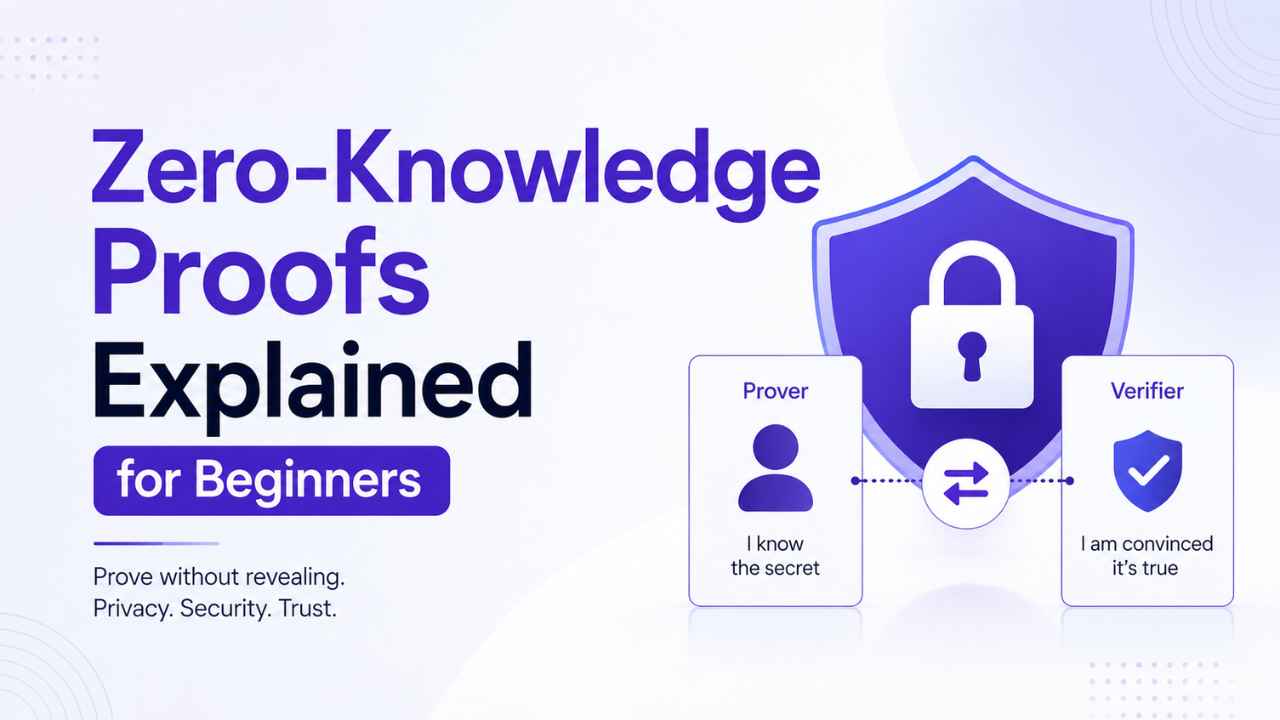
Picture proving you know a friend’s Wi Fi password without ever saying the password out loud, by instead unlocking their laptop right in front of them. They walk away convinced you know it, yet they learned nothing about what the password actually is. That is a zero-knowledge proof. Two parties are involved, a prover who holds a secret and a verifier who needs confidence that the secret is real. Cryptographic math replaces the laptop demonstration, letting the prover generate a proof that the verifier can check instantly, with total confidence, while the underlying secret stays completely hidden the entire time.
The Three Properties Every ZK Proof Must Satisfy
Every legitimate zero-knowledge proof, no matter which blockchain implements it, has to satisfy three conditions simultaneously. Completeness means an honest prover with a true statement can always convince an honest verifier, no exceptions. Soundness means a dishonest prover cannot convince a verifier that a false statement is true, except with a probability so small it is functionally impossible. The zero-knowledge property itself means the verifier learns absolutely nothing beyond the fact that the statement is true, not a single extra bit of the underlying data leaks through. Miss any one of these three and the system stops being a genuine zero-knowledge proof.
zk-SNARKs vs zk-STARKs
Once you start reading about ZK technology, these two acronyms show up constantly, and the difference actually matters for which projects you trust. zk-SNARKs, used by Zcash and many early ZK rollups, generate extremely compact proofs that verify fast, but most versions require a trusted setup ceremony, a one time event where the initial cryptographic parameters get generated and then must be destroyed. zk-STARKs, the technology behind StarkNet, skip the trusted setup entirely and offer quantum resistance, trading a larger proof size for that extra layer of security. Projects prioritizing speed and lower cost often lean SNARK, while projects prioritizing long term security assumptions increasingly lean STARK.
Where Zero-Knowledge Proofs Show Up in Crypto Right Now, 2026 Context
Three use cases dominate the current landscape. ZK rollups bundle thousands of transactions off the main Ethereum chain, generate a single validity proof, and post that proof back on chain, cutting fees dramatically while inheriting Ethereum’s security, a topic our [Optimistic vs Zero-Knowledge Rollups guide] covers in far more depth. Privacy preserving transactions let users prove they hold enough funds or meet a condition without exposing wallet balances or transaction history. Identity and compliance verification is the fastest growing category in 2026, letting a user prove they are over eighteen, uniquely human, or KYC verified without handing a platform their actual documents, a direct response to tightening privacy regulation worldwide.
Real Examples: Zcash, zkSync, StarkNet, Polygon zkEVM
Zcash remains the reference point for ZK privacy, using zk-SNARKs since 2016 to let users shield transaction details while still running on a public, auditable chain. On the scaling side, zkSync and StarkNet compete directly as ZK powered Layer 2 networks sitting on top of Ethereum, each processing transactions off chain before submitting compressed proofs back to the mainnet. Polygon zkEVM takes a slightly different angle, aiming for full compatibility with existing Ethereum smart contracts so developers can deploy ZK powered scaling without rewriting their code. Together these four projects represent the clearest real world proof that this technology works well past the whiteboard stage.
Risks and Limitations Nobody Mentions Enough
Zero-knowledge proofs are powerful, not magic, and a few limitations deserve real attention before you treat any ZK based platform as automatically safe. Generating proofs is computationally expensive, which means some ZK rollups still depend on centralized or semi centralized provers today, a genuine decentralization tradeoff worth checking before assuming full trustlessness. Trusted setup ceremonies in SNARK based systems carry residual risk if the original parameters were never properly destroyed, and users generally have to take a project’s word for it. ZK proofs can only verify that supplied data satisfies a mathematical rule, they cannot independently confirm real world facts, so any system claiming to verify off chain events still needs a trusted oracle or data source somewhere in the pipeline. Treat that dependency as a real attack surface, not a footnote.
Practical Steps to Actually Use ZK Technology
You do not need to understand the underlying math to benefit from it, but a few habits help. Start by checking whether a Layer 2 network you use discloses its proof system, SNARK or STARK, and whether its provers are decentralized or run by a single team, information most serious projects publish openly. If privacy is your priority, understand exactly what a shielded transaction hides and what it does not, since metadata like timing can still leak information on some networks. Before bridging meaningful funds to any ZK rollup, check its stage rating on L2BEAT, which tracks how much a network still depends on training wheels versus fully trustless proof verification. None of this requires coding, just five minutes of due diligence before you move funds.
Frequently Asked Questions
What is a zero-knowledge proof in simple terms? It is a cryptographic method that lets one party prove a statement is true to another party without revealing any of the underlying information behind that statement.
What is the difference between zk-SNARK and zk-STARK? zk-SNARKs produce smaller, faster proofs but usually need a trusted setup, while zk-STARKs skip the trusted setup and add quantum resistance at the cost of larger proof sizes.
Are zero-knowledge proofs the same as encryption? No, encryption hides data so only someone with a key can read it, while a zero-knowledge proof lets you prove something about hidden data without ever revealing the data itself.
Which crypto projects actually use zero-knowledge proofs in 2026? Zcash uses ZK proofs for private transactions, while zkSync, StarkNet, and Polygon zkEVM use them to scale Ethereum through ZK rollups.
Are ZK rollups fully decentralized? Not always. Many ZK rollups in 2026 still rely on centralized or limited prover sets, so checking a network’s L2BEAT stage rating before trusting it with funds is a reasonable step.
Sources and Related Reading
This guide draws on publicly available technical documentation from Ethereum.org, Zcash, and L2BEAT’s rollup stage tracking. For deeper coverage on related topics, see our guides on [Optimistic vs Zero-Knowledge Rollups Explained], [What Is a Layer 2 Blockchain], [What Is a Layer 1 Blockchain], [How Smart Contracts Work], and [What Is Blockchain and How Does It Work]. For the full library of crypto explainers, visit the [Crypto Tech hub].




