Two guys graduate from the same college on the same day. One takes a government job, reads every rule book twice, and moves up slowly but never gets fired. The other joins a fast growing startup, ships things at 2 a.m., breaks stuff, fixes it by morning, and somehow ends up running the department in three years. Same starting line. Completely different lives.
That is basically Cardano and Solana.
Both launched to fix the same problem, Ethereum being too slow and too expensive. Both are proof of stake blockchains. Both have loyal, almost tribal communities. And that is roughly where the similarities stop. Everything else, how they build, how fast they move, how they treat risk, comes from two opposite philosophies about what a blockchain should be.
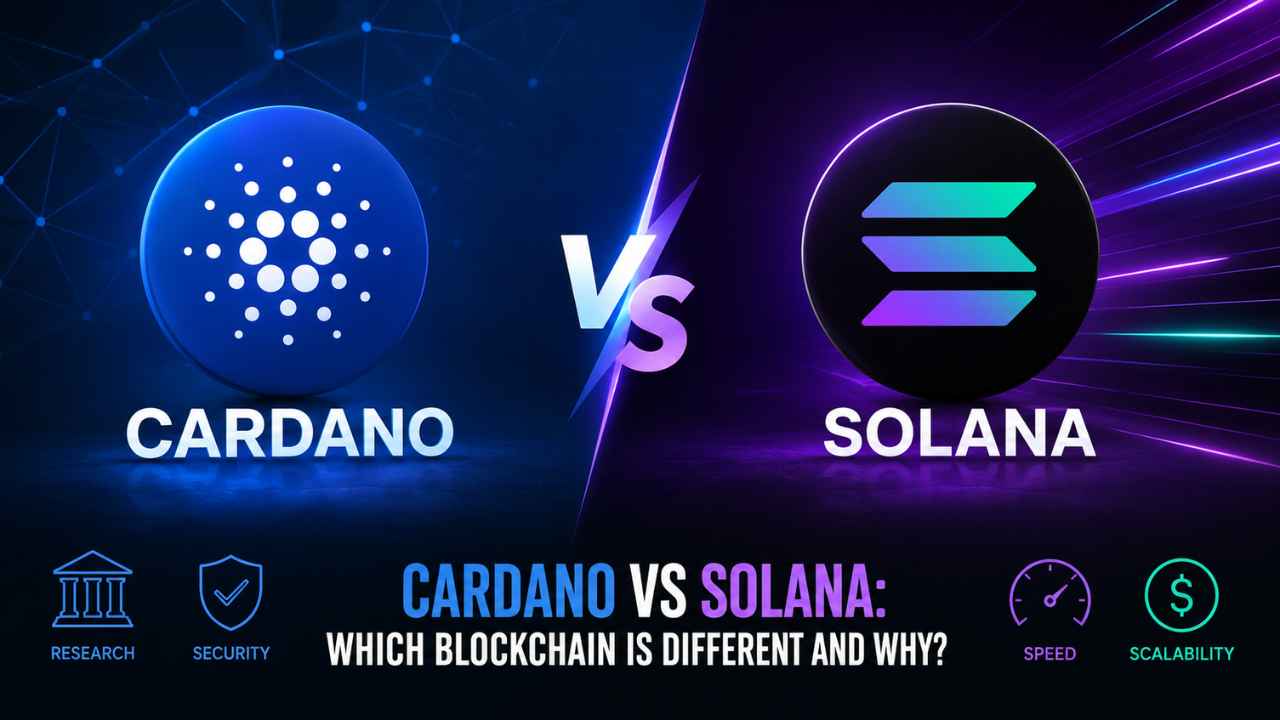
If you are trying to figure out cardano vs solana: which blockchain is different and why before putting money into either one, this crypto guide breaks down the real differences with 2026 numbers, not just vibes.
The Core Philosophy: Peer Reviewed vs Ship Fast
Cardano was built by Charles Hoskinson, an Ethereum co founder who left and decided the next blockchain should be built like academic software. Every major upgrade goes through peer reviewed research before it touches mainnet. It is slow. It is deliberate. Critics call it the blockchain that talks more than it builds. Supporters call it the one that never had a catastrophic outage.
Solana took the opposite bet. Move fast, optimize for raw throughput, let the market decide what survives. It uses a mix of Proof of History and Proof of Stake to timestamp transactions before they are even confirmed, which is what lets it process thousands of transactions per second instead of dozens. That speed came at a cost early on, Solana had a rough reputation for network outages between 2021 and 2023. Those outages are largely history now, and 2026 has been the network’s most stable year yet.
So right there you have the first real answer to why these two chains are different. One optimized for certainty. The other optimized for speed. Everything downstream follows from that one choice.
Consensus Mechanism: Ouroboros vs Proof of History
Cardano runs on Ouroboros, a peer reviewed proof of stake protocol where validators called stake pool operators are chosen to produce blocks based on the ADA delegated to them. It is energy efficient, mathematically provable, and has never had a security breach at the protocol layer since launch.
Solana pairs Proof of History, essentially a cryptographic clock that timestamps events before consensus even happens, with a Proof of Stake layer for validator selection. This is the real engineering trick behind Solana’s speed. Instead of validators talking to each other to agree on the order of transactions, the clock already proves the order, so validators just verify it.
Neither approach is objectively better. Ouroboros trades speed for provable rigor. Proof of History trades some decentralization and validator hardware cost for raw performance.
Speed, Fees and Real Numbers in 2026
Talk is cheap. Numbers are not. Here is where the two chains actually stand as of late August 2026.
Solana processed roughly 4.2 billion transactions in July 2026 alone, with tokenized real world assets on the network nearing 4 billion dollars in value. Real world throughput regularly runs into the thousands of transactions per second during active periods, and fees typically stay a fraction of a cent even during network congestion.
Cardano’s daily transaction count sits far lower, in the tens of thousands rather than millions, with fees that are still cheap by Ethereum standards but not built for the same volume Solana handles. Cardano’s roadmap leans on Hydra, a layer 2 scaling solution now production ready, to eventually push throughput into the same range as Solana without sacrificing its security model.
The gap here is not small. It is one of the biggest reasons developers building high frequency applications, trading platforms, gaming, payments, tend to pick Solana first and ask questions later.
DeFi TVL and Ecosystem Momentum
This is where the contrast gets almost uncomfortable for Cardano fans. Solana’s DeFi total value locked sits close to 9 billion dollars, trailing only Ethereum among major chains, with stablecoin float on the network running into double digit billions. Solana also just picked up a fresh institutional distribution channel, Charles Schwab added SOL trading for its roughly 39 million clients in late August 2026, alongside Avalanche and Chainlink.
Cardano’s DeFi TVL, by comparison, remains under 200 million dollars. That is not a typo. Despite ADA holding a market cap in the multi billion dollar range, very little of that value is actually working inside DeFi protocols on the chain. Hoskinson has publicly pushed a coordinated growth plan and a strategic integration fund aimed at closing this gap through 2026, but the current numbers still favor Solana by a wide margin.
Why does this matter to you as an investor rather than a developer? Because TVL is a proxy for real usage. A chain people actually build on and move money through tends to have stronger long term demand for its native token than one that is mostly held and rarely used.
Staking Rewards Compared
If you are earning yield rather than trading, this part matters just as much as price action.
Solana staking typically pays a baseline reward around 6.6% APY through native inflation, and liquid staking platforms like Jito can push effective yield past 8% once MEV rewards are factored in. Roughly two thirds of circulating SOL supply is currently staked.
Cardano staking runs lower, typically in the 3% to 6% APY range depending on the stake pool and network parameters. Over 60% of ADA supply is staked, which is actually a strength for Cardano since high staking participation reduces circulating sell pressure even if the yield itself is more modest.
Neither chain requires a minimum stake amount, and both let you delegate without locking your tokens into a validator’s custody, which is a real advantage over some proof of stake chains that demand you run your own hardware.
Governance: Voltaire vs Ad Hoc Foundation Control
Cardano finished rolling out its Voltaire governance era through CIP 1694, which hands on chain voting power to ADA holders through delegate representatives, essentially turning Cardano into one of the most formally decentralized governance systems in crypto. Every protocol change, treasury spend, and parameter update now goes through this on chain process.
Solana governance is comparatively informal. Major decisions still lean heavily on the Solana Foundation and core validator client teams, with community input happening more through forums and social consensus than binding on chain votes. This is not necessarily worse, it lets Solana move faster, but it does mean less structural decentralization at the decision making layer.
Cardano vs Solana at a Glance (2026)
| Feature | Cardano (ADA) | Solana (SOL) |
|---|---|---|
| Consensus | Ouroboros Proof of Stake | Proof of History plus Proof of Stake |
| Approx. price (Aug 2026) | ~$0.21 | ~$100 to $104 |
| Approx. market cap | ~$8 billion, rank #19 | ~$58 to $60 billion |
| DeFi TVL | Under $200 million | Near $9 billion |
| Staking APY | Roughly 3% to 6% | Roughly 6.6% baseline, 8%+ with liquid staking |
| Governance | On chain, Voltaire/CIP 1694 | Foundation and validator led, off chain heavy |
| Development pace | Slow, peer reviewed | Fast, iterative |
| Known weakness | Low DeFi adoption relative to market cap | History of past network outages, now largely resolved |
Which One Should Indian Investors Consider
Both ADA and SOL are freely tradable on FIU IND registered Indian exchanges including CoinDCX and Mudrex, so access is not the deciding factor. Tax treatment is identical for both since Indian law does not differentiate between blockchains.
Under Section 115BBH, any profit from selling ADA or SOL is taxed at a flat 30% regardless of your income slab, with no deduction allowed except the cost of acquisition. You also cannot offset a loss on one against a gain on the other, crypto losses cannot reduce your taxable crypto gains at all under current rules. On top of that, Section 194S applies a 1% TDS on most trades above the threshold, deducted automatically by Indian exchanges at the time of sale.
If you are earning staking rewards on either chain through an Indian platform, that income is typically taxed at the time you receive it, and again when you eventually sell, so keep records of both events. Given how different the risk profile of these two chains is, Cardano being the patient, slower moving bet and Solana carrying more momentum but also more competition, most advisors would tell you not to treat either as a full portfolio, but as one piece of a diversified crypto allocation.
FAQ
Is Solana faster than Cardano? Yes, significantly. Solana’s Proof of History design lets it process thousands of transactions per second in practice, while Cardano currently processes far fewer, though its Hydra layer 2 solution aims to close that gap.
Which has more real world usage in 2026? Solana, by a wide margin. Its DeFi TVL near 9 billion dollars and July 2026 transaction volume of roughly 4.2 billion transactions dwarf Cardano’s current on chain activity.
Is Cardano more decentralized than Solana? In terms of formal governance, yes. Cardano’s Voltaire era gives ADA holders binding on chain voting rights through CIP 1694, while Solana’s major decisions still lean on the Solana Foundation and core validator teams.
Which one pays better staking rewards? Solana generally offers higher yield, around 6.6% baseline and above 8% through liquid staking platforms like Jito, compared to Cardano’s roughly 3% to 6% range.
Do Cardano and Solana get taxed differently in India? No. Both fall under the same 30% flat tax on gains under Section 115BBH and 1% TDS under Section 194S, regardless of which blockchain the token runs on.
Is Cardano a good long term bet despite its low DeFi activity? That depends on your thesis. Cardano’s low TVL is a real weakness today, but its research first approach and now completed governance rollout make it a slower, more conservative bet compared to Solana’s momentum driven growth.