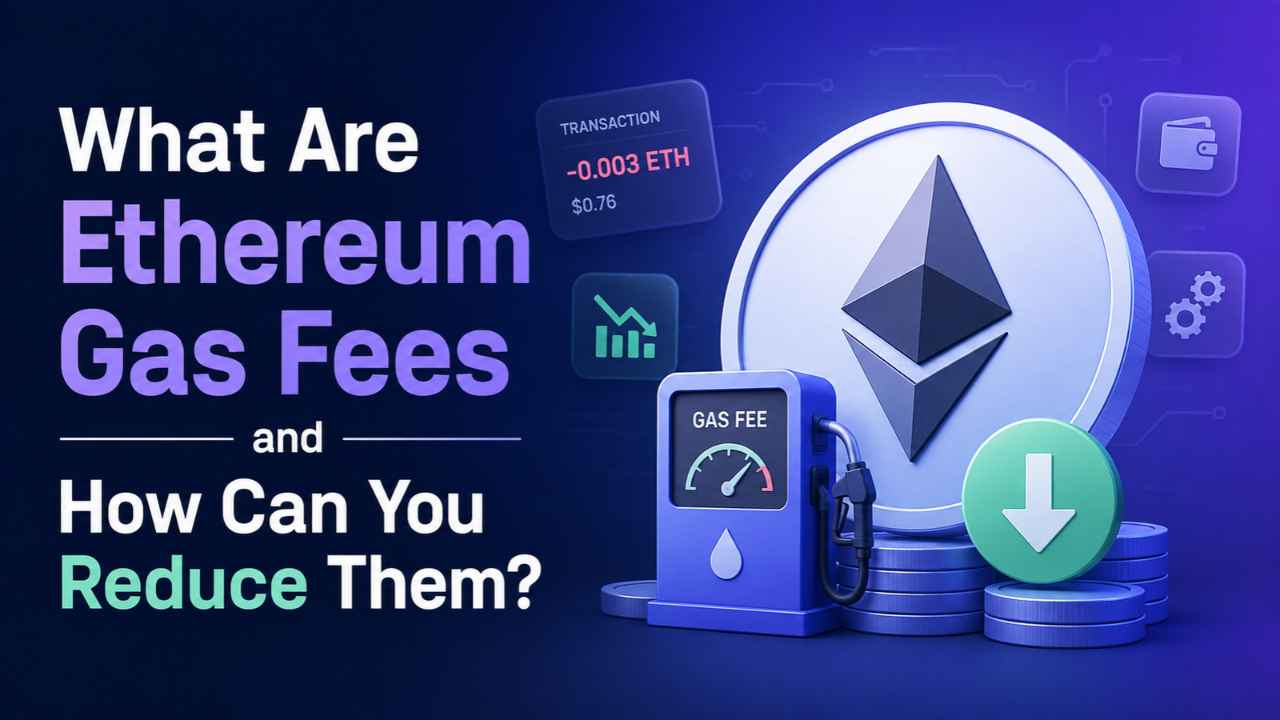
Send ETH to a friend, swap a token, or mint an NFT, and Ethereum asks you to pay for it in gas. New users often assume this is some kind of gimmick fee. It is not. Gas is what keeps the network running, and understanding it is one of the first real skills anyone learns in this crypto guide to Ethereum. The good news for 2026 is that gas fees are cheaper than they have been in years, but the mechanics still trip people up.
What Are Ethereum Gas Fees
Gas is the cost of computation on Ethereum. Every transfer, swap, or smart contract call makes validators do work, and that work is not free. Gas fees pay for it. The fee is priced in gwei, a tiny unit of ETH where one gwei equals 0.000000001 ETH. Think of gas as fuel for a car. A short trip to the corner store, like a plain ETH transfer, needs very little. A cross country drive, like a complex DeFi swap touching multiple contracts, burns a lot more.
Ethereum introduced this system back in 2015, borrowing loosely from Bitcoin’s transaction fee idea but adapting it for a network that runs full programs, not just simple transfers. Since the London upgrade in August 2021, every fee splits into two parts under EIP-1559: a base fee that is burned permanently, and a priority tip that goes to the validator who includes your transaction. That burn mechanism is why heavy Ethereum usage quietly makes ETH more scarce over time.
How Ethereum Gas Fees Are Calculated
The formula is simple once you see it: Gas Fee = Gas Units Used x (Base Fee + Priority Tip). A basic ETH transfer between two wallets uses a fixed 21,000 gas units. An ERC-20 token transfer needs more, typically 45,000 to 65,000 units, because it has to update a balance inside the token’s smart contract. A Uniswap style swap can run 100,000 to 200,000 units or higher, since it touches liquidity pools, price curves, and sometimes an approval transaction first.
Here is a real example using mid-2026 conditions. Etherscan’s gas tracker showed average mainnet gas sitting around 0.14 gwei in August 2026. For a plain transfer, that is 21,000 gas multiplied by 0.14 gwei, which comes out to roughly 2,940 gwei, or about 0.00000294 ETH. At current ETH prices, that is a fraction of a cent. Three years ago, the same transfer at 70 gwei and a higher ETH price would have cost several dollars.
Why Gas Fees Used to Be So Painful
Rewind to 2021. NFT mints and DeFi swaps during peak congestion regularly cost $50 to $100, and gas prices spiked past 200 gwei during hype cycles. The problem was blockspace scarcity. Every rollup, every DeFi trade, and every simple transfer competed for the same limited slots in each block, so demand spikes turned into brutal fee auctions. Ethereum’s mainnet capacity simply could not keep up with how many people wanted to use it at once.
That pain is exactly what pushed Ethereum toward a rollup centric roadmap, where most everyday activity moves to Layer 2 networks like Arbitrum, Base, and Optimism, while the main chain focuses on security and settlement.
What Changed by 2026
Three upgrades did most of the heavy lifting. Dencun, activated in March 2024, introduced blob transactions through EIP-4844, giving Layer 2 rollups their own dedicated data lane instead of forcing them to compete with regular mainnet traffic. That single change cut L2 fees by roughly 90 percent almost overnight.
Pectra followed in May 2025, expanding blob capacity further and adding EIP-7702, which lets ordinary wallets temporarily behave like smart contracts. This unlocked gas sponsorship, batched transactions, and easier account recovery for everyday users, not just developers.
Then came Fusaka in December 2025, which deployed PeerDAS technology and pushed the gas limit from 30 million toward 60 million, with a longer term target of 150 million. By early to mid 2026, this combination brought mainnet base fees down to a range of roughly 0.1 to 0.5 gwei on typical days, according to Etherscan and multiple gas tracking sources. Layer 2 fees now routinely sit below one cent, and rollups handle somewhere between 58 and 65 percent of all Ethereum transaction volume.
How to Reduce Ethereum Gas Fees
Even in this cheaper environment, fees can still spike during major token launches, liquidation events, or viral NFT drops. Here is what actually moves the needle.
Move routine activity to Layer 2. Networks like Arbitrum, Base, and Optimism inherit Ethereum’s security through Dencun’s blob lane but charge a fraction of mainnet cost. For swaps, gaming, and social apps, there is rarely a reason to stay on L1 anymore.
Time your transactions. Gas demand follows daily and weekly patterns tied to US and Asian trading hours. Weekends and late night UTC hours are usually quieter. A gas tracker like Etherscan’s gastracker page shows live and historical patterns before you hit confirm.
Set a realistic priority tip instead of guessing. Wallets like MetaMask now estimate this automatically using eth_feeHistory data, but you can manually lower the tip for non-urgent transactions and save without meaningfully delaying confirmation.
Batch actions where possible. EIP-7702 style smart accounts let you bundle multiple actions, like an approval and a swap, into a single transaction instead of paying the base 21,000 gas cost twice.
Avoid failed transactions. Setting a gas limit below what a transaction actually needs causes it to revert, and you still pay for the gas already consumed. Always let your wallet simulate the transaction first using estimate gas rather than entering a number manually.
Common Mistakes That Waste Gas
A lot of gas gets wasted on habits rather than network conditions. Leaving unlimited token approvals open on old DeFi contracts you no longer use is one example, since some wallets periodically re-check them. Rushing transactions during a launch pump with an inflated priority fee is another, since panic bidding rarely gets you included faster once the block is already full. Bridging small amounts back and forth between L2s repeatedly also adds up, because each bridge transaction still touches L1 data costs.
This is also why comparing Ethereum to alternatives like Bitcoin or newer Layer 1 chains matters when you are deciding where to transact for a given use case. Understanding the broader Layer 2 landscape helps too. And if you want the deeper mechanics behind blobs and rollups, that is worth its own read.
FAQ
What is a gwei in Ethereum gas fees? Gwei is a denomination of ETH, equal to 0.000000001 ETH. Gas prices are quoted in gwei because raw ETH amounts would be too small and awkward to read for everyday transactions.
Why are Ethereum gas fees sometimes still high in 2026? Base fees are algorithmically tied to network congestion. Major token launches, large liquidation events, or viral NFT mints can still push demand above target block capacity, causing short term spikes even though average fees are historically low.
Do Layer 2 networks fully replace the need to use Ethereum mainnet? Not entirely. L2s handle execution and inherit security through data posted back to Ethereum, but withdrawals, high value settlement, and some DeFi protocols still rely on mainnet, so understanding both layers still matters.
Is it cheaper to transact on weekends? Generally yes. Gas demand often dips during weekends and outside peak US and Asian trading hours, though this is a pattern, not a guarantee, and major events can override it.
What happens if I set my gas limit too low? The transaction fails and reverts once it runs out of gas, but you still pay for the computation already performed up to that point. Using your wallet’s built in gas estimate avoids this.
Sources: Etherscan Gas Tracker (August 2026), ethereum.org Fusaka and Pectra documentation, CoinGecko Fusaka upgrade explainer.