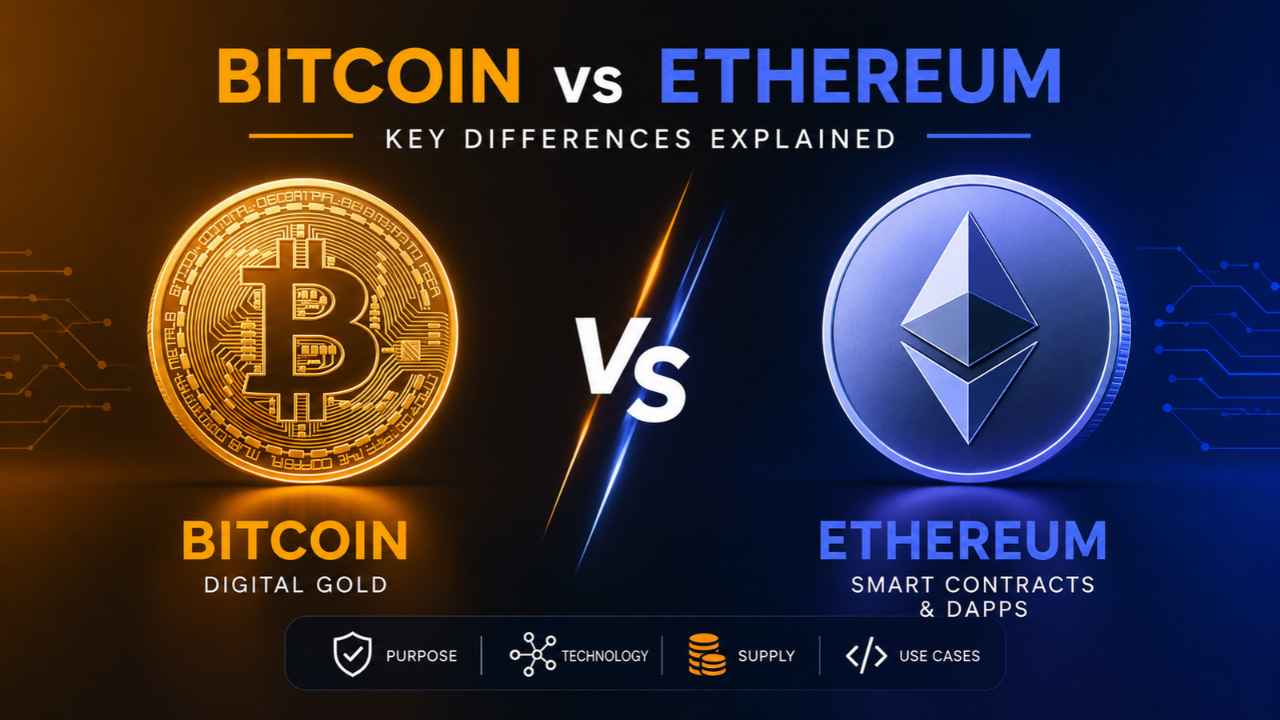
Ask ten crypto traders whether to buy Bitcoin or Ethereum and you will get ten different answers, most of them confident and half of them wrong. That is because BTC and ETH are not really competing for the same job. One was built to be digital gold. The other was built to be a global computer that anyone can build on. Understanding that split is the fastest way to stop comparing apples to oranges and start making an actual decision.
This crypto guide breaks down the real, structural differences between the two biggest assets in the market, not just price charts, so you can decide what fits your portfolio.
What Is Bitcoin, In Simple Terms
Bitcoin launched in January 2009 as the first successful attempt at money that does not need a bank, a government, or any middleman to move. Its entire design revolves around one number: 21 million. That is the hard cap on how many BTC will ever exist, and roughly 19.9 to 20 million of those coins are already mined. Analysts estimate another 3 to 4 million are permanently lost in dead wallets, which tightens the real supply even further.
Bitcoin runs on proof of work, a system where miners burn electricity to validate transactions and secure the network. It is deliberately simple. There is no smart contract layer, no app ecosystem, and almost no scripting beyond basic transfers. That simplicity is the whole point. Bitcoin’s developers prize caution over speed, and the network has barely changed at its core in over a decade.
Related Readings
What Is Ethereum, In Simple Terms
Ethereum launched in 2015 with a completely different goal. Instead of just moving value, it wanted to run code. Developers can build decentralized apps, lending markets, NFT platforms, and entire financial systems directly on top of Ethereum using smart contracts. That is why people call it programmable money rather than digital gold.
Ethereum switched from proof of work to proof of stake in September 2022, an upgrade known as the Merge. Validators now stake ETH instead of mining with hardware, and that staking currently pays out somewhere around 3 to 5 percent annual yield. Unlike Bitcoin, Ethereum has no fixed supply cap. Its total circulating supply sits near 120.6 million ETH, and where that number goes next depends on network activity rather than a hardcoded rule.
Bitcoin vs Ethereum: Key Differences Explained (Comparison Table)
| Factor | Bitcoin (BTC) | Ethereum (ETH) |
|---|---|---|
| Launch year | 2009 | 2015 |
| Core purpose | Store of value, digital gold | Programmable smart contract platform |
| Supply cap | Fixed at 21 million | No fixed cap, net deflationary in high-activity periods |
| Consensus mechanism | Proof of work (mining) | Proof of stake (staking) since the Merge |
| Native yield | None | Roughly 3 to 5 percent annual staking yield |
| Primary use case | Holding, hedging, treasury reserve | DeFi, NFTs, tokenization, dApps |
| Market cap (2026) | Roughly 1.3 to 1.6 trillion dollars | Roughly 220 to 280 billion dollars |
| DeFi TVL share | Minimal on-chain DeFi activity | Around 50 to 60 percent of all-chain DeFi TVL |
Supply and Scarcity: Two Very Different Philosophies
Bitcoin’s scarcity is mechanical and permanent. Every four years, the block reward given to miners is cut in half, an event called the halving. The most recent one hit in April 2024, dropping issuance to roughly 165,000 new BTC a year. Nobody can change this schedule without breaking consensus across the entire network. That predictability is exactly why institutions treat Bitcoin like digital gold.
Ethereum plays a different game. Since the EIP-1559 upgrade in August 2021, a portion of every transaction fee gets burned instead of paid to validators. When network demand is high, that burn rate can exceed new ETH issuance, making the asset net deflationary. When activity slows down, issuance can tick slightly positive again. Roughly 72 percent of ETH supply is currently locked in staking or DeFi protocols, which compresses the freely tradable float considerably.
Technology: Store of Value vs Programmable Platform
Bitcoin’s blockchain is intentionally limited. It settles transactions and little else, and that restraint is a security feature, not a shortcoming. Fewer moving parts mean fewer things that can break or get exploited.
Ethereum’s blockchain does far more, and that comes with tradeoffs. Every DeFi protocol, NFT marketplace, and Layer 2 rollup runs through Ethereum’s base layer or settles back to it eventually. This has made Ethereum the backbone of decentralized finance, but it also means more surface area for bugs, exploits, and congestion during busy periods. Layer 2 networks like Arbitrum and Optimism exist specifically to ease that pressure.
Market Position and Institutional Adoption in 2026
Bitcoin still dominates the crypto market by a wide margin, holding somewhere around 57 to 59 percent market dominance through much of 2026. Spot Bitcoin ETFs have pulled in tens of billions of dollars in cumulative inflows since their 2024 debut, and US ETF products now hold roughly 12 percent of total BTC supply. MicroStrategy and a growing list of corporate treasuries continue stacking BTC as a reserve asset.
Ethereum’s institutional story looks different but is far from small. Spot Ethereum ETFs have drawn billions in inflows of their own, and asset managers including BlackRock, JPMorgan, and Franklin Templeton already run live tokenization programs on Ethereum covering money market funds and bonds. MicroStrategy chairman Michael Saylor summed up the split well when he called Bitcoin digital gold and Ethereum digital oil, a framing BlackRock has effectively adopted by holding both as complementary rather than competing bets.
Fees, Speed and Everyday Usability
Bitcoin transactions can take 10 minutes or more to confirm and fees spike hard during busy periods, since block space is limited by design. It was never built for fast micropayments.
Ethereum’s base layer also gets congested, but its Layer 2 ecosystem now handles a large share of everyday activity at a fraction of the cost and time. For someone actually using DeFi apps, swapping tokens, or minting NFTs, Ethereum’s ecosystem generally feels faster and cheaper day to day than transacting directly on Bitcoin’s base chain.
Which One Should You Choose
Neither asset is objectively better, and framing it that way misses the point entirely. Bitcoin suits investors who want a simple, predictable hedge against currency debasement and are comfortable holding through long, boring stretches. Ethereum suits investors who want exposure to the growth of decentralized finance, tokenization, and Web3 infrastructure, along with a native yield that Bitcoin simply does not offer.
Many serious portfolios in 2026 hold both rather than picking a side, treating BTC as the stability anchor and ETH as the growth and yield component. As always, do your own research and never invest more than you can afford to lose, especially given how sharply both assets can swing in either direction.
FAQ: Bitcoin vs Ethereum
Is Bitcoin or Ethereum a better investment in 2026? It depends on your goal. Bitcoin offers simpler, more predictable scarcity and works well as a long-term store of value. Ethereum offers exposure to DeFi growth and a staking yield of roughly 3 to 5 percent, but it carries higher volatility.
Will Ethereum ever flip Bitcoin’s market cap? This is called the Flippening. As of 2026, Bitcoin’s market cap is still several times larger than Ethereum’s, so a full flip remains possible in theory but far from imminent given the current gap.
Does Ethereum have a maximum supply like Bitcoin? No. Bitcoin is hard capped at 21 million coins. Ethereum has no fixed supply ceiling, though its EIP-1559 burn mechanism can make it net deflationary during periods of high network activity.
Can you earn passive income holding Ethereum? Yes. Ethereum holders can stake ETH to help secure the network and earn roughly 3 to 5 percent annual yield. Bitcoin has no native staking mechanism since it runs on proof of work rather than proof of stake.
Which is more energy efficient, Bitcoin or Ethereum? Ethereum, by a wide margin. Since switching to proof of stake in September 2022, Ethereum’s energy use dropped dramatically compared to Bitcoin’s proof of work mining, which still consumes an estimated 95 terawatt hours annually.
Should beginners buy Bitcoin or Ethereum first? Most beginners start with Bitcoin because it is simpler to understand and less exposed to smart contract risk. Ethereum makes sense once you want to explore DeFi, staking, or NFTs directly
Sources: CoinLaw Bitcoin vs Ethereum Statistics 2026, Messari Bitcoin vs Ethereum Comparative Report, VanEck Bitcoin vs Ethereum 2026 Outlook, Cambridge Centre for Alternative Finance (CBECI), Spoted Crypto 2026 Long-Term Investment analyses.