
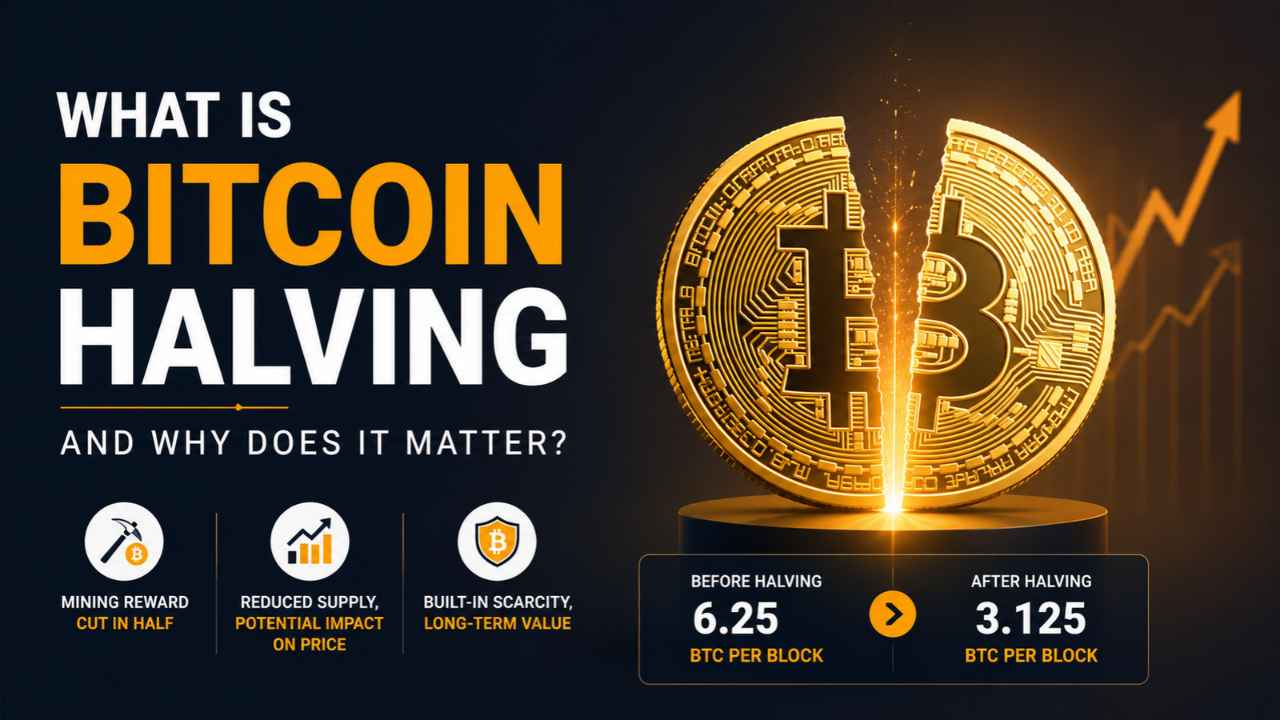
Every four years or so, something happens deep inside Bitcoin’s code that quietly reshapes the entire crypto market. It is called the halving. If you have spent any time reading crypto news this year, you have probably seen the term thrown around alongside big price swings and even bigger predictions. So what is Bitcoin halving, really, and why does it matter enough to move a trillion dollar market? Let us break it down properly.
What Is Bitcoin Halving?
Bitcoin halving is a pre programmed event that cuts the reward miners earn for validating transactions exactly in half. It happens automatically, once every 210,000 blocks, which works out to roughly every four years. There is no company, founder, or government pulling the lever. It is written straight into Bitcoin’s source code by Satoshi Nakamoto back in 2009, and it cannot be changed without the consensus of the entire network.
Think of it as Bitcoin’s built in inflation brake. Instead of a central bank deciding how much new currency enters circulation, Bitcoin’s supply schedule was fixed from day one. Halving is the mechanism that enforces it, block after block, cycle after cycle.
How Bitcoin Halving Actually Works
Bitcoin miners use computing power to solve complex puzzles and add new blocks to the blockchain. In return, they earn newly minted BTC plus transaction fees. This block reward started at 50 BTC in 2009. After the first halving in 2012, it dropped to 25 BTC. It has been cut in half three more times since, most recently in April 2024, when the reward fell from 6.25 BTC to the current 3.125 BTC per block.
Miners currently produce around 450 new BTC per day. After the next halving, that number drops to roughly 225 BTC per day. Fewer new coins entering circulation, same or growing demand. That imbalance is the entire economic logic behind why halving gets so much attention.
Bitcoin Halving History: A Quick Timeline
| Halving | Date | Block Height | Reward Change |
|---|---|---|---|
| 1st | November 2012 | 210,000 | 50 BTC to 25 BTC |
| 2nd | July 2016 | 420,000 | 25 BTC to 12.5 BTC |
| 3rd | May 2020 | 630,000 | 12.5 BTC to 6.25 BTC |
| 4th | April 2024 | 840,000 | 6.25 BTC to 3.125 BTC |
| 5th (expected) | April 2028 | 1,050,000 | 3.125 BTC to 1.5625 BTC |
Historically, each halving has been followed by a strong rally, though never on the same day. In the 2012 to 2013 cycle, Bitcoin jumped from about 12 dollars to over 1,170 dollars. After the 2016 halving, it climbed toward 19,400 dollars by late 2017. Following 2020, it touched roughly 66,700 dollars in 2021. These gains typically showed up 12 to 18 months after the actual event, not immediately.
Why Does Bitcoin Halving Matter?
It Reinforces Scarcity
Bitcoin has a hard cap of 21 million coins, and over 19.8 million have already been mined. Halving is what slows down the remaining issuance. Every four years, new supply growth gets cut in half, which is why people call Bitcoin digital gold. Unlike gold, though, its scarcity schedule is completely predictable and cannot be mined faster no matter how much demand rises.
It Squeezes Miner Economics
Halving instantly cuts miner revenue in half unless the price rises to compensate. Miners with older, less efficient hardware often become unprofitable and shut down, which can briefly reduce network hashrate. This forces the industry to upgrade equipment and chase cheaper electricity, a pattern that has repeated after every single halving so far.
It Shapes Market Psychology
Even before a halving arrives, traders position around it. The countdown itself becomes a talking point across exchanges, YouTube, and X, drawing fresh retail attention to Bitcoin and often the wider altcoin market alongside it. Whether or not that hype is fully rational, it has been a consistent feature of every cycle since 2012.
2026 Brings a New Variable: ETFs
This cycle looks different from the previous ones. Spot Bitcoin ETFs in the United States now hold more than 1.3 million BTC, worth tens of billions of dollars, creating a layer of institutional demand that simply did not exist in 2012, 2016, or even 2020. Some analysts argue this structural buying could soften the old boom and bust rhythm tied purely to halving cycles.
The Next Bitcoin Halving: What to Expect in 2028
The fifth halving is projected for around April 2028, at block height 1,050,000, when the reward drops from 3.125 BTC to 1.5625 BTC. The exact date shifts slightly depending on how fast blocks are mined, since Bitcoin targets a 10 minute block time but actual timing varies with network hashrate. Annual supply inflation is expected to fall from roughly 0.79 percent to about 0.39 percent once the reward cut takes effect.
By that point, less than 5 percent of all Bitcoin will remain unmined. Every halving pushes Bitcoin closer to its final coin, expected to be mined sometime around the year 2140, after which miners will rely entirely on transaction fees.
What Bitcoin Halving Means for Investors Right Now
As of August 2026, Bitcoin has been trading in a wide range through the year, dipping into the low 60,000 dollar zone before a sharp rally pushed it back above 70,000 dollars on renewed Treasury liquidity moves and progress on the Clarity Act in Washington. None of that daily noise changes the underlying halving math, but it is a reminder that price in any given month is driven by many overlapping forces, not the halving cycle alone.
If you are holding BTC with a multi year horizon, the halving is one input among several, not a guaranteed trigger for an immediate rally. Combine it with liquidity conditions, regulatory news, and institutional flows before making decisions, and never invest based on a countdown clock alone.
Related Readings:
Common Myths About Bitcoin Halving
A lot of misinformation circulates around halving season, so it helps to separate fact from hype.
- Myth: Price always spikes on halving day. Reality: past rallies took months to build, not hours.
- Myth: Halving stops Bitcoin mining. Reality: it reduces miner rewards, it does not stop the network.
- Myth: Every cycle repeats identically. Reality: ETF flows and macro conditions now play a much bigger role than before.
Frequently Asked Questions
What is Bitcoin halving in simple terms? It is an automatic event in Bitcoin’s code that cuts the reward miners earn for confirming transactions by 50 percent, roughly every four years.
Why does Bitcoin halving matter for price? It slows the rate of new BTC entering circulation. If demand stays steady or grows while new supply shrinks, basic scarcity economics can push prices higher over time, though not instantly.
When is the next Bitcoin halving? The fifth halving is expected around April 2028, at block height 1,050,000, cutting the reward from 3.125 BTC to 1.5625 BTC.
How many Bitcoin halvings have happened so far? Four halvings have occurred, in 2012, 2016, 2020, and 2024. A total of 32 more are expected before the last Bitcoin is mined around 2140.
Does Bitcoin halving affect miners badly? It cuts their block reward revenue instantly. Less efficient miners often become unprofitable and exit, while larger operations upgrade hardware to stay competitive.
Is Bitcoin halving good or bad for investors? Historically it has coincided with strong multi month rallies, but past performance never guarantees future results. Treat it as one factor among many, not a standalone signal.