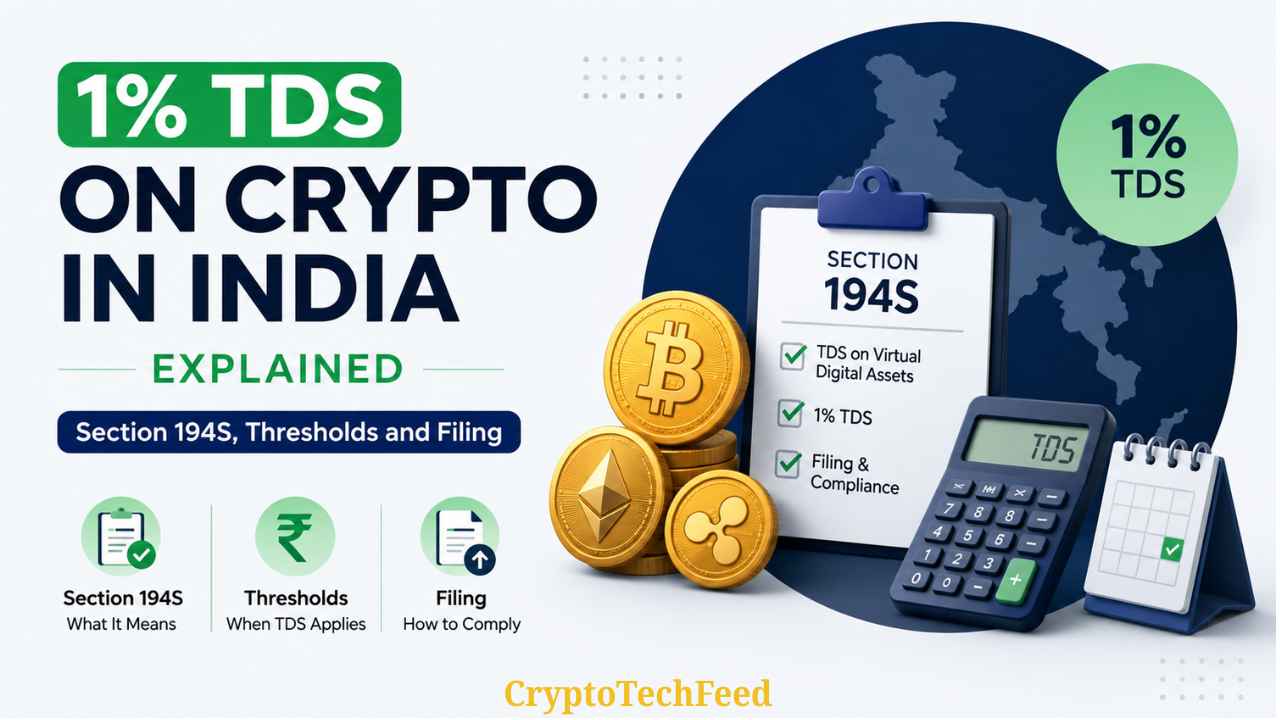
Open a crypto sell order on any Indian exchange and something quietly happens before the money ever reaches your bank account. One rupee out of every hundred gets pulled aside and sent straight to the government. That is the 1% TDS on crypto in India, and if you have ever wondered why your payout never quite matches what the trade screen showed you, this is the answer. It is not a new tax stacked on top of your existing crypto liability. It is something sneakier and, once you understand it, far less confusing, a tracking mechanism wearing a tax’s clothing.
What the 1% TDS on Crypto Actually Is
TDS stands for Tax Deducted at Source, and under Section 194S of the Income Tax Act, 1% of the transaction value gets withheld every time you transfer a Virtual Digital Asset above a set threshold. It began on 1 July 2022 through the Finance Act 2022, and it survived the transition into the new Income Tax Act 2025 largely untouched, just renumbered on paper. The government was never primarily chasing that 1%. It was chasing visibility. Before this rule, crypto trades left almost no paper trail the tax department could see. Now every qualifying trade generates a record tied directly to your PAN.
Related reading: 30% Crypto Tax in India Explained
How Section 194S Works, Step by Step
The mechanics are simpler than the legal language suggests. Whenever a Virtual Digital Asset changes hands for consideration, whether that is crypto sold for INR or one coin swapped for another, the payer withholds 1% of the transaction value at the time of credit or payment, whichever happens first. On Indian exchanges like Mudrex and CoinDCX, this happens automatically in the background under CBDT Circular 13/2022, so you never manually calculate or send it yourself. The withheld amount gets deposited with the government and shows up later against your PAN in Form 26AS and the Annual Information Statement, the same records your income tax return gets cross checked against.
Who Deducts It and When It Kicks In
Technically, the buyer carries the deduction obligation, not the seller, which surprises a lot of first time traders. In practice, when you trade through a registered Indian exchange, the platform itself acts as the deductor on your behalf, so the distinction rarely matters day to day. It matters far more on peer to peer trades or decentralized exchanges without a built in compliance layer, where the buyer is directly responsible for withholding and depositing the 1% themselves, and failing to do so creates real penalty exposure. Section 194S also strictly applies only when the seller is an Indian tax resident, which is why cross border DEX activity sits in murkier territory.
Also read on CryptoTechFeed: Crypto Tax in India 2026: Complete Guide
Specified Person vs Other Person: Threshold Comparison
Not every trade triggers TDS immediately, and the threshold depends on who you are under the law. This distinction trips up more investors than almost anything else in this section.
| Category | Annual Threshold | Who Qualifies |
|---|---|---|
| Specified Person | Rs 50,000 | Individuals or HUFs with no business income, or business turnover up to Rs 1 crore, or professional receipts up to Rs 50 lakh |
| Any Other Person | Rs 10,000 | Everyone else, including higher turnover businesses and most active traders |
| No PAN Provided | 20% flat rate | Applies to any seller who has not furnished a valid PAN, regardless of category |
These thresholds apply as an annual aggregate, not per transaction, which is the single most common misunderstanding among casual investors.
A Worked Example With Real Numbers
Say you sell Bitcoin worth Rs 1,00,000 on a registered exchange. The platform withholds Rs 1,000 as TDS before the trade settles, so Rs 99,000 lands in your account, and the Rs 1,000 gets logged against your PAN. That Rs 1,000 is not lost money. It becomes a credit you claim back when filing your return under Schedule VDA. If your actual tax liability for the year, calculated at the flat 30% rate under Section 115BBH plus 4% cess, comes out lower than the TDS already collected, you get the difference refunded. TDS is an advance, not an extra bill layered on top of your existing 30% obligation.
Why Active Traders Feel This the Hardest
For a long term holder making one or two trades a year, 1% barely registers. For someone trading frequently, the math turns brutal fast. Every single trade bleeds 1% of its full transaction value regardless of whether that specific trade was profitable, and because crypto losses cannot be set off against gains under Indian tax law, a string of small losing trades still triggers TDS on every leg. A trader running twenty trades a month against Rs 20 lakh in cumulative volume could see Rs 20,000 or more withheld in TDS alone, even if their actual net profit for the month barely clears Rs 10,000. This cash flow squeeze, more than the 30% tax itself, is what pushed a lot of high frequency trading volume toward offshore platforms outside India’s TDS net.
How to Claim Your TDS Credit at Filing Time
Claiming your TDS credit back is mostly a matching exercise rather than an application. Every trade an Indian exchange deducts TDS on gets reported quarterly through Form 26Q or Form 26QE, and that data feeds directly into your Form 26AS and Annual Information Statement. When you file your return, cross check the TDS figure the exchange reports against your own transaction history before claiming the credit under Schedule VDA. If you traded through a foreign exchange or a P2P deal where no TDS was deducted, you still owe the full 30% on any gains, you simply have no credit to offset it with. Tools like KoinX and TaxNodes have become common precisely to reconcile this across multiple platforms.
Common Mistakes Investors Make With Crypto TDS
The most frequent error is assuming the threshold resets with every trade rather than accumulating across the financial year, which leads to surprise deductions midway through the year once cumulative volume crosses the line. A close second is confusing the 1% TDS with the actual tax owed, then being caught off guard when the real bill arrives at 30% come filing season. Investors also regularly forget that crypto to crypto swaps count as taxable transfers under Section 194S just like INR sales, not some kind of tax free grey zone. And traders using multiple exchanges often fail to reconcile TDS credits across platforms, leaving legitimate refunds unclaimed simply because nobody added up the fragments.
Frequently Asked Questions
What is the 1% TDS on crypto in India? It is a tax deduction under Section 194S that withholds 1% of a crypto transaction’s value at the time of transfer, acting as an advance credit against your final 30% tax liability.
Who deducts the 1% TDS on crypto transactions? The buyer is legally responsible, but on registered Indian exchanges the platform automatically deducts and deposits it on your behalf.
Is the 1% TDS an additional tax on top of the 30%? No, it is an advance payment. You claim it as a credit when filing your return, and only pay the remaining tax owed after that credit is applied.
Does TDS apply to crypto to crypto swaps? Yes, swapping one cryptocurrency for another counts as a transfer under Section 194S and triggers the same 1% deduction as selling for INR.
What happens if I do not provide my PAN for a crypto trade? The TDS rate jumps from 1% to 20% of the transaction value if a valid PAN is not furnished.
Can I get my TDS refunded if I made a loss? Yes, if your total tax liability for the year is lower than the TDS already deducted, the excess is refundable when you file your income tax return.
Sources
This piece draws on Section 194S of the Income Tax Act, CBDT Circular 13/2022, and the Finance Act 2022, cross checked against 2026 filing guidance from ClearTax, CoinDCX and TaxGarden.