
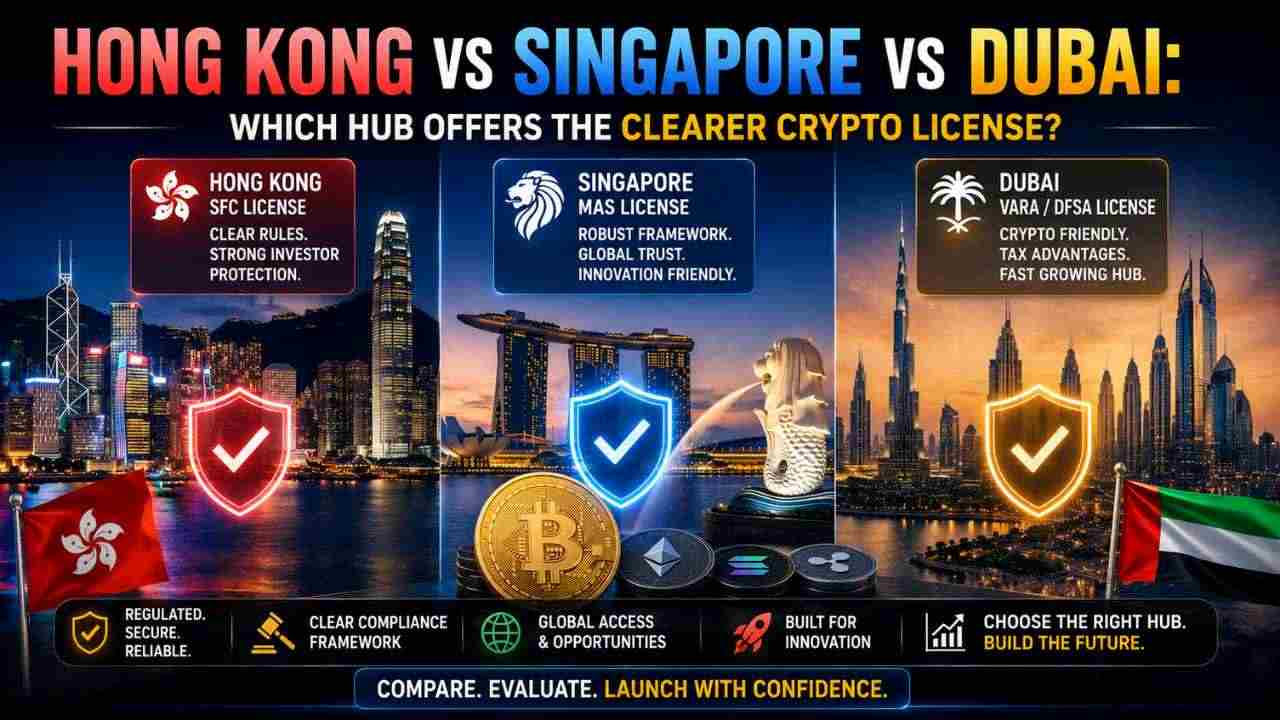
On June 29, 2026, Dubai’s regulator quietly approved its fiftieth virtual asset license, handing it to a tokenization platform most people outside the industry have never heard of. That single approval put Dubai ahead of Singapore and Hong Kong on paper, and crypto Twitter treated it like a scoreboard update. It is not that simple. Each of these three cities regulates a different slice of the crypto industry, counts licenses differently, and asks for wildly different amounts of capital and patience before a founder can legally open shop. Picking a hub on headline numbers alone is exactly the mistake compliance officers warn against.
Also read: MiCA Compliance: What Exchanges and Web3 Startups Need to Know to Operate in the EU
Dubai and VARA: The Activity Based Fast Mover
Dubai built its crypto reputation on speed, and the numbers back that reputation up. The Virtual Assets Regulatory Authority, a standalone crypto regulator running since March 2022, licenses across seven distinct activity categories rather than forcing every business into one generic bucket. The process now runs in two stages, an Approval to Incorporate followed by the Full Market Product VASP license, typically closing in four to eight months. Corporate tax sits at just 9 percent, with the first AED 375,000 taxed at zero, and some qualifying free zone activities can reach zero corporate tax entirely. The catch is real substance. VARA expects a physical Dubai office, local senior management, and a UAE resident compliance officer, so a letterbox entity will not pass review.
Singapore and MAS: The Seal of Quality With a Slower Clock
Singapore plays a different game entirely, and its reputation reflects that. The Monetary Authority of Singapore does not run a standalone crypto regulator the way Dubai does, instead folding digital payment token services into its existing payments licensing regime. That structure means a Singapore license doubles as approval to handle crypto and traditional fiat processing under one roof, which is exactly why major payment institutions gravitate here. The tradeoff is procedural weight. MAS runs one of the most demanding licensing regimes in Asia, minimum paid up capital sits at SGD 250,000, and approval timelines routinely stretch well past what Dubai offers. What you get in exchange is a license widely treated as a genuine seal of quality across institutional crypto.
Hong Kong and SFC: Narrow, Institutional, and Finally Open to Retail
Hong Kong’s Securities and Futures Commission takes the narrowest approach of the three, licensing virtual asset trading platform operators specifically rather than the broader activity categories Dubai covers. That narrower scope explains why Hong Kong’s headline license count sits so far below the other two, just 13 formally licensed platforms as of mid 2026. The capital bar is steep too, HKD 5 million in paid up capital plus another HKD 3 million in liquid assets on top. What makes Hong Kong worth watching in 2026 specifically is retail access. The city has now fully opened its doors to retail crypto trading, positioning itself as the primary regulated bridge to liquidity flowing out of Mainland China, a role neither Dubai nor Singapore can realistically claim.
Comparison Table: Cost, Timeline, Capital and Tax Side by Side
| Factor | Dubai (VARA) | Singapore (MAS) | Hong Kong (SFC) |
|---|---|---|---|
| Regulator type | Standalone crypto regulator | Payments regime, DPT license | Securities regulator, VATP regime |
| Licensed entities (2026) | 50 VASPs | 37 major payment institutions | 13 trading platforms |
| Typical timeline | 4 to 8 months | Longer, procedurally heavy | Multi stage, institutional pace |
| Minimum capital | Varies by activity category | SGD 250,000 | HKD 5 million paid up plus HKD 3 million liquid |
| Corporate tax | 9 percent, 0 percent on first AED 375,000 | Standard Singapore corporate tax applies | Standard Hong Kong profits tax applies |
| Best fit | Exchanges, custody, tokenization, fast market entry | Payment institutions blending fiat and crypto | Institutional platforms targeting retail and Mainland liquidity |
What the License Counts Actually Mean, and Why They Mislead
Treating 50, 37 and 13 as a simple ranking is the exact trap regulators themselves have warned against. Dubai counts broad VASP categories spanning everything from custody to tokenization. Singapore counts payment institutions operating inside a payments framework, not a dedicated crypto regime. Hong Kong counts exchange operators alone, nothing else. A license also does not equal an operating business. VARA itself has confirmed that of its licensed VASPs, only 39 were classified as fully operational by the end of 2025, meaning a chunk of that headline 50 is still moving through onboarding rather than serving clients. Anyone comparing these three cities purely on license totals is comparing three different measuring sticks and calling it one ranking.
Which Hub Fits Which Kind of Crypto Business
The right answer depends entirely on what you are building, not which city has the biggest number this quarter. A trading platform or exchange chasing fast market entry with broad activity coverage leans toward Dubai’s VARA regime. A payment institution that wants to blend crypto rails with traditional fiat processing, and values a license that reads as institutional grade to banking partners, fits Singapore’s MAS framework better despite the slower runway. A platform specifically targeting retail volume and Mainland Chinese liquidity has a genuinely strong case for Hong Kong, now that its retail doors are open, even with the steeper capital requirement. None of the three is objectively best. Each one is built for a different kind of crypto business to walk through its door.
Frequently Asked Questions
Which is the fastest crypto license to get, Dubai, Singapore or Hong Kong? Dubai’s VARA process is generally the fastest, closing in roughly four to eight months, compared to the longer and more procedurally demanding timelines in Singapore and Hong Kong.
Which jurisdiction has the most crypto licenses in 2026? Dubai leads with 50 licensed VASPs, ahead of Singapore’s 37 major payment institutions and Hong Kong’s 13 licensed trading platforms, though each regime licenses a different scope of activity.
Does Hong Kong allow retail crypto trading? Yes, as of 2026 Hong Kong has fully opened retail crypto trading and positions itself as a regulated bridge to liquidity from Mainland China.
What is the minimum capital for a Singapore crypto license? Singapore’s MAS requires a minimum paid up capital of SGD 250,000 for major payment institutions offering digital payment token services.
Is Dubai’s crypto tax rate lower than Singapore or Hong Kong? Dubai offers a 9 percent corporate tax rate with the first AED 375,000 taxed at zero, generally lower than standard corporate tax rates applied in Singapore and Hong Kong.