You’re scrolling your phone at 11pm. A headline pops up. “SEC issues statement on crypto asset classification.” Your stomach drops a little. Is this good news or bad news? Should you sell? Should you buy the dip? You skim three articles, get three different takes, and end up more confused than when you started.
Here’s the thing nobody tells you. Most crypto regulatory announcements are boring on purpose. Agencies write in a language designed to protect them legally, not to inform you quickly. Learning to read past that language is a skill, and once you have it, you stop reacting to headlines and start reading the actual document.
This guide walks through exactly how to do that. No law degree required.
Why This Actually Matters in 2026
Regulatory noise around crypto has picked up sharply this year. The SEC and CFTC signed a joint memorandum of understanding in March 2026 to coordinate oversight. Days later, the SEC put out a release clarifying how federal securities laws apply to crypto assets. In August, a new Regulation Crypto Assets proposal landed on the table. Add the CLARITY Act sitting in Senate procedure, MiCA enforcement playing out across Europe, and near weekly statements from individual commissioners, and you get a firehose of headlines competing for your attention.
Most traders never read the source. They read a summary of a summary, usually written by someone trying to get clicks, not clarity. That’s how “SEC opens comment period” turns into “SEC bans crypto” by the time it reaches your group chat. If you want a serious edge in 2026 crypto markets, reading the primary document yourself is one of the cheapest ways to get it.
The Five Parts of Every Announcement
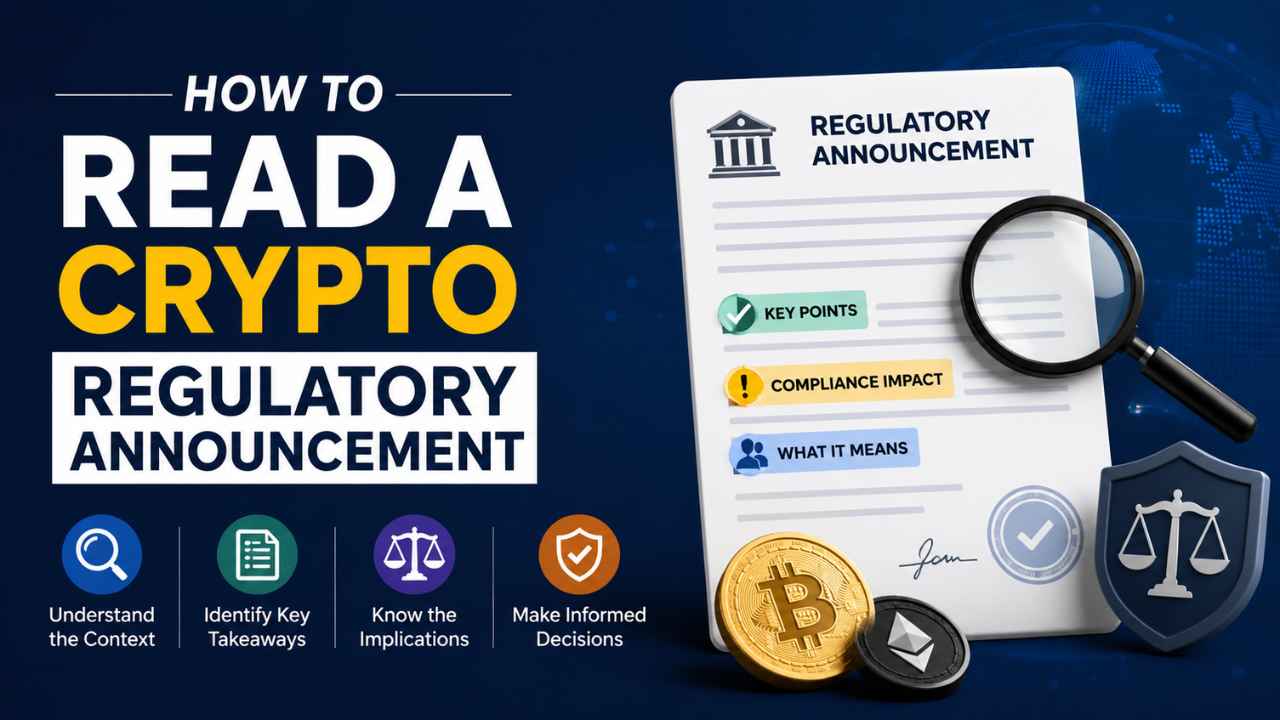
Strip away the legal dressing and almost every crypto regulatory announcement is built from the same five pieces. Once you can spot them, the document stops feeling like a wall of jargon and starts feeling like a form you’re filling in.
Who is speaking. Is this the agency itself, in an official press release, or one individual commissioner giving a personal statement? A speech from a single SEC commissioner carries their opinion. A joint press release from the SEC and CFTC carries institutional weight. Mixing these up is the single biggest reason people overreact to news that was never binding in the first place.
What kind of document it is. Rules, proposed rules, interpretive guidance, no action letters, enforcement actions, and speeches all sound similar in headlines but mean completely different things. A proposed rule is a draft still open to public comment. A final rule is law. A speech is one person’s opinion, even if that person runs the agency.
What action word is doing the work. Look for verbs like “proposes,” “clarifies,” “finalizes,” “charges,” or “settles.” “Proposes” means nothing has changed yet. “Finalizes” means it has. “Charges” means an enforcement case just started, not ended. Traders who skip straight to the headline miss this verb constantly, and it’s usually the difference between panic and patience.
When it actually takes effect. Announcements love to bury the effective date three paragraphs in, sometimes with a transition period attached. MiCA’s stablecoin rules, for example, came with a transitional deadline that gave firms until July 2026 to comply, not an overnight switch. Always scroll for the date before you trade on the headline.
Who it actually applies to. A rule aimed at custodians doesn’t touch your personal wallet. A statement about broker dealer custody of crypto securities has nothing to do with your Bitcoin sitting on an exchange app. Read the scope before you assume the news is about you.
A Quick Translation Table
Regulatory language has its own dialect. Here’s how to translate the phrases you’ll see most often into what they actually mean for your portfolio.
| What the announcement says | What it usually means |
|---|---|
| “Request for comment” or “proposed rule” | Nothing is final. This is a draft, open for public input, often for 30 to 90 days |
| “Clarifies” or “interprets existing law” | No new rule. The agency is explaining how it already reads current law |
| “No action letter” | Staff won’t recommend enforcement for a specific, narrow situation. Not a blanket approval |
| “Finalizes” or “adopts” | The rule is now law, usually with a stated effective or compliance date |
| “Charges” or “files complaint” | An enforcement case has started. It can take years and may end in dismissal or settlement |
| “Settles” | The case is over, but a settlement is not a court ruling on the underlying law |
| “Joint statement” | Two or more agencies agree on direction, but each keeps its separate legal authority |
Reading One Step by Step
Let’s actually do this with a real example. Take the SEC and CFTC’s joint memorandum of understanding from March 2026.
Step one, identify the speaker. This came from both agencies together, not one commissioner freelancing on a podcast. That already tells you it carries more institutional weight than a solo speech.
Step two, identify the document type. A memorandum of understanding is a coordination agreement between agencies, not a rule and not a law. It changes how the SEC and CFTC talk to each other internally. It does not, by itself, change what’s legal for you to trade.
Step three, find the action verb. The word here is “coordinate,” not “mandate” or “ban.” That single word tells you this is about reducing confusion between two regulators, not creating new restrictions on the market.
Step four, check the timing. MOUs typically take effect on signing and describe an ongoing process, not a hard deadline you need to prepare for.
Step five, check the scope. This affects how the two agencies classify and jointly review crypto products going forward. It’s relevant to exchanges and issuers navigating dual jurisdiction, less directly relevant to someone holding coins in a personal wallet.
Run through those five steps on any announcement and you’ll walk away knowing exactly how much it matters to you, instead of guessing from a headline.
Where People Get This Wrong
The most common mistake is treating every announcement as equally urgent. A speech from one commissioner at a conference gets the same panicked reaction as a finalized rule, even though only one of them actually changes anything. Slow down and check who’s speaking before you act.
The second mistake is stopping at the headline. Financial journalists compress a forty page release into one sentence, and something always gets lost. The actual PDF or press release, usually sitting right there on the agency’s own website, takes ten minutes to skim and clears up most of the confusion a headline creates.
The third mistake is ignoring jurisdiction entirely. A rule from the US SEC has no direct bearing on an exchange operating under MiCA in the EU, and Indian investors trading on FIU registered platforms are governed by an entirely separate framework built around Section 115BBH and the 1% TDS rule. Always ask which jurisdiction the announcement is even talking about before you assume it touches your holdings.
FAQ
Where can I find crypto regulatory announcements directly from the source? Go straight to the agency. The SEC posts press releases and commissioner statements on its crypto task force newsroom page. The CFTC, FinCEN, and international regulators like ESMA for MiCA all publish primary documents on their own official sites, usually before any news outlet covers them.
Is a proposed rule the same as a law? No. A proposed rule is a draft open for public comment, often for 30 to 90 days. It can change, get delayed, or get withdrawn before ever becoming binding. Only a finalized or adopted rule carries the force of law.
Does a lawsuit against a crypto company mean that coin is now illegal? Not automatically. An enforcement case is an allegation, not a verdict. Many cases end in dismissal or settlement without any admission of wrongdoing, and the underlying asset often keeps trading throughout the process.
How is this different for Indian crypto investors? US and EU announcements don’t automatically apply in India. Indian investors should track FIU-IND registration status for exchanges, RBI commentary, and any updates to the 30% flat tax under Section 115BBH or the 1% TDS under Section 194S, since these are the frameworks that actually govern trading here.
How often should I actually check regulatory news? Weekly is enough for most retail investors. Set up alerts for your specific jurisdiction’s primary regulator instead of scrolling general crypto news, and you’ll cut out most of the noise that causes overreaction.