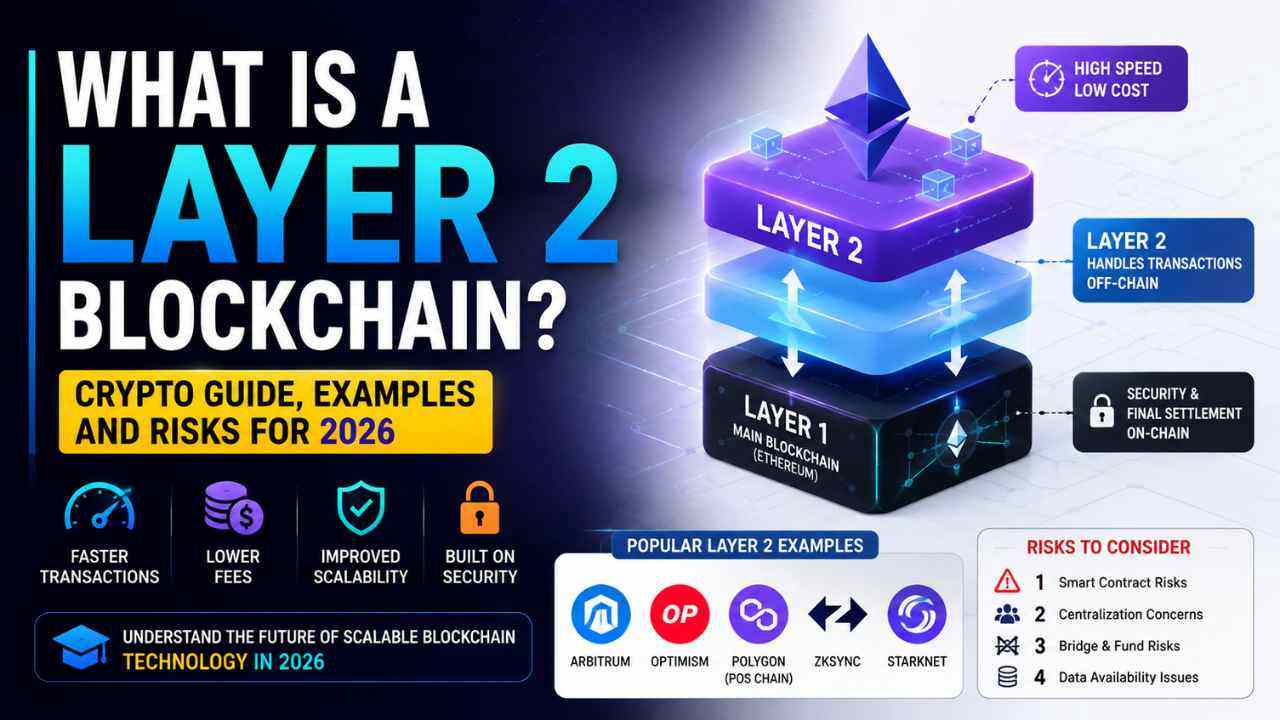
A Layer 2 blockchain is a separate network built on top of a Layer 1 blockchain like Ethereum, designed to process transactions faster and cheaper while still relying on the Layer 1 for final security. Think of it as a fast lane built above a crowded highway, one that still checks in with the highway’s traffic authority to keep everyone honest. In 2026, this fast lane is no longer a side experiment. It has become the primary place where Ethereum activity actually happens, with tens of billions of dollars now sitting on Layer 2 networks instead of Ethereum’s base chain itself.
Layer 2 Blockchain Explained
Skip the jargon for a second. Ethereum, the Layer 1, can only process a limited number of transactions per block, and every transaction competes for that limited space, driving fees up whenever the network gets busy. A Layer 2 solves this by handling transactions on its own separate chain, then bundling thousands of them together and posting a compressed summary back to Ethereum. Ethereum never has to process each individual swap or transfer, only the final proof that everything on the Layer 2 happened correctly. You get Ethereum grade security with a fraction of the cost and a fraction of the wait.
Why Layer 2 Blockchain Exists: The Problem It Solves
Back before Layer 2s matured, sending a simple token swap on Ethereum during a busy period could cost more than the transaction itself was worth, sometimes tens of dollars for a few seconds of block space. That is the blockchain trilemma at work, the idea that a network can only fully optimize two of three qualities at once: decentralization, security, and scalability. Ethereum chose to stay maximally decentralized and secure, which meant scalability had to come from somewhere else. Layer 2 networks are that somewhere else, inheriting Ethereum’s security guarantees while handling the actual transaction volume on infrastructure built specifically for speed.
How a Layer 2 Blockchain Actually Works
Most Layer 2s today are rollups, and the mechanics are genuinely elegant once you see the shape of it. Users transact on the Layer 2 network directly, where fees are low and confirmations are near instant. Periodically, the Layer 2 bundles a batch of these transactions and submits compressed transaction data back to Ethereum, along with a proof that the resulting state is valid. Ethereum stores that data and proof permanently, which means even if the Layer 2’s own operators disappeared tomorrow, users could theoretically reconstruct their balances directly from what Ethereum has recorded. That fallback guarantee is what separates a genuine rollup from a sidechain that merely borrows Ethereum’s branding.
Also Read: How Smart Contracts Work
Layer 2 Blockchain Examples in 2026, With Real TVL Data
The numbers here tell a consolidation story more than a competition story. According to The Block’s 2026 Layer 2 Outlook, total value locked across all Layer 2 networks has grown from under 4 billion dollars in 2023 to somewhere between 40 and 48 billion dollars by 2026, and nearly all of that growth has concentrated in a small handful of chains. L2BEAT data from May 2026 puts Arbitrum One at roughly 16.9 billion dollars in TVL, the single largest Layer 2 by that measure, with Base, Coinbase’s own rollup, following at somewhere between 10 and 13 billion dollars depending on the snapshot date. Together, Arbitrum and Base account for somewhere around three quarters of all Layer 2 value secured. Optimism, Starknet, Linea and zkSync Era make up most of the remaining share, with Base separately leading on daily active users and transaction count thanks to Coinbase’s built in distribution.
Optimistic Rollups vs ZK Rollups
Not every Layer 2 verifies its transactions the same way, and the split matters if you are choosing where to move funds. Optimistic rollups, the category Arbitrum, Base and Optimism all belong to, assume transactions are valid by default and only run a fraud check if someone formally disputes a batch within a set challenge window, usually about a week. Zero knowledge rollups, the category zkSync Era, Starknet and Linea belong to, generate a cryptographic proof for every batch upfront, which means finality is faster but historically at a cost of heavier engineering complexity. As of 2026, optimistic rollups still hold roughly 80 percent of total Layer 2 value according to industry trackers, even though ZK technology is generally considered the more elegant long term design.
Risks of Using a Layer 2 Blockchain
Layer 2s inherit Ethereum’s security for the data they post, but that does not make them risk free, and treating them as identical to Ethereum itself is a common beginner mistake. Many Layer 2 networks still rely on a centralized sequencer, a single operator ordering transactions, which creates a point of failure if that operator goes offline or acts maliciously. Withdrawing funds back to Ethereum from an optimistic rollup can take up to a week during the fraud proof challenge window, catching users off guard who expect instant access. Smaller or newer Layer 2s carry additional risk since dozens of rollups launched in 2024 and 2025 saw usage collapse once early incentive programs ended, and bridge contracts connecting Layer 2s to Ethereum remain a frequent target for exploits industry wide.
Read more: Hot Wallet vs Cold Wallet
How to Use a Layer 2 Blockchain Safely: Practical Steps
Getting started does not need to be complicated, but a few habits reduce risk meaningfully. Start by using only official bridge contracts linked directly from a project’s verified website, never a link shared in a random comment or direct message. Bridge a small test amount first before moving significant funds, since a wrong network selection on a wallet can send tokens to an address you cannot recover. Stick to established networks like Arbitrum, Base and Optimism for anything beyond experimentation, since they carry the deepest liquidity and longest operating track record. Keep your wallet’s network settings updated and double check the chain ID before confirming any transaction, and treat any Layer 2 offering unusually high yields as a signal to research harder, not to move faster.
Layer 2 Blockchain vs Layer 1 Blockchain: Quick Comparison
| Factor | Layer 1 (Ethereum) | Layer 2 (Arbitrum, Base, etc.) |
|---|---|---|
| Transaction fees | Higher, rises with congestion | Typically under 10 cents per transaction |
| Speed | Slower finality | Near instant on chain confirmation |
| Security model | Native, fully independent | Inherits Ethereum security via proofs |
| Decentralization | Highly decentralized validator set | Often relies on a centralized sequencer |
| Best for | Maximum security, base settlement | Everyday transactions, DeFi activity, apps |
Frequently Asked Questions
What is a Layer 2 blockchain in simple terms? A Layer 2 blockchain is a network built on top of a base blockchain like Ethereum that processes transactions faster and cheaper while still relying on the base chain for final security.
Is a Layer 2 as secure as Ethereum? It depends on the design. Rollups inherit strong security guarantees from Ethereum, but centralized sequencers and bridge contracts introduce risks that pure Ethereum transactions do not carry.
What are the biggest Layer 2 networks in 2026? Arbitrum and Base lead by total value locked, together accounting for roughly three quarters of all Layer 2 value, followed by Optimism, Starknet, Linea and zkSync Era.
How long does it take to withdraw funds from a Layer 2? Optimistic rollups like Arbitrum and Optimism can take up to about a week due to the fraud proof challenge window, while some ZK rollups offer faster finality.
Do I need a different wallet for a Layer 2? No, most Layer 2 networks work with standard wallets like MetaMask. You simply add the Layer 2 network and bridge funds across from the base chain.