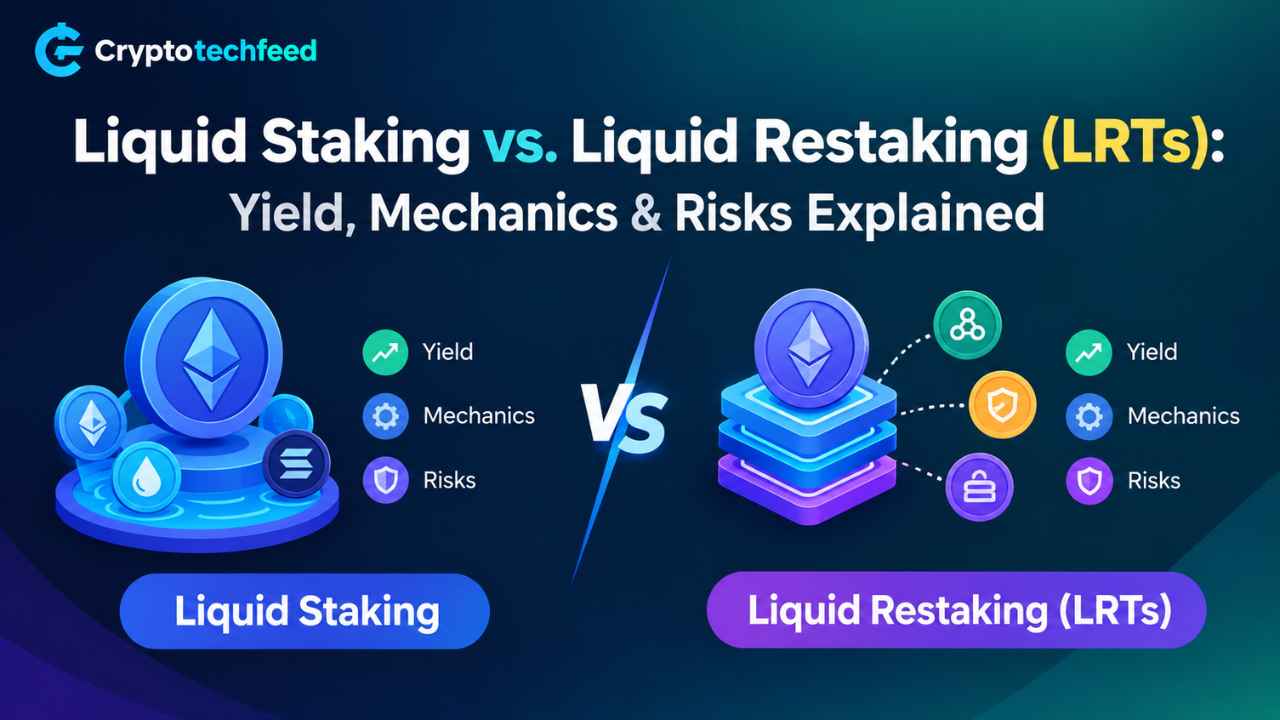
A friend messaged me last month asking why his stETH was suddenly earning “half of what his cousin’s eETH was making.” Same ETH. Same year. Nearly double the yield gap. He wasn’t being scammed, and he wasn’t missing some secret farm. He just didn’t know he was holding two fundamentally different products. One was liquid staking. The other, restaking wrapped inside a liquid token. And the extra yield on the second one wasn’t free money. It was rent charged for extra risk.
That confusion is everywhere right now, so let’s actually untangle it. Liquid staking and liquid restaking look almost identical from the outside, both hand you a token, both let you keep trading while your ETH works in the background, and both show up in the same DeFi dashboards. Underneath, they run on completely different trust assumptions. Get that difference wrong and you can end up holding a token that behaves nothing like the “safe yield” you thought you signed up for.
What liquid staking actually does
Liquid staking solves one specific problem: ETH staking locks up 32 ETH per validator and used to lock your funds for good. Lido fixed that by pooling deposits from anyone, running the validators on your behalf, and giving you stETH, a token that rebases daily to reflect your growing stake plus rewards. You can hold it, trade it, or drop it into Aave or Curve for extra yield while the underlying ETH keeps validating Ethereum in the background.
Lido remains the dominant player here by a wide margin, with tens of billions of dollars locked and a stETH APY that currently sits in the roughly 2.5 to 3.5 percent range after the protocol’s 10 percent fee. That yield comes from exactly one source: Ethereum’s own consensus layer rewards, plus a bit of MEV. Nothing exotic. Nothing layered. Your validator either does its job correctly or it gets a small, well understood penalty for going offline. That’s basically the entire risk model.
What liquid restaking adds
Liquid restaking takes that same staked ETH, or an LST like stETH, and puts it back to work a second time. EigenLayer pioneered this idea: you deposit your staked ETH into its contracts, and that ETH now backs the security of other networks too, things like data availability layers, oracles, and bridges, collectively called Actively Validated Services, or AVS. In exchange, you earn extra rewards on top of your base staking yield.
Nobody wants to babysit which AVS to delegate to, so liquid restaking tokens exist to wrap the whole process. Deposit ETH or an LST into a protocol like ether.fi, and you get eETH back, a token that represents your restaked position and keeps accruing rewards automatically while the protocol handles operator selection behind the scenes. It’s the same convenience trick Lido pulled off for staking, just applied one layer deeper, with one extra set of smart contracts and one extra set of slashing conditions sitting underneath your token.
Lido stETH vs EigenLayer eETH: a quick side by side
| Lido stETH (Liquid Staking) | ether.fi eETH (Liquid Restaking) | |
|---|---|---|
| What it secures | Ethereum consensus only | Ethereum consensus plus AVS networks via EigenLayer |
| Typical yield | Roughly 2.5 to 3.5 percent APY | Roughly 3.8 to 6 percent base, higher with AVS rewards and LRT loops |
| Slashing exposure | Validator offline or double sign penalties only | Beacon chain slashing plus AVS specific slashing conditions |
| Smart contract layers | Lido protocol contracts | LST or native ETH contract, EigenLayer contracts, LRT contracts, AVS contracts |
| Redemption | Withdrawal queue tied to validator exits | Withdrawal queue plus secondary market liquidity, can thin out under stress |
| Protocol scale | Largest liquid staking protocol by TVL | Largest liquid restaking protocol, though exposure to EigenLayer itself has shifted through 2026 |
That yield gap in the table isn’t decoration. It’s the entire story of this article, really. Every extra percentage point of restaking yield exists because someone, somewhere, took on a new way to lose money.
Restaking yield explained
Here’s what actually generates that extra restaking yield. AVS projects need economic security, meaning a pool of capital that gets destroyed if operators misbehave. Building that from scratch is expensive and slow. EigenLayer lets them rent Ethereum’s existing staked capital instead, and they pay for it in token rewards, distributed down to whoever restaked. Your eETH or rsETH balance grows a bit faster because you’re effectively insuring several networks at once, not just Ethereum.
The catch is that this yield isn’t guaranteed the way base staking rewards are. It depends on how many AVS actually pay meaningful fees, and honestly, most don’t yet. EigenDA, the data availability layer built by EigenLayer itself, still captures the bulk of restaking demand. A lot of the eye catching APYs you see advertised come from token incentives and LRT looping strategies, where users borrow against their LRT to restake again, rather than organic AVS revenue. Strip out the incentives and the underlying yield looks a lot thinner than the marketing page suggests.
Top LRT protocols worth knowing in 2026
ether.fi (eETH/weETH) built the deepest brand in liquid restaking and still holds the largest share of the category. Notably, through 2026 ether.fi has been actively cutting its own EigenLayer restaking exposure, routing more of its book through alternative shared security layers like Symbiotic instead. That’s a telling signal from the market leader about where it sees the risk concentrated.
Renzo (ezETH) is the cautionary tale everyone in this space already knows. In April 2024, ezETH lost its peg violently, dropping close to 80 percent in under an hour after a points program change triggered a wave of exits into thin liquidity. It recovered, but leveraged positions using ezETH as collateral got liquidated in real time. Nothing was hacked. The mechanism just broke under stress.
Kelp DAO (rsETH) built a niche serving users who wanted restaking exposure without unwinding existing LST positions. A roughly 300 million dollar exploit in April 2026 rattled the entire restaking sector, triggering billions in withdrawals across competing protocols as users pulled back on principle rather than direct exposure.
Puffer Finance (pufETH) leans harder into slashing protection through its native restaking design, aiming to reduce the odds of validator level penalties reaching token holders in the first place.
Risk breakdown: what you’re actually signing up for
Smart contract risk
Liquid staking has one contract layer to trust. Liquid restaking stacks several: the LST contract, EigenLayer’s core contracts, the LRT protocol’s own contracts, and then whatever contracts the AVS itself runs. Each layer is a fresh attack surface, and audits don’t catch everything, obviously. Kelp DAO’s 2026 exploit is the clearest recent proof that this isn’t theoretical. More moving parts simply means more places for something to go wrong, and restaking has a lot more moving parts than plain staking ever did.
Depeg risk
An LRT’s price is a promise, not a law. Under normal conditions it tracks ETH closely because arbitrageurs keep it honest. Under stress, when everyone wants out at once and redemption queues back up, that promise can bend hard, exactly what happened to ezETH. If you’re just holding the token, a depeg is uncomfortable but usually temporary. If you’re using it as collateral anywhere, that same depeg can trigger liquidation before the price ever recovers.
Slashing risk in restaking
Base Ethereum slashing is narrow and well documented: go offline too long or sign conflicting blocks, and you lose a small, predictable slice of your stake. Restaking slashing is a different animal entirely. It went fully live on EigenLayer in 2025, and it now covers misbehavior across every AVS your operator supports, not just Ethereum consensus. Most retail restakers have no realistic way to audit an operator’s performance across a dozen different networks. You’re trusting someone else’s judgment, and slashing penalties can flow through to your LRT balance even though you never personally chose the AVS.
So which one should you actually hold
If you want ETH exposure with yield and you sleep better not thinking about it, stick with plain liquid staking. Lido’s stETH does one job and does it with a track record measured in years, not months. If you understand restaking’s mechanics, you’re comfortable researching which AVS and operators a protocol actually delegates to, and you’re not planning to lever the position into oblivion, liquid restaking can add real yield on top. Just size it like the higher risk bet it is, because right now, even the biggest names in the category are quietly hedging their own exposure to it.
Related reading
- What is a modular blockchain: execution, settlement and data availability explained
- 10 best crypto staking platforms ranked by APY, security and ease
- Blockchain bridges explained: how cross chain transfers work
- Understanding crypto tokenomics: supply schedules, inflation curves and FDV valuation
- Cryptocurrency fundamentals pillar guide
Frequently asked questions
Is liquid restaking safer than staking directly on EigenLayer? Not inherently. LRTs add convenience and liquidity, but they also add the LRT protocol’s own contract risk on top of EigenLayer’s. Direct restaking cuts out that extra layer but demands you run your own validator infrastructure.
Can stETH lose its peg like ezETH did? It’s happened briefly during extreme market stress, most notably in 2022, though the mechanism differs from LRT depegs since stETH isn’t backing AVS obligations. Any liquid token can trade off its 1 to 1 value temporarily when redemption demand outpaces available liquidity.
Do I need 32 ETH to try restaking? No. Liquid restaking tokens exist specifically so you can restake any amount, from a fraction of an ETH upward, without running validator hardware yourself.
Which LRT protocol has the highest yield right now? It shifts constantly and often reflects token incentives more than organic AVS revenue, so treat headline APY numbers with real skepticism and check the yield source before assuming it’s sustainable.