A trader on Crypto Twitter posted a screenshot last month that made the rounds. He swapped 40,000 dollars worth of a mid cap token. The quote said he would get 39,600 dollars back. He confirmed the trade. He got 36,100 dollars.
That gap is not a bug. It is slippage. And it is the single most underrated cost in decentralized trading. Fees get all the attention because they sit right there on the screen before you confirm. Slippage hides. It only shows up after the trade settles, when it is too late to do anything about it.
This guide ranks the decentralized exchanges that consistently deliver the lowest slippage in 2026, explains why some pools bleed value and others don’t, and gives you a practical checklist to protect your trades going forward.
What Slippage Actually Means on a DEX
Slippage is the difference between the price you expect and the price you actually get. On a centralized exchange with a deep order book, slippage is usually small because buyers and sellers are matched directly. On a DEX, most trades run through a liquidity pool instead of an order book. Your trade changes the ratio of tokens in that pool, and the price moves as a result. The smaller and thinner the pool, the bigger that price move. The deeper the pool, the smaller it is.
This is why the same trade can cost you almost nothing on one exchange and several percentage points on another. It has nothing to do with the token itself. It has everything to do with where the liquidity sits.
Slippage vs Price Impact vs Fees: Know the Difference
People use these three terms interchangeably. They are not the same thing, and mixing them up is how traders end up blaming the wrong thing for a bad fill.
- Trading fee: the fixed percentage the protocol or liquidity provider charges, usually 0.01 percent to 0.3 percent, shown upfront
- Price impact: the price movement caused by your own trade size relative to pool depth, which scales with how big your order is
- Slippage: the gap between the quoted price and the final executed price, caused by price impact plus any price movement that happens while your transaction is pending
A well designed DEX minimizes all three. A poorly designed one hides price impact until the confirmation screen, if it shows it at all.
What Actually Determines Low Slippage on a DEX
Before the rankings, it helps to know what you are actually judging. Four things decide whether a DEX gives you tight fills or painful ones.
- Liquidity depth. More capital sitting in the pool means your trade moves the price less.
- Pool design. Concentrated liquidity and stable swap curves handle large trades far better than old style constant product pools.
- Routing intelligence. Smart order routing splits a trade across multiple pools and even multiple chains to avoid draining any single one.
- MEV protection. Sandwich bots front run and back run unprotected trades, which shows up as extra slippage even when the pool itself is deep.
Keep these four in mind as you read the rankings below. They explain why the order looks the way it does.
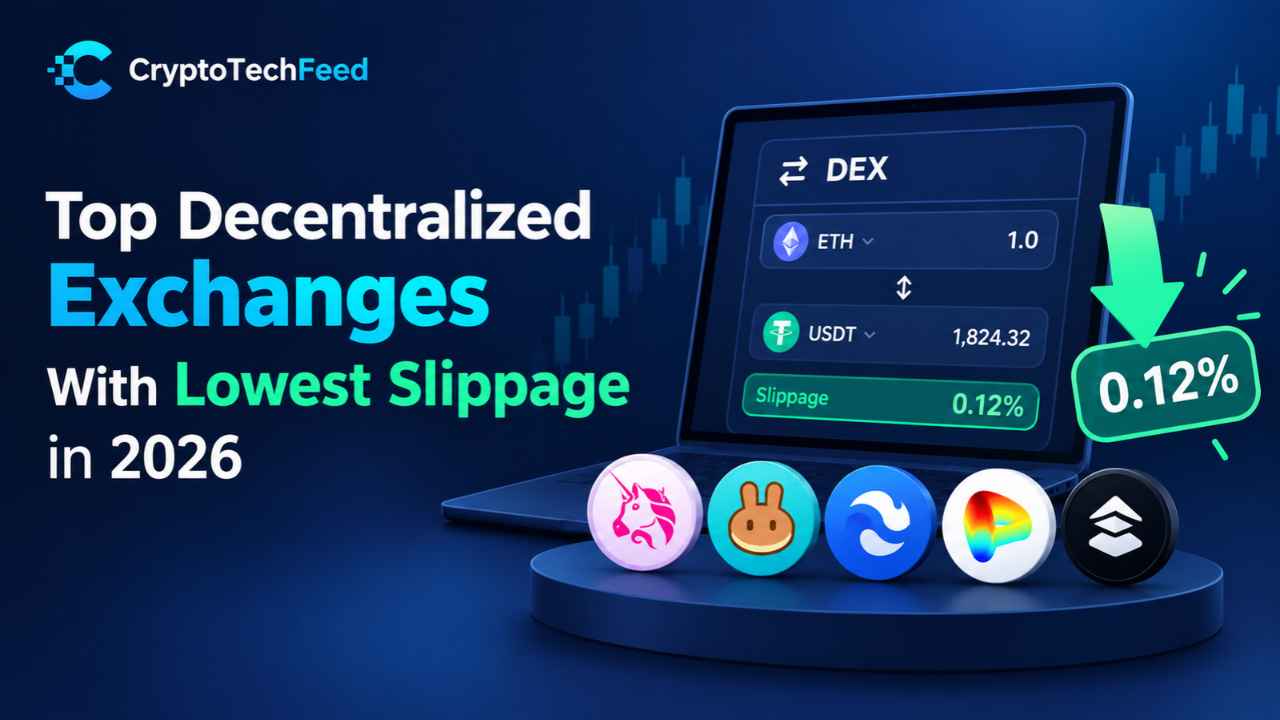
Top Decentralized Exchanges With Lowest Slippage in 2026
1. Uniswap v4
Uniswap still sets the bar for large cap pairs on Ethereum and its major L2s. Concentrated liquidity lets market makers stack capital exactly where price trades most, instead of spreading it thin across the whole curve. Version 4’s hooks architecture lets pools plug in custom logic, including just in time liquidity and dynamic fees that respond to volatility in real time. For ETH, stablecoins, and top 50 tokens, Uniswap routinely delivers some of the tightest fills in DeFi. Thin, newly listed tokens are the exception, where depth can still be shallow in the first days after launch.
2. Curve Finance
Curve was built for one job: swapping assets that are supposed to trade near the same price, like stablecoins or liquid staking tokens. Its StableSwap curve is flatter than a standard AMM curve near the peg, which means even large trades barely move the price. If you are moving six figures between USDC, USDT, and DAI, or between stETH and ETH, Curve is usually the cheapest route in the entire market. Outside of pegged asset pairs, Curve is not the right tool, and its slippage advantage disappears fast.
3. Balancer
Balancer generalizes the AMM model with weighted pools and, more recently, boosted pools that route idle liquidity into yield while it sits there. For multi asset pools and index style baskets, Balancer often beats a standard two token AMM because it can balance capital across more than one pair at once. Its newer Composable Stable Pools apply Curve style math to correlated assets beyond stablecoins, which has quietly made it a strong option for liquid staking token swaps too. Depth varies more by pool here than on Uniswap or Curve, so check the specific pool before a large trade.
4. 1inch (Aggregator)
1inch does not hold its own liquidity. Instead it scans dozens of DEXs and splits your order across the best combination of pools, sometimes across several in a single transaction. This matters because the single best priced DEX for a 1,000 dollar trade is often not the best priced DEX for a 100,000 dollar trade. 1inch’s Pathfinder algorithm recalculates the optimal split in real time, which usually beats manually picking one exchange and hoping the pool is deep enough. For larger trades, an aggregator should almost always be your starting point.
5. CowSwap
CowSwap batches trades and matches buyers and sellers directly when it can, settling the rest through its solver network. The batch auction model means your trade is not visible in the public mempool before it executes, which removes the sandwich attack risk that quietly inflates slippage on other DEXs. Solvers compete to find the best execution path, and CowSwap pays out when a solver beats the quoted price rather than just matching it. For MEV sensitive trades, this is currently one of the strongest slippage and protection combinations available.
6. PancakeSwap v3
On BNB Chain, PancakeSwap carries the deepest liquidity by a wide margin, and its v3 concentrated pools behave similarly to Uniswap’s. Gas costs on BNB Chain are low enough that routing across multiple pools for a better fill barely adds overhead, so PancakeSwap’s router can afford to be aggressive about splitting orders. For BNB Chain native pairs and bridged majors, it is consistently the lowest slippage option on that chain.
7. Trader Joe (Liquidity Book)
Trader Joe’s Liquidity Book model organizes liquidity into discrete price bins instead of a continuous curve. Trades inside a single bin execute at zero slippage, and only cross into the next bin once that bin’s liquidity is exhausted. On Avalanche and Arbitrum, this has made Trader Joe one of the more efficient venues for mid size trades on popular pairs, particularly stable and correlated asset pairs where bins can be packed tightly together.
8. GMX
For traders who need size on perpetuals rather than spot swaps, GMX uses a shared multi asset liquidity pool (GLP or GM pools depending on version) that backs every position. Because the pool, not an order book, absorbs the other side of every trade, large positions do not move the market price the way a thin order book would on a centralized perp exchange. Funding rates and borrow fees matter more here than spot slippage, but execution quality on size remains a core reason traders choose GMX over order book based perp DEXs.
Quick Comparison: Slippage-Friendly DEXs at a Glance
| DEX | Best For | Chain(s) | Why It Minimizes Slippage |
|---|---|---|---|
| Uniswap v4 | Large cap spot pairs | Ethereum, L2s | Concentrated liquidity + dynamic hooks |
| Curve Finance | Stablecoins, LSTs | Ethereum, L2s | Flat StableSwap curve near peg |
| Balancer | Multi asset baskets | Ethereum, L2s | Weighted and boosted pool design |
| 1inch | Any size, aggregated | Multi chain | Splits orders across best pools |
| CowSwap | MEV sensitive trades | Ethereum | Batch auctions, no public mempool exposure |
| PancakeSwap v3 | BNB Chain pairs | BNB Chain | Deepest BNB Chain liquidity |
| Trader Joe | Bin based execution | Avalanche, Arbitrum | Zero slippage within active bin |
| GMX | Leveraged perps | Arbitrum, Avalanche | Pooled liquidity absorbs position size |
How to Minimize Slippage Yourself
Picking the right venue solves half the problem. The rest comes down to how you trade on it.
- Route through an aggregator for anything over a few thousand dollars. Manual pool picking rarely beats automated splitting at size.
- Set a realistic slippage tolerance. Too tight and your transaction fails repeatedly, wasting gas. Too loose and a sandwich bot has room to work.
- Break large trades into smaller tranches spread across a short window instead of one block.
- Check pool depth before you trade, not after. Most DEX interfaces show total value locked right next to the pair.
- Use private transaction relays like Flashbots Protect where available, to keep your trade out of the public mempool.
- Avoid trading brand new listings in the first hours, when pools are shallowest and most volatile.
Aggregators vs Trading Directly on a Single DEX
A fair question at this point is why anyone trades directly on a single DEX at all, given how well aggregators route around thin liquidity. The honest answer is that direct trading still wins in specific situations: when you know a particular pool is unusually deep for your exact pair, when you want to interact with a protocol’s native rewards, or when an aggregator’s routing fee eats into savings on a very small trade. For most retail sized and institutional sized swaps, though, an aggregator should be the default, with a direct DEX as the exception rather than the rule.
Frequently Asked Questions
Which DEX has the lowest slippage overall? There is no single universal answer because it depends on the asset pair. Curve wins for stablecoins and liquid staking tokens. Uniswap v4 wins for most large cap spot pairs. Aggregators like 1inch often beat both for large or unusual trades by routing across several pools at once.
Is slippage the same as a trading fee? No. A trading fee is a fixed, disclosed percentage charged on every trade. Slippage is the variable gap between the quoted price and the executed price, driven by trade size relative to pool depth and by market movement during confirmation.
What slippage tolerance should I set? For deep, large cap pairs, 0.1 to 0.5 percent is usually enough. For thinner or more volatile pairs, 1 to 3 percent may be needed to avoid failed transactions, though that also opens the door to worse execution if a sandwich bot is active.
Do aggregators always beat trading directly on a DEX? Not always, but most often yes for medium and large trades. On very small trades, the aggregator’s extra routing step can sometimes cost more in gas than it saves in price improvement.
Can slippage be completely avoided? No. Some slippage is structural to how AMMs price trades. It can be minimized through deep pools, smart routing, and MEV protection, but a trade of any meaningful size will almost always move the price by some amount.
Final Take
Low slippage is not about finding a magic exchange. It is about matching your trade to the venue built for that specific asset pair, and letting routing technology do the heavy lifting on anything beyond a small swap. Curve for stable pairs, Uniswap v4 for large caps, and an aggregator like 1inch or CowSwap as your default for anything in between. That combination, more than any single “best” DEX, is what actually keeps slippage off your trade confirmation screen.