I swapped $4,000 worth of a mid cap token on a DEX I’d never used before, glanced at the price impact number for about half a second, and hit confirm. Lost close to 9 percent of it to slippage. Not a hack, not a scam, just a thin pool and a trade size it couldn’t absorb quietly. That’s the thing nobody tells you when they say “just use a DEX.” The exchange matters. The chain matters. The liquidity sitting in that specific pool at that specific moment matters more than any headline fee percentage on the homepage.
Must Read: New DEX Listings vs CEX Listings Explained
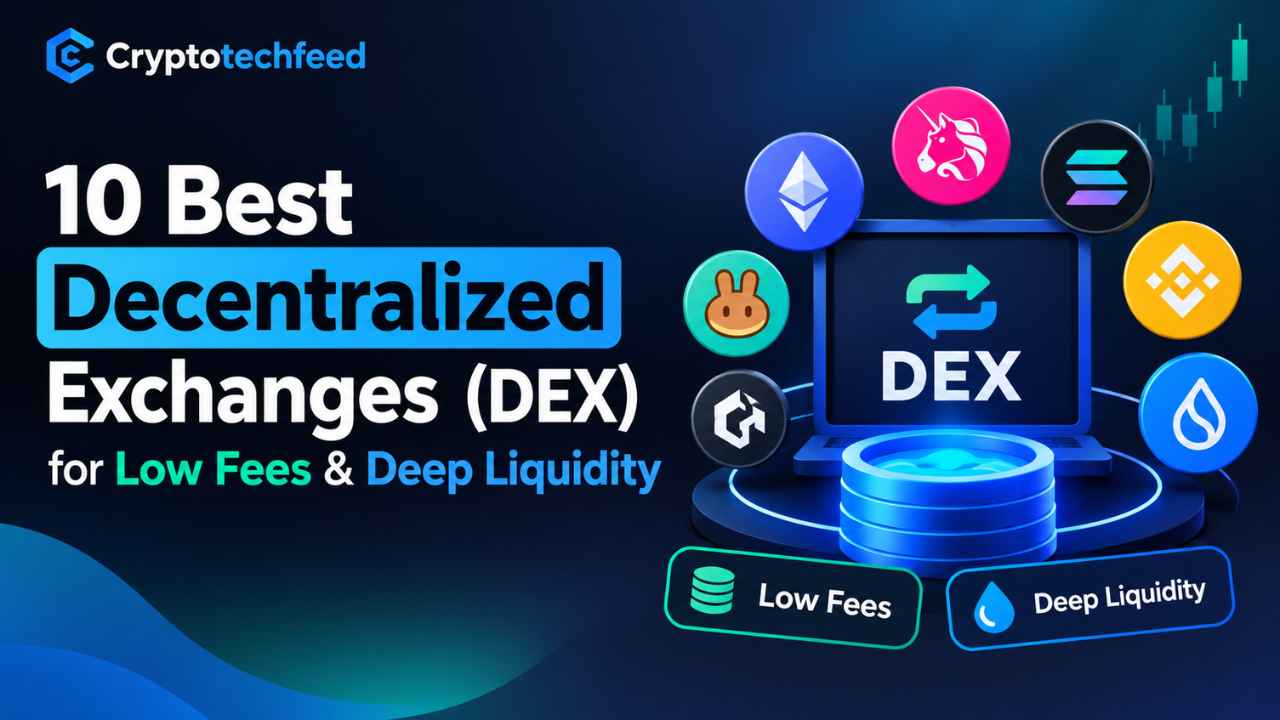
So here’s an actual working list. Ten decentralized exchanges worth your attention in 2026, ranked with real numbers instead of marketing copy, plus the parts people usually search for separately: how Uniswap, PancakeSwap, and Raydium actually stack up, what “non KYC” really means once you dig into it, and when an aggregator will save you more than switching platforms ever could.
DEX Comparison Table: Chain, Volume, Fees and Wallets
| DEX | Primary Chain(s) | ~30 Day Volume | Fee Tier | Wallets Supported |
|---|---|---|---|---|
| Uniswap | Ethereum + 40 chains | $37 to 43B | 0.05% to 1% | MetaMask, Rabby, Coinbase Wallet, Rainbow |
| PancakeSwap | BNB Chain + 9 chains | $20 to 27B | ~0.25% | MetaMask, Trust Wallet, Binance Wallet |
| Raydium | Solana | $7 to 9B | ~0.22% | Phantom, Solflare, Backpack |
| Orca | Solana | $7 to 8B | ~0.30% | Phantom, Solflare, Backpack |
| Curve Finance | Ethereum + 26 chains | $2 to 3.5B | ~0.04% | MetaMask, Ledger, WalletConnect |
| Aerodrome | Base | $8 to 10B | ~0.20% | Coinbase Wallet, MetaMask, Rabby |
| Meteora | Solana | $3 to 4B | Dynamic (DLMM) | Phantom, Solflare, Backpack |
| Camelot | Arbitrum | $500M to 1B | 0.01% to 1% | MetaMask, Rabby, WalletConnect |
| THORChain | Native cross chain | $1 to 2B | ~0.1% to 0.3% | Trust Wallet, Xdefi, Ledger |
| SunSwap V3 | Tron | $700M to 1B | 0.05% to 0.3% | TronLink, imToken |
Figures move week to week, sometimes hour to hour if a memecoin decides to go vertical on Solana. Treat these as a snapshot, not gospel, and always check live volume before you commit real size.
The 10 Best Decentralized Exchanges, Broken Down
1. Uniswap: Still the Default for a Reason
Uniswap runs across roughly 40 to 47 chains now, but Ethereum, Base, and Arbitrum carry most of the weight. Concentrated liquidity means fees can sit as low as 0.05% on stable pairs, though most volatile pairs land around 0.3%. What actually sells it is depth. On blue chip pairs like ETH/USDC you can push a six figure trade through with barely a ripple in price. Gas on mainnet still stings during busy hours, which is why so much Uniswap volume has quietly migrated to its Base and Arbitrum deployments.
2. PancakeSwap: The BNB Chain Powerhouse
PancakeSwap owns something like 85% of BNB Chain’s DEX volume, and it’s not close. Fees hover near 0.25%, but the real draw is what you pay to actually settle a transaction. BNB Chain gas runs a few cents compared to dollars on Ethereum, so PancakeSwap ends up cheaper in practice even when its posted fee percentage looks higher on paper. It’s also expanded onto tokenized stocks in a big way this year, processing over $3 billion in that category alone since January.
3. Raydium: Solana’s Memecoin Engine
Raydium sits right at the center of Solana’s trading culture, especially for tokens fresh off Pump.fun. Fees run around 0.22% and settlement is near instant, but the honest caveat is pool quality varies wildly. A blue chip Solana pair trades beautifully. A three day old token might have $40,000 of total liquidity holding up a $2 million market cap, and that’s where my slippage horror story from the intro came from. Check the pool before the trade, not after.
4. Orca: Solana’s Calmer Sibling
Orca runs a concentrated liquidity model similar to Uniswap’s, and it’s generally the friendlier entry point for anyone new to Solana DeFi. The interface doesn’t bury you in options, fees sit around 0.30%, and its “whirlpool” pools tend to hold up better under volume spikes than smaller Raydium pairs. If Raydium is where the memecoin chaos lives, Orca is where you go for the established Solana names.
5. Curve Finance: Built for Stablecoins Only
Curve isn’t trying to be your everything exchange, and that focus is exactly why it works. Fees on stable to stable swaps sit around 0.04%, among the lowest of any DEX on this list, because its bonding curve is mathematically tuned for assets that shouldn’t move much against each other. Swap USDC for USDT here, not ETH for a random altcoin. It’s the wrong tool for volatile pairs and the right one for everything else.
6. Aerodrome: Base’s Home Grown Champion
Aerodrome launched purpose built for Coinbase’s Base network and now handles somewhere between 50 and 63% of all Base DEX volume. Its ve(3,3) vote escrow model rewards long term liquidity providers over mercenary capital, which in practice means deeper, stickier pools than you’d expect from a chain this young. Fees land around 0.2%, and Base’s low gas costs make it genuinely cheap to trade here even on smaller positions.
7. Meteora: Dynamic Liquidity Done Right
Meteora’s Dynamic Liquidity Market Maker (DLMM) shifts fee tiers automatically based on volatility, charging more during chaotic price swings and less during calm periods. It’s a Solana native project, popular with liquidity providers who are tired of getting picked off by arbitrage bots on static fee pools. For everyday swappers it functions a lot like Raydium or Orca, just with a fee curve that adapts underneath you.
8. Camelot: Arbitrum’s Local Favorite
Camelot built its reputation as Arbitrum’s community DEX, offering custom fee tiers from as low as 0.01% up to 1% depending on the pair. It leans heavily into partnerships with Arbitrum native projects, so if you’re trading tokens that launched specifically on that ecosystem, Camelot often has liquidity that bigger multi chain DEXs haven’t bothered to build yet.
9. THORChain: Native Swaps Without Wrapping
THORChain does something most DEXs on this list can’t. It lets you swap actual BTC for actual ETH without wrapping either one into a synthetic version first. That cross chain trick comes at a cost, fees run higher and variable, typically 0.1% to 0.3% plus a network fee that swings with congestion. Worth it specifically for native asset swaps where wrapping risk is something you’d rather avoid entirely.
10. SunSwap V3: Tron’s Quiet Giant
SunSwap doesn’t get talked about much outside Tron circles, but Tron carries a huge share of global USDT transfer volume, and SunSwap is where a lot of that liquidity actually trades. Fees range from 0.05% to 0.3%, and Tron’s rock bottom transaction costs make it one of the cheapest chains around for frequent small swaps, particularly for anyone already holding USDT-TRC20.
Uniswap vs PancakeSwap vs Raydium: Which One Actually Wins
There’s no single winner here, and anyone telling you otherwise is selling something. Uniswap wins on raw liquidity depth and chain reach, which matters most once your trade size climbs past five figures. PancakeSwap wins on total cost when you account for gas, not just the posted fee, because BNB Chain is simply cheaper to transact on than Ethereum mainnet. Raydium wins on speed and access to brand new tokens, but that same speed is exactly what lets thin, risky pools onto the platform in the first place.
Think about it by trade profile instead of brand loyalty. Moving established assets in real size, Uniswap. Trading smaller amounts frequently and want to keep gas costs invisible, PancakeSwap. Chasing early Solana tokens and comfortable checking liquidity depth before every trade, Raydium. Using the wrong one for your situation is how that 9 percent slippage story happens to someone else.
Non KYC Crypto Exchange: What It Actually Means
Every DEX on this list is non custodial, meaning you connect a wallet and trade directly from it, no account creation, no ID upload, no email verification screen standing between you and a swap. That’s the real definition of a non KYC crypto exchange, not some hidden loophole, just software that never asked for your identity because it never held your funds to begin with.
It’s not a free pass to disappear from regulators, though. Your wallet address is public and permanently visible on chain, tax obligations on gains still apply in most countries regardless of where you traded, and if you ever move funds through a centralized exchange afterward, that platform can and often does trace the wallet’s transaction history. Non KYC means no identity check at the point of the swap. It doesn’t mean invisible.
Cheapest DEX to Swap Tokens: The Real Cost Breakdown
The posted fee percentage is only half the bill. Total cost is fee tier plus gas plus price impact, and gas is where chains separate hard from each other. A 0.3% swap on Ethereum mainnet during a busy afternoon can cost more in gas alone than the entire trade would cost end to end on Solana or BNB Chain. For pure cost per swap, Solana DEXs like Raydium, Orca, and Meteora typically land cheapest overall, often fractions of a cent in network fees stacked on top of a sub 0.3% trading fee.
If you’re specifically swapping stablecoins, Curve’s 0.04% fee tier on Ethereum beats almost everything else on a percentage basis, though you’ll still eat mainnet gas to get there. Layer 2s and sidechains close that gap fast. Base, Arbitrum, and BNB Chain all offer a combination low enough that the chain you pick matters more than which DEX you use on it.
DEX Aggregator Guide: When to Skip the Comparison Shopping
An aggregator does the comparison work for you, scanning dozens of pools across multiple DEXs and routing your trade through whichever combination gets you the best price, sometimes splitting one swap across three or four venues at once. Jupiter handles this for Solana and has become close to the default entry point for swapping there, charging no protocol fee itself. 1inch does the same across a dozen plus EVM chains, with its Fusion mode adding MEV protection through private resolvers. Matcha, built on the 0x protocol, offers a simpler consumer interface aimed at people who just want the best price without touching routing settings.
Use an aggregator by default for anything above a few hundred dollars, and honestly for most swaps under that too. The one case where going direct to a single DEX still makes sense is when you already know exactly which pool has the depth you need and you’d rather not add the aggregator’s extra routing step to a trade that’s simple enough not to need it.
FAQ
What is the safest DEX for beginners? Uniswap and Orca are generally considered the most beginner friendly, thanks to clean interfaces, deep liquidity on major pairs, and years of audited, battle tested contracts.
Do decentralized exchanges require KYC? No. DEXs are non custodial and connect directly to your wallet, so there’s no identity verification step. Your on chain activity remains publicly visible regardless.
Which DEX has the lowest fees overall? Curve Finance posts the lowest percentage fee for stablecoin swaps at around 0.04%. For total cost including gas, Solana based DEXs like Raydium and Orca usually come out cheapest across most trade types.
Is it cheaper to use a DEX aggregator than a single DEX? Usually yes, especially for larger trades, since aggregators split orders across multiple pools to reduce price impact. For very small swaps the difference often isn’t worth the extra routing step.
Can I lose money using a DEX even without getting hacked? Yes. Slippage on thin liquidity pools, high gas during network congestion, and impermanent loss if you’re providing liquidity can all eat into returns without any exploit involved. Always check the price impact number before confirming a trade.