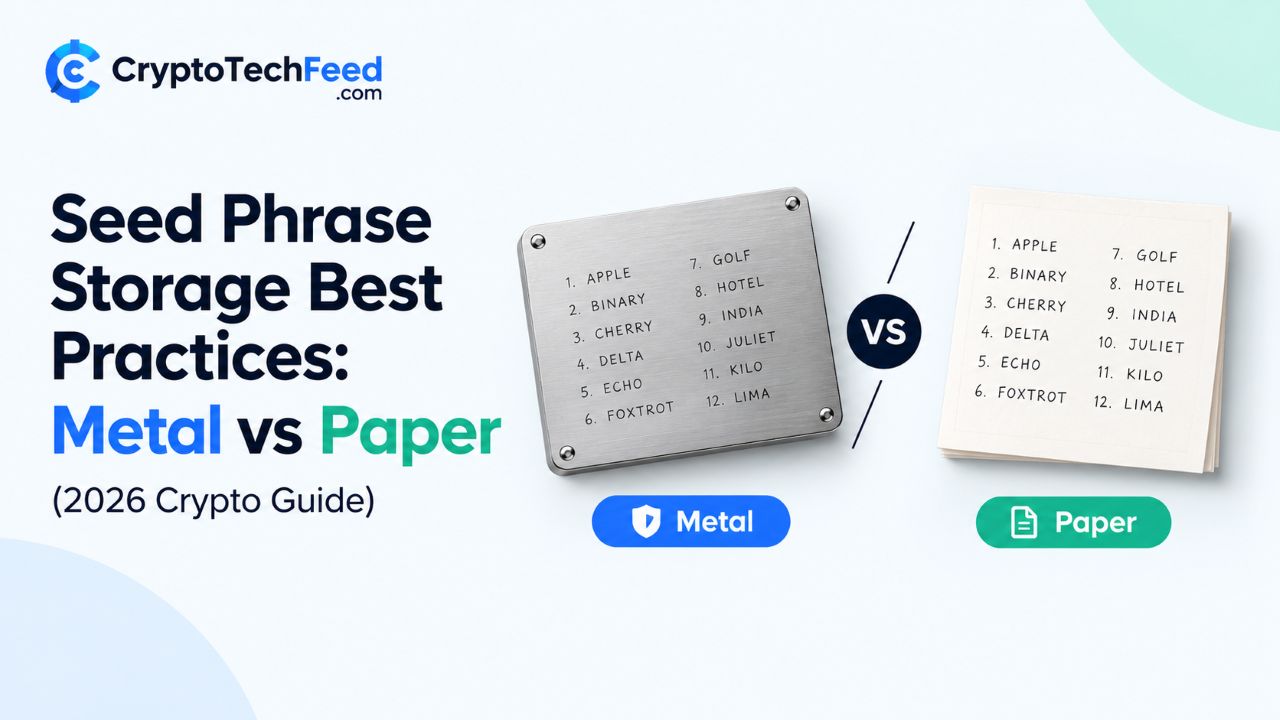
Somewhere in a drawer, a shoebox, or folded inside a book, millions of crypto holders are keeping their entire net worth written on a piece of paper. It feels fine until the day a pipe bursts, a house fire starts, or the ink simply fades into nothing readable. Seed phrase storage best practices metal vs paper is not a trivia question for hobbyists anymore. It is the single decision that determines whether your Bitcoin, Ethereum, or any self custodied asset survives a disaster or disappears with it. This guide breaks down both methods with real failure data, cost comparisons, and a verdict you can actually act on.
Why Your Seed Phrase Storage Method Matters More Than Your Wallet Choice
Most people spend weeks researching which hardware wallet to buy, then write their twelve or twenty four word recovery phrase on whatever paper is nearest and call it done. That backwards priority causes more permanent fund losses than hacks do. Chainalysis and multiple wallet recovery firms have pointed to lost or destroyed seed phrases, not stolen ones, as a leading cause of inaccessible crypto over the past several years. Your hardware wallet can be replaced for under two hundred dollars. Your seed phrase cannot be replaced at all. If it is gone, the funds it protects are gone with it, permanently and without appeal.
Here is what actually threatens a stored seed phrase over a multi year holding period:
- House fires, which burn at temperatures standard paper cannot survive
- Flooding or burst pipes, which dissolve ink and pulp paper within hours
- Fading ink or ballpoint marks that degrade over five to ten years
- Pests, mold, and basic humidity damage in storage areas
- Simple misplacement during a move or renovation
Each of these risks sits quietly for years before it strikes, which is exactly why so many holders underestimate them until it is too late.
Paper Storage: The Default Method and Its Real Limitations
Paper is where almost everyone starts, mainly because every hardware wallet ships with a paper card for exactly this purpose. It costs nothing extra, takes thirty seconds to fill out, and requires no special tools. For a first time user moving a small amount of crypto off an exchange, writing the phrase on the included card and storing it somewhere reasonably safe is a legitimate starting point, not a mistake in itself.
The problem shows up with time, not immediately. Standard paper combined with pen or pencil ink has a practical lifespan measured in years, not decades. Thermal printer paper, often used for backup cards, actively fades and can become unreadable within two to five years even without water damage. Add a house fire, which can reach temperatures above eight hundred degrees Fahrenheit, and paper of any kind is reduced to ash in minutes. A basement flood, a leaking roof, or even high ambient humidity over several years can blur ink past recognition long before anyone checks on it.
Where Paper Still Makes Sense
- A temporary backup while you research and purchase a metal solution
- A secondary copy stored in a bank safe deposit box with low fire and flood risk
- Small, low value wallets where losing access would not be financially significant
- Testing a new wallet setup before committing to permanent storage
Treat paper as a bridge, not a destination. It is acceptable for the first few weeks of holding crypto, but anyone planning to hold for years should budget for an upgrade sooner rather than later.
Metal Storage: Built for Decades, Not Just Years
Metal seed phrase storage solves the exact failure modes that make paper unreliable. These products, sold under names like Cryptosteel, Billfodl, Keystone Tablet, and ColdTi, are typically made from stainless steel or titanium plates where you stamp, engrave, or slot in individual letters representing your recovery words. Stainless steel resists corrosion, survives submersion in water, and withstands house fire temperatures that would destroy paper in seconds. Titanium goes further, tolerating temperatures above 3,000 degrees Fahrenheit and resisting nearly all forms of corrosion, including saltwater exposure.
Independent stress tests conducted by wallet manufacturers and third party reviewers have repeatedly shown these plates surviving direct flame exposure, hammer strikes, and submersion tests that leave the engraved words fully legible afterward. That level of durability is the entire point. A seed phrase is meant to outlive the owner in some cases, passed down as inheritance, and metal is the only widely available consumer method built with that timeline in mind.
What Makes Metal Storage Worth the Cost
- Fire resistance up to and beyond typical house fire temperatures
- Full corrosion resistance against water, humidity, and in some cases saltwater
- No ink or print to fade, since words are physically stamped or slotted
- Reusable kits that let you correct mistakes during setup
- Compact size that fits inside a standard safe or deposit box
The tradeoff is upfront cost and setup time. Basic stamped steel kits start around twenty five to forty dollars, while premium slotted titanium versions can run well over one hundred dollars. Stamping twenty four words by hand with a center punch also takes considerably longer than writing them on paper, often thirty minutes to an hour for a careful first attempt.
Metal vs Paper: Direct Comparison
| Factor | Paper | Metal |
|---|---|---|
| Fire resistance | Destroyed at low temperatures | Survives typical house fires |
| Water or flood resistance | Ink dissolves, paper degrades | Fully water and corrosion resistant |
| Expected lifespan | Two to ten years before fading | Decades, often described as lifetime |
| Setup cost | Free with most wallets | Twenty five to over one hundred dollars |
| Setup time | Under five minutes | Thirty minutes to one hour |
| Ease of correcting mistakes | Easy, just rewrite | Harder, depends on stamped vs slotted design |
| Best suited for | Short term or low value holdings | Long term or significant holdings |
The table makes the analytical case clear enough on its own. Paper wins on cost and convenience. Metal wins on every durability metric that actually determines whether your funds survive an unexpected event. For anyone holding crypto as a multi year investment rather than a short term trade, that durability gap is the deciding factor.
Best Practices That Apply Regardless of Which Method You Choose
Picking metal over paper solves the durability problem, but it does not solve every risk. A handful of practices matter no matter which material you choose, and skipping them undermines even the best storage method.
- Never store your seed phrase digitally in any form, including photos, cloud notes, password managers, or email drafts
- Split or duplicate your backup across two separate physical locations to protect against a single point of failure like one house fire or theft
- Avoid writing the phrase anywhere near your hardware wallet itself, since a thief finding one should not lead them to the other
- Consider a passphrase or hidden wallet feature for an added layer that a found seed phrase alone cannot bypass
- Tell a trusted family member or executor where the backup exists, without revealing the actual words, so funds are not lost permanently after your death
That last point gets skipped constantly, and it is one of the more common reasons families end up unable to recover a deceased relative’s crypto. A seed phrase that nobody else knows exists is functionally the same as one that was destroyed.
Which One Should You Actually Choose
For holdings under a few hundred dollars, paper stored in a reasonably safe location is a defensible choice, and spending forty dollars on a metal plate for a near empty wallet is not a rational use of money. Once your holdings cross into the low thousands or you plan to hold for more than a year or two, the math flips firmly toward metal. The cost of a steel backup kit is a rounding error compared to the funds it protects, and the failure modes that destroy paper, fire and water specifically, are common enough that insurance companies price homes around them every year.
A reasonable middle path many analysts recommend is layered redundancy: one metal backup in a home safe for quick access, and a second metal backup in a bank safe deposit box or with a trusted relative, covering both convenience and catastrophic loss scenarios at once. This approach costs roughly sixty to one hundred fifty dollars total depending on the kits chosen, a small price against six figure or larger holdings.
Common Mistakes to Avoid
- Storing the only copy of a seed phrase in a single location with no backup
- Photographing the phrase for a quick digital reference “just in case”
- Using a safe deposit box as the sole copy, since bank access can be legally restricted during estate proceedings
- Choosing metal storage but never testing the recovery process to confirm every word was stamped correctly
- Assuming a fireproof paper envelope is equivalent to metal, when most consumer fireproof bags are only rated for short exposure at moderate temperatures
FAQ
Is metal seed phrase storage actually necessary, or is paper good enough? Paper is acceptable for small or short term holdings, but it fails against fire and water, the two most common causes of permanent, non theft related crypto loss. Metal removes both risks and is worth the modest cost for any meaningful holding.
What is the cheapest reliable metal seed phrase backup? Basic stamped stainless steel plates start around twenty five to forty dollars and offer solid fire and water resistance, making them the most cost effective upgrade from paper for most users.
Can I just laminate my paper seed phrase instead of buying metal? Lamination helps slightly against moisture but does nothing against fire, which remains the bigger long term risk. It is a minor improvement, not a substitute for metal.
Should I split my seed phrase across multiple locations? Yes, splitting or duplicating the backup across two physically separate, secure locations protects against a single disaster destroying your only copy, though some users prefer a single well protected metal backup kept with a passphrase for added security instead.
How often should I check on my stored seed phrase? Checking once a year, ideally during a routine home maintenance task, confirms the backup is still legible and in its intended location without exposing it unnecessarily often.
Related Reading
- Hot Wallet vs Cold Wallet: Which One Protects Your Crypto Better
- Crypto Security Fundamentals Every Beginner Should Know
- Multisig Wallet Setup: Why Safe and Gnosis Reduce Single Point of Failure Risk
- Best Hardware Wallets Compared for 2026
- How to Back Up Your Crypto Wallet the Right Way