
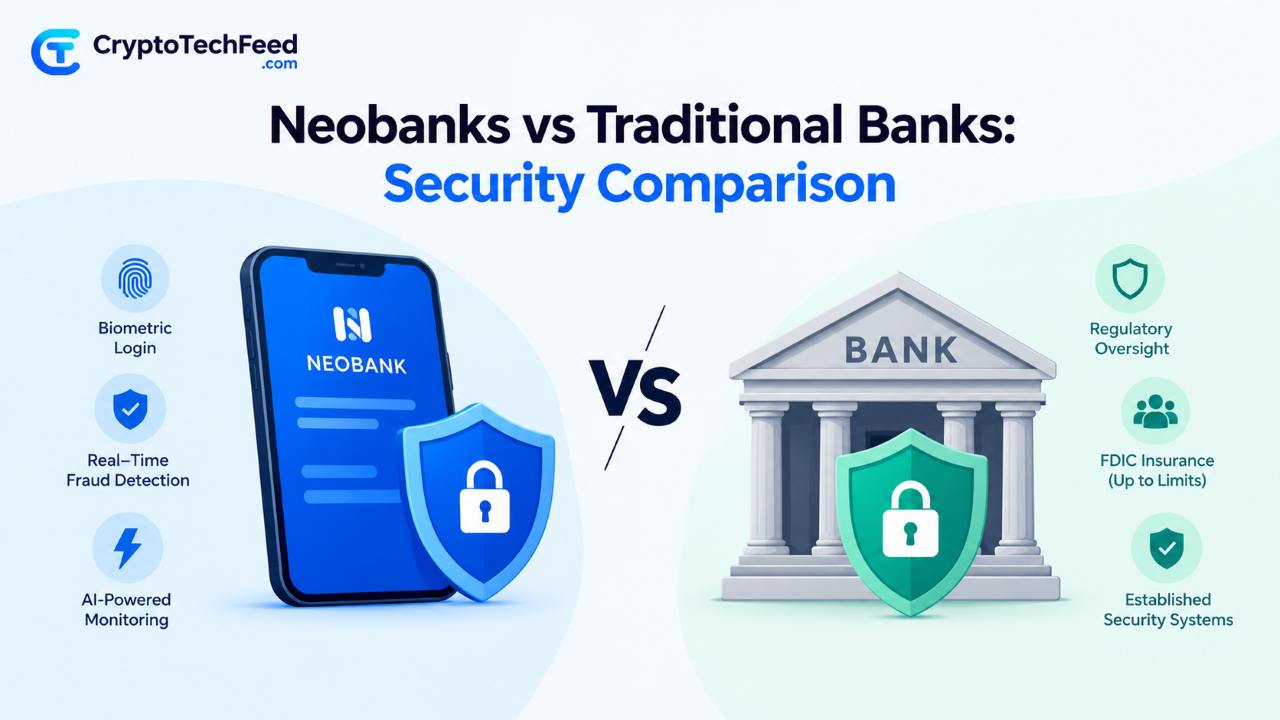
A friend of mine moved her entire emergency fund into a neobank last year because the app looked cleaner and the signup took four minutes instead of a branch visit and a stack of forms. Three weeks later she read about a fintech data exposure affecting a different neobank and called me at midnight asking if her money was actually safe. That question sits at the center of almost every banking decision made in 2026. Neobanks promise speed and slick interfaces. Traditional banks promise history and thick vaults. Neither promise tells you much about where your deposits and your data are genuinely better protected, so let’s break it down properly.
What Exactly Is a Neobank, and How Is It Different?
Neobanks are digital only financial institutions that operate without physical branches, running entirely through mobile apps and cloud infrastructure. They often partner with a licensed bank behind the scenes rather than holding a full banking charter themselves, which matters a lot for how your money is actually insured. Traditional banks, by contrast, hold direct charters, operate physical branches, and have decades of regulatory oversight baked into their compliance structure. This single structural difference, who actually holds the charter and the license, shapes almost every security and insurance question that follows in this comparison, so keep it in mind as we go through each category below.
Security Comparison: How Each Model Actually Protects You
1. Data Encryption and Infrastructure
Both neobanks and traditional banks rely on industry standard encryption protocols, typically AES 256 for stored data and TLS 1.3 for data in transit. Where they genuinely differ is infrastructure age and flexibility.
- Neobanks are built on modern cloud native architecture, which allows faster patching of vulnerabilities and quicker deployment of new security layers.
- Traditional banks often run on legacy core banking systems decades old, which are stable but slower to update and sometimes incompatible with newer security tooling.
- Cloud native systems also mean neobanks can scale fraud detection models in real time, something legacy mainframes struggle with.
Neither approach is inherently unsafe, but legacy systems carry more technical debt, while cloud systems carry more exposure to misconfiguration, a tradeoff worth understanding rather than dismissing either side outright.
2. Authentication and Access Controls
Authentication is where neobanks tend to pull ahead on paper. Most neobanks default to biometric login, device binding, and app level two factor authentication from day one. Traditional banks have added similar features over the past several years, but adoption across their full customer base is uneven, especially among older account holders who still rely on PINs and physical cards without layered verification.
- Neobanks: biometric login by default, device fingerprinting, instant card freeze from the app.
- Traditional banks: PIN and password reliant for many users, 2FA often optional rather than mandatory, physical card controls through branch or phone support.
The gap here is real, though it is narrowing as regulators push stronger authentication standards across both models in most major markets through 2026.
3. Regulatory Oversight and Deposit Insurance
This is the category where traditional banks still hold a clear structural advantage, and it matters more than any app feature. A chartered traditional bank carries direct deposit insurance, FDIC coverage in the United States up to 250,000 dollars per depositor, or equivalent schemes like DICGC in India covering amounts up to 5 lakh rupees per depositor per bank. Neobanks that partner with a sponsor bank usually pass through similar insurance, but only on funds actually held at the partner institution, not on balances sitting in a connected investment or crypto wallet feature within the app. Several 2026 fintech collapses exposed exactly this gap, leaving users confused about what was actually covered when the neobank itself was not the insured entity.
Fraud Protection and Customer Liability
Fraud response speed often decides how much money a customer actually loses, and this is a category both models approach very differently.
- Neobanks typically offer instant in app transaction alerts, one tap card freezing, and chatbot or live chat dispute initiation within minutes.
- Traditional banks still often require a phone call or branch visit to freeze a card or dispute a transaction, though most major banks have improved app based controls significantly since 2023.
- Liability rules under regulations like Regulation E in the US apply similarly to both, but neobanks generally resolve disputes faster simply because their support stack is built around app first workflows rather than call centers.
Faster resolution does not always mean better outcomes though, since some neobanks have been criticized in 2025 and 2026 for algorithmic fraud flags that freeze legitimate accounts without quick human review, leaving customers locked out of their own funds for days.
Real Incident Data: Breaches and Outages Compared
Numbers tell a more useful story than marketing pages from either side. Fintech and neobank platforms have reported a noticeably higher frequency of smaller scale data exposures and third party vendor breaches over the past two years, largely because they depend heavily on external API providers for identity verification, card issuing, and payment processing. Traditional banks report fewer breaches overall but tend to experience larger scale incidents when they do occur, partly because of the sheer size of their customer databases and decades of accumulated legacy data. Outage frequency also differs. Neobanks have suffered more visible app wide outages during peak usage periods, while traditional banks more commonly report localized ATM or card network outages rather than full app failures.
Neobanks vs Traditional Banks Security Comparison Table
| Security Factor | Neobanks | Traditional Banks |
|---|---|---|
| Encryption standard | AES 256, TLS 1.3, cloud native | AES 256, TLS 1.3, legacy core systems |
| Default 2FA and biometrics | Standard by default | Improving but inconsistent |
| Deposit insurance | Pass through via partner bank only | Direct FDIC or DICGC coverage |
| Fraud dispute speed | Fast, app and chat based | Slower, often call or branch based |
| Breach frequency | Higher, smaller scale, vendor related | Lower, occasionally larger scale |
| Regulatory maturity | Developing, partner dependent | Established, decades of oversight |
| Physical branch backup | None | Available for identity and dispute support |
Where Crypto Fits Into This Picture
For crypto focused readers, this comparison carries an extra layer. Many neobanks now bundle crypto wallet features, staking products, or stablecoin on ramps directly into their main banking app, and that blending of regulated banking funds with unregulated digital asset products is exactly where the deposit insurance gap discussed earlier becomes dangerous. A balance sitting in a neobank’s crypto tab is almost never covered by the same insurance protecting the cash balance sitting right next to it in the same interface. Several 2025 fintech failures left users assuming full protection simply because everything lived inside one familiar app. Anyone holding crypto through a neobank should treat that portion of their balance with the same scrutiny they would apply to any exchange or custodial wallet, insured cash and uninsured crypto are not the same thing just because they share a login screen.
So Which One Is Actually Safer?
There is no single winner here, and any article claiming otherwise is oversimplifying a genuinely layered question. Traditional banks win decisively on regulatory maturity, direct deposit insurance, and decades of audited infrastructure. Neobanks win on authentication defaults, fraud response speed, and modern encryption deployment. The safest approach for most people in 2026 is not picking one model exclusively but understanding exactly what each account actually covers. Keep large emergency savings in a directly insured account, whether neobank or traditional, confirm the partner bank relationship in writing, enable every available authentication layer, and treat any crypto or investment feature bundled inside a banking app as a separate risk category entirely.
Frequently Asked Questions
Is a neobank safer than a traditional bank? Neither is universally safer. Neobanks generally offer stronger default authentication and faster fraud response, while traditional banks offer more established regulatory oversight and direct deposit insurance in most cases.
Are neobank deposits FDIC insured? Often yes, but only through a partner bank relationship, and only for cash balances. Investment or crypto features inside the same app are typically not covered by that insurance.
What is the biggest security risk with neobanks? Reliance on third party vendors for identity verification and card processing creates more potential points of failure compared to the fully in house infrastructure many traditional banks maintain.
Do traditional banks have better fraud protection? Not necessarily better, but often slower. Traditional banks match neobanks on liability rules but typically take longer to freeze accounts or resolve disputes due to call center dependent processes.
Should I keep crypto in my neobank account? Treat any crypto or staking feature inside a neobank app as uninsured and separate from your protected cash balance, regardless of how seamlessly it is integrated into the interface.




