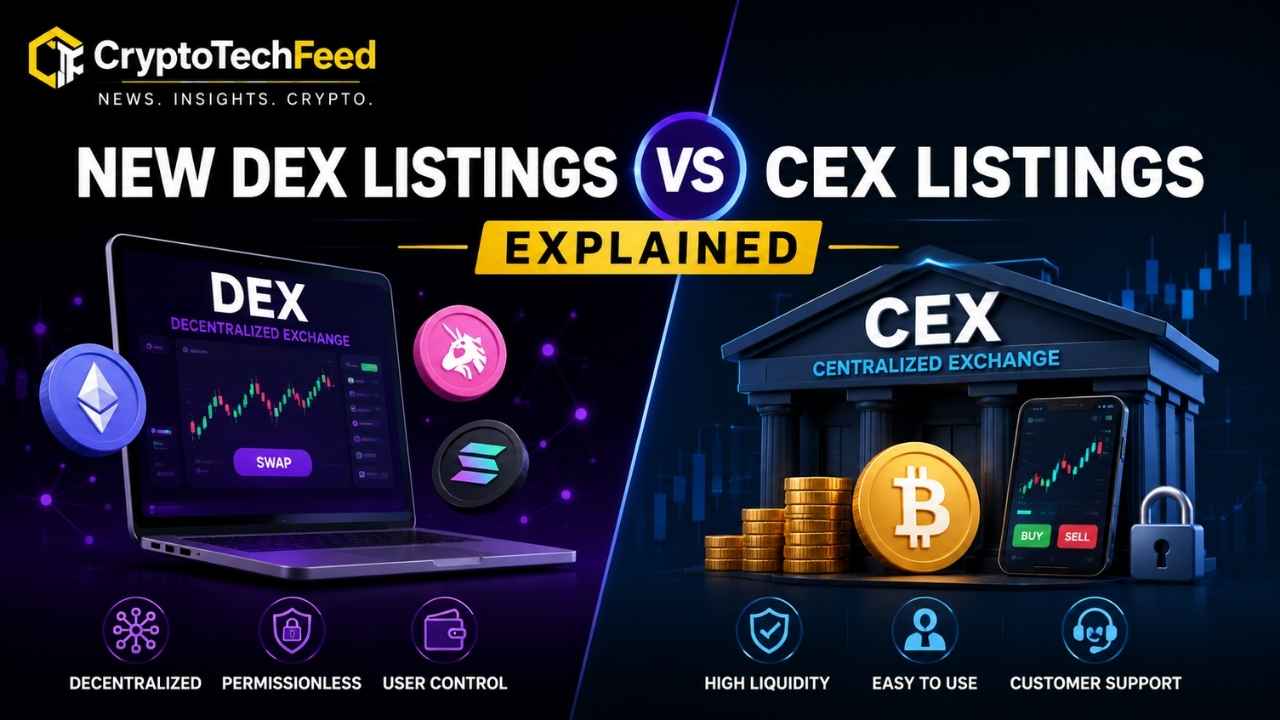
You’ve probably seen it happen. A token shows up on your timeline with a chart that’s three hours old, already up 400%, and everyone’s arguing about whether it’s the next big thing or the next rug pull. Somebody mentions it’s “only on a DEX right now.” Somebody else says they’re waiting for it to hit Binance before they touch it. And if you’re newer to this, you’re just sitting there wondering what the difference even is, and why it seems to matter so much.
Here’s the short version. A DEX listing can happen the second a token is created, with nobody’s permission. A CEX listing takes weeks or months of review, and most tokens never get one at all. That gap is the whole story behind why crypto in 2026 has two completely different listing worlds running side by side, and why treating them the same way can cost you money.
Let’s actually walk through it.
DEX and CEX, the quick version
A DEX, or decentralized exchange, is a piece of software running on a blockchain. Platforms like Uniswap, PancakeSwap, Jupiter, and Raydium don’t hold your funds, don’t require sign up, and don’t decide what gets traded. Anyone with a wallet and a bit of the native token can create a trading pair and start swapping. There’s no gatekeeper. That’s the whole point.
A CEX, or centralized exchange, is a company. Binance, Coinbase, OKX, Kraken, all of them run order books on their own servers, hold custody of user funds, and decide exactly which tokens they’ll support. Before a coin shows up in the CEX search bar, someone on that exchange’s listings team has reviewed it, negotiated terms, and pressed a button.
Same industry, two completely different gates.
How a new token actually gets listed on each
On a DEX, listing isn’t really a step, it’s a byproduct of creation. A developer deploys a smart contract, pairs it with some ETH, SOL, or a stablecoin in a liquidity pool, and the token is instantly tradable. No application, no fee paid to an exchange, no waiting period. CoinGecko’s 2026 exchange activity research found that from January 2025 to January 2026, roughly 24 million new tokens were created on chain, and Uniswap alone listed over 13.6 million of them. Pump.fun added another 5 million. That’s not a typo. Millions.
Compare that to a CEX. The same research found that even the most active centralized exchange listed only a fraction of a percent of all the tokens created in that window, something like 0.01%. CEXs run application processes, legal reviews, liquidity requirements, sometimes a listing fee, and a genuine business decision about whether a token fits their user base and their regulatory exposure. A project might sit in that pipeline for months before an exchange even replies.
So when you see a coin trending with a chart that looks brand new, it’s almost always trading on a DEX first. If it ever reaches Binance or Coinbase, that usually happens weeks, months, or sometimes years later, if it happens at all.
The comparison, side by side
| Factor | DEX Listing | CEX Listing |
|---|---|---|
| Who approves it | Nobody, it’s permissionless | Exchange listings team |
| Speed | Instant, minutes after contract deployment | Weeks to months of review |
| Cost to list | Gas fees plus initial liquidity | Often a negotiated fee, sometimes six figures |
| KYC required to trade | Usually none | Yes, on nearly every major exchange |
| Custody | You hold your own wallet | Exchange holds your funds |
| Price history when you find it | Often minutes to hours old | Weeks to years of trading data already exists |
| Liquidity depth | Can be extremely thin | Generally deeper, especially for top pairs |
| Rug pull risk | Meaningfully higher | Lower, though not zero |
| Regulatory scrutiny on the token | Minimal to none | Exchange has already done some vetting |
None of this makes one option better than the other. It makes them different tools for different situations, and mixing them up is where people get hurt.
Why DEX listings are eating into CEX volume
This isn’t just a vibe, the numbers back it up. The Block’s data series showed DEX spot volume reaching roughly 24% of CEX spot volume in July 2026, the highest reading since the metric started being tracked back in 2019. ARK Invest’s DeFi Quarterly put the DEX to CEX spot ratio at 27.4% for Q1 2026, up 270 basis points from the prior quarter, even as total DEX volume actually fell. And CoinGecko’s own tracking shows DEX share of spot trading doubling from under 7% in January 2024 to nearly 14% by January 2026.
What’s driving it. Speed to market, mostly. When a new token launches on Solana, Base, or BNB Chain, it can be trading within minutes, and traders who want early exposure simply can’t wait for a CEX listing that might never come. Add memecoin culture, airdrop farming, and a generation of traders who are comfortable connecting a wallet instead of filling out a KYC form, and you get a structural shift, not a temporary trend.
Worth noting, though, CEXs still hold the bulk of total dollar volume. CoinGecko’s Spot CEX Report 2026 puts total 2025 spot volume across the top 12 centralized exchanges at nearly $21 trillion. DEXs are gaining share fast, but they’re gaining it against a market that’s still dominated, in raw size, by centralized players.
And the activity isn’t evenly spread across one or two DEXs anymore either. DefiLlama’s tracking in August 2026 showed Solana carrying close to $50 billion in trailing 30 day spot volume, with BNB Chain, Ethereum, and Base all pulling meaningful volume of their own, and newer entrants like Robinhood Chain adding tens of billions almost as soon as they launched. That spread matters. It tells you the shift toward permissionless listing isn’t tied to one platform’s hype cycle, it’s happening across the entire chain landscape at once, which is exactly why CEXs have started experimenting with their own on chain integrations instead of pretending the trend will reverse.
The risk profile is genuinely different
Here’s where I’ll be blunt. A brand new DEX listing is one of the riskiest things you can trade in crypto, full stop. There’s no vetting layer between the developer and your wallet. Liquidity pools can be drained by the person who created them. Contracts can carry hidden functions that block you from selling. And the data backs this up too, CoinGecko’s Spot CEX Report found that even after a CEX has already reviewed a token, only about 32% of newly listed tokens show positive price action in their first month. If that’s the survival rate after formal vetting, imagine the odds on a token with zero vetting at all.
A CEX listing doesn’t remove risk, it just moves it. You’re trusting a company with your custody, trusting their review process was thorough, and trusting the exchange itself doesn’t get hacked or freeze withdrawals during a crisis. That’s a different kind of risk, not the absence of one.
So which one should you actually use
Honestly, it depends on what you’re trying to do. If you’re chasing genuinely early stage projects, airdrops, or new chain launches, you’re going to end up on a DEX, there’s no way around it. If you want deeper liquidity, easier fiat on ramps, customer support, and a token that’s already survived some scrutiny, a CEX listing gives you that comfort layer.
The mistake is treating a fresh DEX listing like it carries the same safety assumptions as a coin that’s been on Coinbase for two years. It doesn’t. Before you put real money into anything trading exclusively on a DEX, you want to actually dig into contract permissions, holder concentration, and whether the liquidity looks organic or manufactured. We’ve covered exactly how to do that step by step in our guide on how to research a newly listed cryptocurrency, and it’s worth reading before your first DEX trade, not after.
If you’re trying to catch listings before the crowd does, our piece on how to find new crypto coin listings before trading walks through the tools traders actually use for that. And if a coin eventually does move from DEX to CEX, our explainer on how exchange listings affect prices breaks down what typically happens to the chart when that transition hits.
FAQ
Is a DEX listing the same as being “listed” in the traditional sense? Not really. On a DEX, creating a liquidity pool is the listing. There’s no approval process, so the word “listed” just means a trading pair exists, not that anyone has reviewed the project.
Why do some tokens never get listed on a CEX? Most simply never apply, don’t meet liquidity or legal requirements, or the exchange doesn’t see enough demand to justify the review process. Remember, CEXs listed a tiny fraction of all tokens created in 2025 and 2026.
Does a CEX listing mean a token is safe? No. It means the exchange has done some due diligence and the token cleared their bar, but plenty of CEX listed tokens still lose most of their value. Around a third show positive price action in their first month, according to CoinGecko’s own data.
Can a token be delisted from a DEX? Not by anyone, technically, since there’s no central operator. But liquidity can dry up completely, which has the same practical effect. If nobody’s providing liquidity, you can’t trade it even if the contract still exists.
Should beginners trade on DEXs at all? You can, but go in with your eyes open. Start small, understand wallet security, and treat every new DEX listing as unverified until you’ve done your own research on the contract and the team behind it.
Are gains from DEX or CEX trading taxed differently in India? No. Under India’s crypto tax rules, the 30% flat tax on gains and 1% TDS apply regardless of whether the trade happened on a DEX or a CEX. The exchange type doesn’t change your tax liability.