
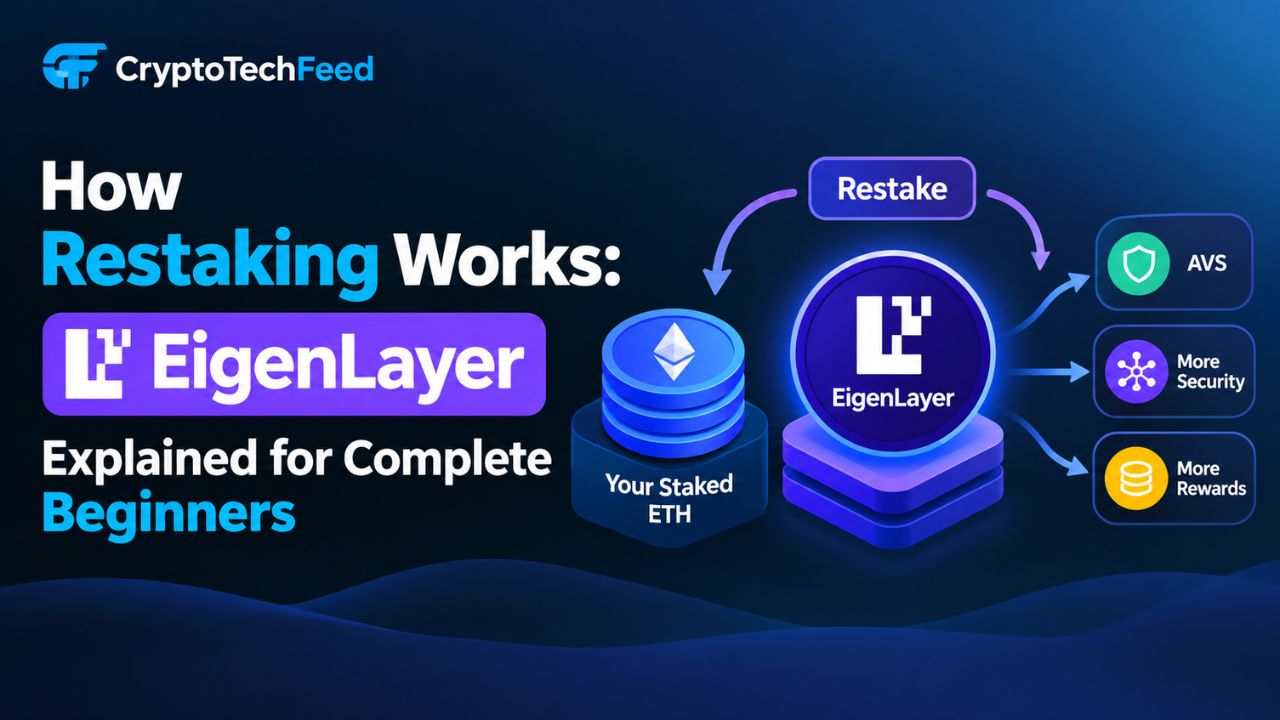
I remember the first time someone tried to explain EigenLayer to me. They used the phrase “restake your restaked stake” without blinking, and I just nodded like I understood. I didn’t. It sounded like something a bank would invent to make an already confusing product sound smarter.
Turns out the idea underneath it is actually pretty simple once someone strips away the jargon. You’re not restaking your stake twice. You’re reusing the trust your ETH already earned, and renting it out again. That’s it. That’s the whole trick.
This guide breaks down exactly how restaking works, what EigenLayer actually does, who the players are, what you can earn, and what can go wrong. No fluff, no Twitter thread shorthand.
What Is Restaking, Actually?
Staking ETH means locking it up to help secure the Ethereum network. In return, you earn a modest yield, somewhere around 2.7 to 2.8% base APR in 2026. Solid, but not exciting.
Restaking takes that same staked ETH, or a token that represents it, and lets it secure other services too. Not instead of Ethereum. On top of Ethereum. Your ETH is still doing its original job. It’s just picking up a second job on the side.
Think of it like a security guard who already protects one building. Restaking is that same guard also agreeing to patrol the building next door during their shift, for extra pay, using the reputation they already built.
Who Actually Invented This: A Quick Word on EigenLayer
EigenLayer is the protocol that made restaking a real, working product on Ethereum. It launched in 2023, exploded through 2024 airdrop season, and by 2026 has become the dominant restaking platform by a wide margin.
Its core insight was this. Ethereum has billions of dollars in staked ETH securing consensus. That security is valuable. Dozens of newer projects, oracles, bridges, data layers, need that same kind of economic security but don’t have billions of dollars or years to build it themselves.
EigenLayer built the plumbing that lets those newer projects borrow Ethereum’s existing security instead of bootstrapping their own from scratch. It’s a marketplace for trust, basically.
The Three Players in Every Restaking Transaction
EigenLayer’s whole system runs on three roles working together. Understanding these three unlocks basically the entire concept.
- Restakers. That’s you, if you restake. You deposit ETH or a liquid staking token and opt in to extend its security to other services.
- Operators. These are node runners. They run the actual software for the services being secured, and restakers delegate their stake to an operator they trust.
- AVS, or Actively Validated Services. These are the projects renting security. Oracles, bridges, data availability layers, sequencers. Anything that needs a distributed set of honest validators.
Restakers provide the capital. Operators provide the labor. AVS providers pay for the protection. Everyone gets paid from the same pool of restaked ETH.
What Is an AVS, With Real Examples
An AVS is any service that needs its own group of validators checking its work, but doesn’t want to launch a brand new token and recruit its own validator set from zero. That process is slow, expensive and honestly kind of risky for a new project with no track record.
Instead, an AVS plugs into EigenLayer and taps operators who already have restaked ETH backing them. EigenDA, EigenLayer’s own data availability layer, is the biggest example and its largest fee source. Oracle networks like RedStone, bridges, keeper networks and various rollup sequencing services have also launched as AVS.
The AVS defines its own rules for what counts as bad behavior, and what gets an operator slashed for breaking those rules.
The Restaking Flow, Step by Step
Here’s what actually happens when you restake, laid out simply:
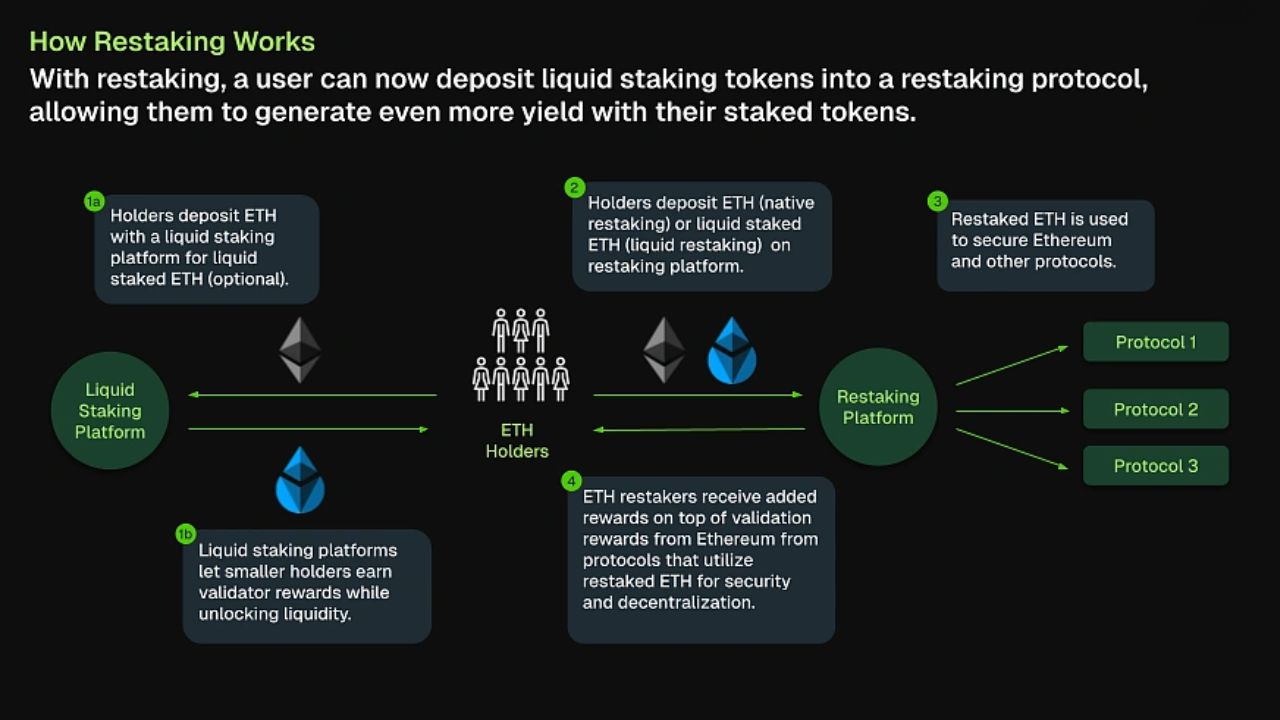
- You deposit ETH natively, or deposit a liquid staking token like stETH or rETH, into EigenLayer’s smart contracts.
- You choose an operator to delegate your restaked position to, or run your own operator setup if you’re technical enough.
- That operator opts in to secure one or more AVS on your behalf.
- The operator runs the required software and does the validation work the AVS needs.
- You earn rewards from the AVS, on top of your normal staking yield, paid out based on your share of delegated stake.
- If the operator misbehaves or fails at the job, a slice of the restaked collateral can get slashed as a penalty.
That last step is the part most beginners skip over, and it’s the one that matters most.
What You Actually Earn: EigenLayer Yield in 2026
Let’s talk real numbers instead of vague promises of “extra yield.”
The typical restaking yield stack in 2026 looks roughly like this: 2.7 to 2.8% from base Ethereum staking, plus another 1 to 2% or so in EigenLayer AVS rewards on top. That lands you somewhere around 3.8 to 6% total in real yield, depending on which AVS your operator secures and how rewards are distributed that quarter.
Some liquid restaking strategies stack points, token incentives and looped leverage on top of that, pushing headline numbers into the double digits. Be skeptical of those numbers. Speculative token rewards aren’t the same thing as sustainable yield, and they tend to evaporate once the incentive campaign ends.
Slashing: The Part Nobody Talks About Enough
Restaking isn’t free money layered on top of staking. It comes with a new category of risk called slashing, and it works differently from regular Ethereum staking penalties.
Here’s the honest version. Every AVS you secure defines its own slashing conditions. Sign a conflicting message, go offline too long, fail a required task, and a chunk of the restaked collateral backing that operator can be cut. Secure five AVS at once through the same operator, and you’ve effectively stacked five separate ways to lose money on the same pile of ETH.
EigenLayer activated live, on chain slashing in April 2025, with redistribution mechanics added afterward. Before that, the risk was mostly theoretical. It isn’t anymore. No catastrophic slashing event has hit a major operator at scale as of late 2026, but the mechanism is live and largely untested under real stress.
EigenLayer’s TVL: A Reality Check
EigenLayer’s total value locked tells a pretty dramatic story if you look at the timeline honestly.
- Early 2024: around $1.4 billion, right after launch.
- Peak, around late 2024 into early 2025: nearly $20 billion, at the height of points farming mania.
- Mid to late 2026: roughly $5 to $10 billion, depending on the tracker and the week you check.
That drop isn’t necessarily a crisis. A big chunk of the peak number was speculative capital chasing an airdrop that already happened. What’s left is a smaller, arguably more honest picture of actual demand for restaking security. EigenLayer still commands the large majority of restaking market share, but competitors like Symbiotic and Babylon have chipped away at that dominance through 2026.
| Metric | 2024 Peak | Late 2026 |
|---|---|---|
| EigenLayer TVL | ~$19.7 to $20B | ~$5 to $10B |
| Market share of restaking | Dominant | Still leading, but eroding |
| Live slashing | Not active | Active since April 2025 |
| Major LRT exposure | Heavy | ether.fi and others winding down |
Liquid Restaking Tokens: The Easier Entry Point
Not everyone wants to run an operator relationship directly. That’s where liquid restaking tokens, or LRTs, come in. You deposit ETH into a protocol like ether.fi, Renzo or Kelp DAO, and receive a token representing your restaked position, which you can still trade or use elsewhere in DeFi while it earns yield.
This convenience adds a layer of smart contract risk on top of EigenLayer’s own risk. The Kelp DAO exploit in April 2026, which drained roughly $300 million and triggered billions in sector wide withdrawals, is the clearest recent example of that extra layer going wrong. Worth noting too, ether.fi has been actively reducing its EigenLayer exposure through 2026, shifting weight toward Symbiotic instead.
Risks Worth Weighing Before You Restake
Quick, honest list of what can actually hurt you here:
- Smart contract risk stacked across six or seven separate systems in a single restaking position
- Operator risk, since a careless or malicious operator can get your delegated stake slashed
- LRT depeg risk during periods of market stress or thin liquidity
- Withdrawal delays, since exiting a restaked position isn’t instant and can take days depending on the path you took in
- Concentration risk, since most of Ethereum’s restaked capital still sits with a small number of dominant operators
None of these make restaking a bad idea automatically. They just mean it’s not the free lunch some 2024 airdrop threads made it sound like.
Is Restaking Worth It Compared to Just Staking?
Honestly, it depends on your risk appetite. Straight Ethereum staking at 2.7 to 2.8% is about as close to boring and safe as crypto gets. Restaking on top of that can realistically add another 1 to 3 percentage points, sometimes more with LRT incentives, but every extra point of yield comes wrapped in an extra layer of slashing exposure and smart contract surface area.
If you’re the type who wants simplicity and sleep well nights, plain staking or a liquid staking token alone is probably enough. If you understand the operator and AVS risk you’re taking on, and you’re comfortable reading slashing conditions before delegating, restaking can be a reasonable way to squeeze more use out of capital that’s already locked up anyway.
How to Start Restaking on EigenLayer
If you’ve decided it’s worth trying, here’s the practical path:
- Have ETH already staked, or hold a supported liquid staking token like stETH or rETH.
- Visit EigenLayer’s app and connect a wallet holding that ETH or LST.
- Choose to restake natively or deposit your LST into EigenLayer’s contracts.
- Research operators carefully. Check their track record, which AVS they secure and their slashing history before delegating.
- Alternatively, use a liquid restaking token from a provider like ether.fi or Kelp DAO if you want a simpler, more liquid entry point, understanding that adds its own contract risk.
- Monitor your position. Restaking rewards and slashing conditions can change as AVS add new requirements.
Frequently Asked Questions
Is EigenLayer safe to use in 2026? No DeFi protocol is fully risk free, and EigenLayer is no exception. On chain slashing is live since April 2025, and while no major catastrophic event has occurred at scale, the mechanism remains relatively untested under real market stress.
What’s the difference between staking and restaking? Staking secures Ethereum alone and earns base network rewards. Restaking reuses that same staked ETH to also secure other services called AVS, earning additional yield in exchange for taking on additional slashing risk.
What is an AVS in simple terms? An AVS, or Actively Validated Service, is any project that needs its own group of honest validators but borrows that security from EigenLayer’s restaked ETH instead of building a validator set from scratch.
How much can you earn from EigenLayer restaking? Typical real yield in 2026 runs roughly 3.8 to 6% total, combining base staking rewards with AVS restaking rewards. Numbers advertised well above that usually include speculative token incentives rather than pure yield.
What happened to EigenLayer’s TVL? It peaked near $19.7 to $20 billion in late 2024 into early 2025 during heavy points farming activity, then retraced to roughly $5 to $10 billion through 2026 as speculative capital rotated out and slashing repriced the risk.




