You know that moment when you’re twelve steps into a DeFi swap, you finally click confirm, and MetaMask tells you that you don’t have enough ETH to pay for gas. Not to swap. Just to pay the fee for swapping. You have the token you want to trade sitting right there, but the network wants a completely different token just to let you move it.
That single moment has probably killed more first time crypto users than any hack or scam ever did. It’s not dramatic. It’s just annoying enough that people close the tab and never come back. And for years, the entire industry more or less shrugged and called it the cost of decentralization.
Account abstraction is the fix nobody could ship for almost four years, mostly because it kept getting stuck in Ethereum governance. Then in March 2023, a standard called ERC 4337 went live and quietly rewired how wallets work without touching Ethereum’s core protocol at all. No hard fork, no contentious upgrade vote. Just smart contracts doing what Ethereum wallets should have done from day one.
The Problem With Regular Crypto Wallets (EOAs)
Every wallet you’ve probably used, MetaMask, Trust Wallet, the one on your exchange app, is what’s called an Externally Owned Account, or EOA. An EOA is controlled by exactly one private key. That’s it. One key, one signature, one point of failure.
Think about what that actually means in practice. Lose the seed phrase and there’s no support line to call, no password reset. The funds are gone. Want someone to recover your wallet if something happens to you? Not possible, an EOA has no concept of a backup signer. Want to batch three actions, approve a token and then swap it, into one click? Can’t do it, each action needs its own signed transaction and its own gas payment in the network’s native token.
That last part is the one that trips up beginners the most. Every single EOA transaction needs ETH, or MATIC, or whatever the chain’s gas token happens to be, sitting in that exact wallet before anything can happen. New users show up with USDT or USDC, the tokens they actually bought, and find out they can’t move a cent of it until they go buy a completely separate token just to pay fees.
So What Is Account Abstraction, Really
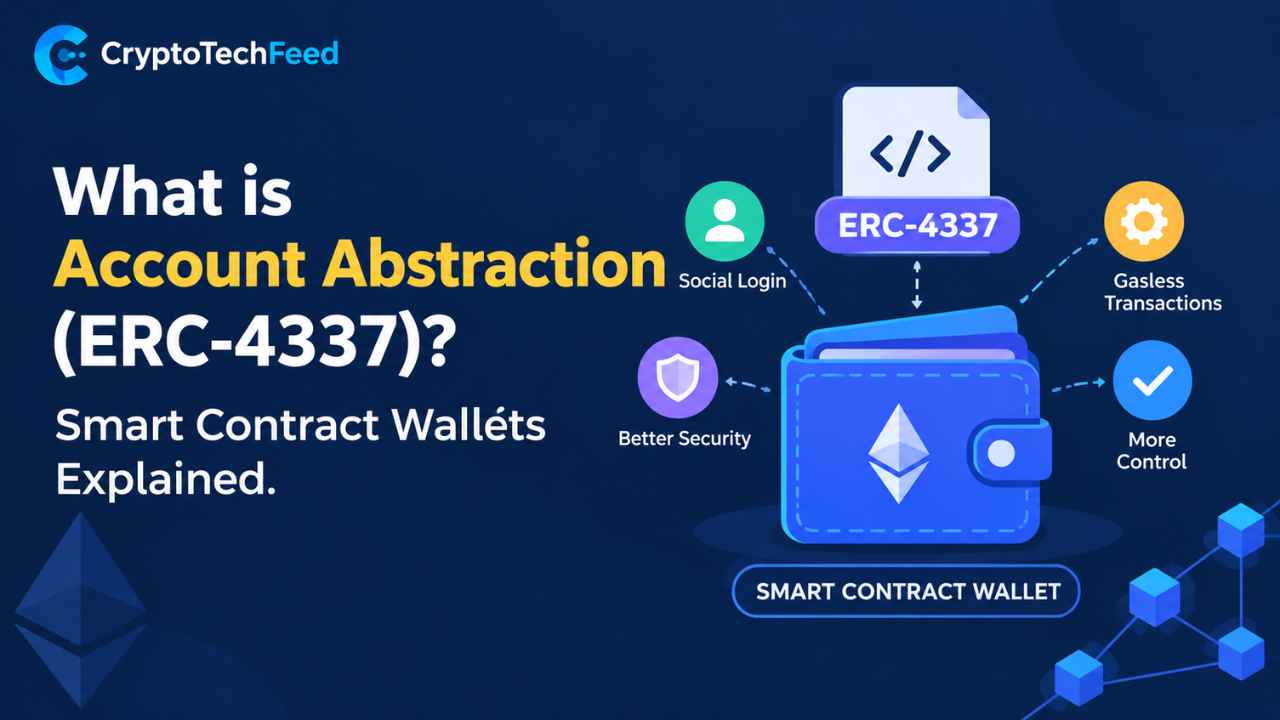
Here’s the simplest way to put it. Account abstraction turns your wallet from a rigid, single key gatekeeper into a programmable smart contract that you get to set the rules for. Instead of “one key must sign everything,” a smart account can say things like “any of these three devices can sign,” or “this app can spend up to 0.1 ETH without asking me every time,” or “someone else can pay my gas fee for me.”
ERC 4337 is the standard that made this possible without asking Ethereum’s core developers to change the protocol. Earlier proposals, EIP 2938 and EIP 3074, tried to bake account abstraction into the base layer and both got stuck in years of debate. ERC 4337 sidestepped all of that by building an entirely separate, parallel system that sits on top of Ethereum using nothing but existing smart contract capability.
How ERC 4337 Actually Works Under the Hood
The system runs on a few moving parts that all have slightly unusual names, so let’s go through them like you’re seeing them for the first time.
A UserOperation is basically an intent, a signed instruction that says what you want to happen, rather than a raw Ethereum transaction. Bundlers are the network participants who scoop up a batch of these UserOperations and package them into one real transaction that actually gets submitted to Ethereum. Sitting at the center of it all is the EntryPoint contract, a single, heavily audited smart contract that every ERC 4337 wallet routes through to validate and execute operations. And then there are Paymasters, which is where the gasless part comes from, plus Account Factories, which deploy your smart wallet deterministically the first time you use it.
None of this needs a validator upgrade or a hard fork. It’s all just contracts talking to contracts, which is exactly why it managed to ship where the earlier proposals failed.
Smart Accounts vs EOA: What Actually Changes For You
This is the comparison most people actually care about, so let’s lay it out plainly.
| Traditional EOA | ERC 4337 Smart Account | |
|---|---|---|
| Signing | One private key, no exceptions | Multiple keys, passkeys, or multisig, your choice |
| Recovery | None, lose the key and funds are gone | Social recovery through trusted guardians |
| Gas | Must hold the chain’s native token | Can be sponsored or paid in any token |
| Transactions | One action per signed transaction | Multiple actions batched into one |
| Permissions | All or nothing | Scoped session keys with limits and expiry |
| Setup | Instant, just generate a key | Deployed on first transaction, small extra cost |
The smart accounts vs EOA debate isn’t really close once you see it laid out like that. The tradeoff is mostly upfront complexity for the developer and a slightly higher first transaction cost for the user, deploying that smart contract wallet isn’t free. Everything after that first deployment gets cheaper and easier, not harder.
The Features That Actually Matter
Gasless Crypto Transactions Through Paymasters
This is the headline feature and it’s the one that solves the exact problem from the top of this article. A Paymaster is a smart contract that agrees to cover gas fees on a user’s behalf, either fully sponsoring the transaction or letting the user pay in a stablecoin instead of ETH. Coinbase has sponsored transactions across its Base ecosystem this way. Farcaster does it for social posts. Polymarket sponsors trade execution so bettors never think about gas at all.
As of April 2026, dApps and infrastructure teams have collectively sponsored somewhere around 180 million dollars in cumulative gas across ERC 4337 deployments. That’s not a rounding error, that’s an entire category of onboarding friction that quietly disappeared for tens of millions of users who never had to think about it.
Social Recovery Crypto Wallet Setups
A social recovery crypto wallet lets you name a set of guardians, a hardware wallet, a friend’s address, an institutional custodian, who can collectively approve a recovery if you lose access. No single guardian can take over your account alone, it takes a threshold of them agreeing together. Safe, previously known as Gnosis Safe, popularized this model for both individuals and DAOs, and it’s become the default answer to “what happens if I lose my seed phrase” that the industry never had a good response to before.
Session Keys
Picture playing an onchain game and getting a wallet popup for every single move. Unplayable. Session keys fix this by letting you approve a temporary, scoped key for a specific app, capped at a certain spending limit and expiring after a set window, four hours, one game session, whatever makes sense. The game gets to execute transactions silently in the background. Your main wallet key never leaves cold storage. When the session ends or the spending cap hits, the app just asks you to renew.
Batched Transactions
Approve and swap in one click instead of two separate signatures and two separate gas payments. Multiple DeFi actions bundled into a single UserOperation instead of five sequential ones. It sounds small until you’ve done it the old way a hundred times and realize how much friction just vanished.
The Numbers Behind The Hype
ERC 4337 isn’t a theoretical standard anymore, it’s production infrastructure with real usage behind it. Since launching on Ethereum mainnet in March 2023, the standard has powered more than 40 million native smart accounts and processed over 100 million UserOperations, a tenfold jump from its first year. Base, Polygon, and Optimism currently lead adoption, with Base pulling ahead noticeably after Coinbase leaned into the infrastructure directly.
Then in May 2025, Ethereum’s Pectra upgrade shipped EIP 7702, a companion standard that lets existing EOAs temporarily behave like smart accounts without migrating funds to a brand new address. Within the first week alone, over 11,000 EIP 7702 authorizations landed on mainnet, and MetaMask, Rabby, and Trust Wallet all added support soon after. Combine ERC 4337’s ground up smart accounts with EIP 7702’s upgrade path for existing wallets, and industry estimates now put the total smart wallet count somewhere north of 200 million globally.
The Future of Web3 Onboarding
Here’s the honest take. The future of web3 onboarding was never going to be “teach every new user what a seed phrase is and hope they don’t lose it.” That approach has had a decade to work and it hasn’t. Account abstraction is the industry finally admitting that and building around it instead.
The direction is pretty clear at this point. New users sign up with a passkey, the same fingerprint or face unlock they already use for their banking app. Their first few transactions get sponsored so they never hit that gas wall. If something goes wrong, guardians can help recover the account instead of it just vanishing. Apps request scoped, temporary permission instead of a blanket key that can do anything forever.
None of this removes self custody, and that part matters. You’re not handing your funds to a custodian, you’re just getting a wallet that finally behaves like modern software instead of a 2015 command line tool.
Worth Knowing Before You Switch
Account abstraction isn’t free of tradeoffs. Deploying a smart contract wallet costs slightly more gas than the first transaction from an EOA. Bundler infrastructure, while production grade by mid-2026, still adds a dependency layer between you and the chain. And because everything routes through the EntryPoint contract, its security matters enormously, which is why it’s one of the most heavily audited pieces of code in Ethereum. None of this is a reason to avoid smart accounts. It’s just the fine print worth knowing before you move funds over.
Frequently Asked Questions
What is account abstraction ERC 4337 in simple terms? It’s an Ethereum standard that turns your wallet into a programmable smart contract instead of a single private key, enabling features like sponsored gas fees, social recovery and batched transactions, all without changing Ethereum’s core protocol.
Are gasless crypto transactions actually free? Not exactly free, someone still pays the gas. A Paymaster contract, usually run by the app or platform, covers the cost on the user’s behalf, or lets the user pay in a stablecoin instead of the chain’s native token.
Is a social recovery crypto wallet safe? It can be safer than a single seed phrase for most people, since no single guardian can unilaterally take over the account. Safety depends on choosing trustworthy guardians and a reasonable approval threshold.
Do I lose self custody with a smart account? No. You still control the account. Account abstraction changes how you sign and recover access, not who owns the funds.
What’s the difference between ERC 4337 and EIP 7702? ERC 4337 builds brand new smart accounts from scratch. EIP 7702, shipped in the May 2025 Pectra upgrade, lets existing EOAs temporarily gain smart account features without moving funds to a new address. Most platforms now support both.