
A friend of mine sent 500 USDC from Ethereum to Base last month. When it landed, the token in his wallet had a different contract address and a slightly different name, and for ten minutes he was convinced he’d been scammed.
He hadn’t. That’s just what cross chain interoperability looks like from the inside. Nobody warns you that “moving” crypto to another chain usually means your original coins get locked somewhere and a brand new version gets minted for you to use. It’s not a bug, it’s the system working exactly as designed. But if you don’t know that going in, it feels like watching your money vanish into a black box.
So let’s open the box. This is cross chain interoperability explained the way I wish someone had explained it to my friend first.
What Cross Chain Interoperability Actually Means
Blockchains don’t talk to each other by default. Bitcoin has no idea Ethereum exists. Solana can’t read a Polygon transaction. Each chain is its own island, with its own validators, its own rules, and its own ledger that nobody outside that chain can directly touch.
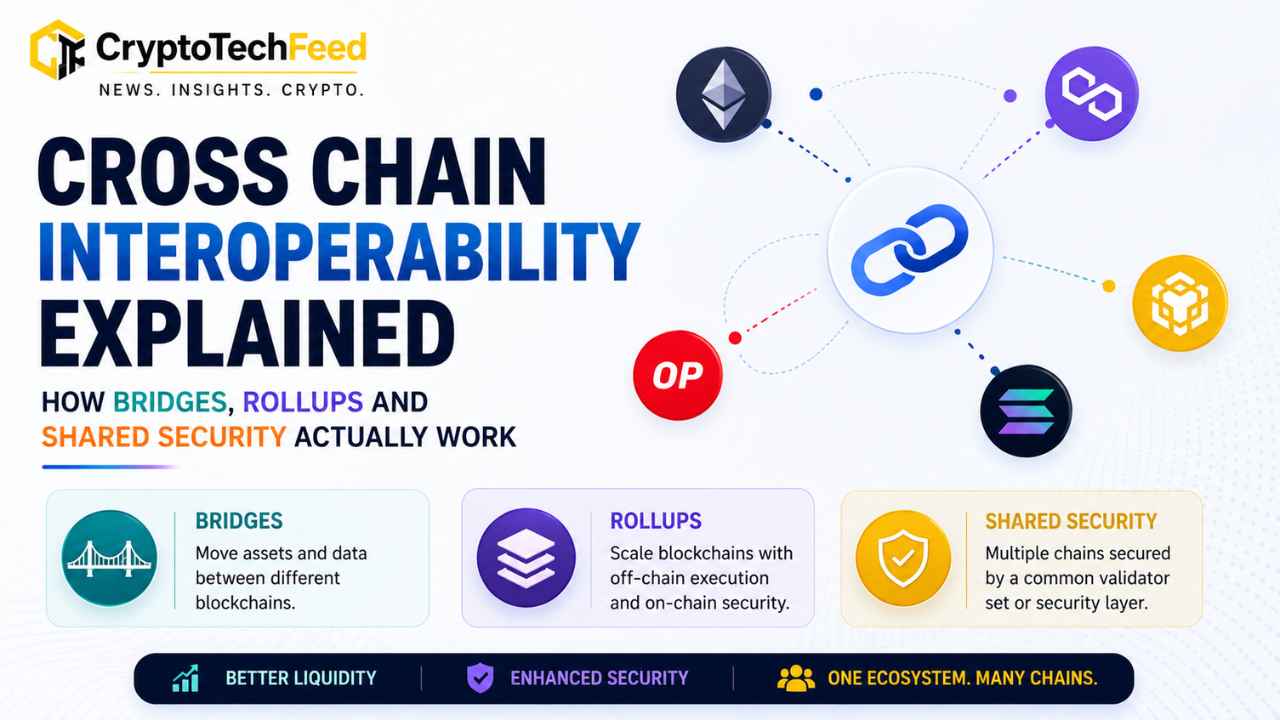
Cross chain interoperability is the umbrella term for everything built to fix that. It covers blockchain bridges, messaging protocols, shared security networks, and the data layers that let modular chains split up the work of running a blockchain. The goal is simple even when the engineering isn’t: let value and information move between separate, mutually blind networks without forcing everyone onto one chain.
By 2026 this has stopped being a side quest for crypto. Liquidity is scattered across dozens of Layer 1s and hundreds of rollups, and interoperability is the plumbing that keeps the whole thing from turning into isolated ponds.
How Cross Chain Transfers Actually Work
Here’s the part most explainers skip. When you move an asset across chains, nothing physically travels anywhere. Tokens can’t leave the chain they were created on. What actually happens falls into three broad models.
Lock and mint. Your original asset gets locked in a smart contract on the source chain. A wrapped, IOU style version gets minted on the destination chain. That wrapped token is a claim on the locked original, not the original itself, which is exactly why my friend’s USDC looked unfamiliar. This is the most common bridge design and also the riskiest, because that lockup contract becomes a single honeypot holding potentially hundreds of millions of dollars.
Burn and mint. The source token gets destroyed instead of locked, and an equivalent amount is minted fresh on the destination chain. No pooled liquidity sits around waiting to be drained, which removes one entire category of attack. Circle’s native USDC transfer protocol works this way, and it’s a big reason regulators and institutions have warmed up to it faster than older lock and mint bridges.
Liquidity network. No locking, no minting. Instead, liquidity providers hold pools of the same asset on both chains, and a transfer is really just a swap. You deposit on chain A, a solver pays you out from a pool on chain B, and the two sides settle up later behind the scenes. It’s fast, often near instant, but it depends entirely on there being enough liquidity sitting on the receiving end.
Underneath all three models sits a verification layer, the part that decides whether a message from chain A should be trusted on chain B. That layer might be a set of external validators, a light client, or an optimistic system with a challenge window. Whichever it is, that verification step is the actual attack surface. Break it, and you don’t need to touch a single token contract to steal everything the bridge is holding.
Modular vs Monolithic Blockchain: Why This Debate Matters Here
Interoperability isn’t only about moving assets between separate chains. It’s increasingly about how a single chain splits its own workload, and that’s where the modular vs monolithic blockchain debate comes in.
A monolithic blockchain, think early Bitcoin or Ethereum before rollups, handles everything itself. Execution, consensus, data availability and settlement all happen on one chain, by one set of validators. It’s simple and battle tested, but it hits a ceiling fast. Push more activity through it and fees climb, blocks get congested, and the chain either scales awkwardly or stays small on purpose.
A modular blockchain breaks those jobs apart and hands them to specialists. Execution happens on a rollup. Settlement and dispute resolution happen on a base layer like Ethereum. Data availability, the job of just making sure transaction data is published and can’t be hidden, gets handed to a dedicated layer built for exactly that. Each piece can scale on its own timeline instead of dragging the whole stack down together.
This split is why modular chains lean so heavily on interoperability infrastructure. A rollup that outsources data availability has to trust that layer completely. A rollup that settles on Ethereum has to communicate with Ethereum constantly. The bridges and messaging protocols aren’t an accessory to modular design anymore, they’re load bearing.
Celestia Data Availability and the Rollup Settlement Layer
Celestia is the clearest real world example of what a dedicated data availability layer looks like in production. Its entire job is making sure rollup transaction data gets published somewhere permanent and checkable, so nobody can quietly hide fraudulent activity behind an unavailable data trail.
As of mid 2026, Celestia has processed over 160 gigabytes of rollup data and holds roughly half the data availability market, with more than 100 rollups built on frameworks like Arbitrum Orbit, OP Stack and Polygon CDK using it as their DA layer. That’s the trade a modular rollup makes: give up doing everything yourself, hand data availability to Celestia, and focus purely on execution.
Settlement is the other half of that equation. A rollup’s settlement layer, usually Ethereum, is where disputes get resolved and where the rollup’s state ultimately gets anchored as final. Optimistic rollups lean on a challenge window at the settlement layer to catch fraud after the fact. ZK rollups submit a cryptographic proof that gets verified there directly. Either way, the settlement layer is the referee. Everything upstream, execution and data availability included, only matters because the settlement layer will eventually check its work.
EigenLayer Shared Security and the AVS Model
Building a brand new chain used to mean bootstrapping your own validator set from zero, which is slow, expensive, and genuinely risky if you can’t attract enough honest validators fast enough. EigenLayer’s shared security model exists to skip that step entirely.
The idea is restaking. Ethereum validators who’ve already staked ETH can opt to restake it, essentially reusing that same capital to also secure other services, called Actively Validated Services or AVSs. An AVS might be a data availability network, an oracle, a bridge, or almost any service that needs decentralized verification. In exchange for taking on extra slashing risk, restakers earn extra rewards, and new protocols get to borrow Ethereum grade economic security instead of building their own from scratch.
EigenLayer’s restaked total value locked corrected hard from its roughly 20 billion dollar 2024 peak but still sits in the mid teens of billions of dollars in 2026, with millions of ETH restaked across more than 20 live AVSs. EigenDA, its own data availability product, is the largest of them and now competes directly with Celestia for rollup customers. That competition is good news for anyone building or using a rollup. It means the cost of secure data availability keeps getting pushed down.
The Uncomfortable Truth About Bridge Security
I’m not going to sugarcoat this part. Bridges have been the single most expensive category of exploit in crypto for years running, and 2026 hasn’t broken that streak.
By June 2026, PeckShield had tracked 14 major cross chain bridge exploits for the year, totaling roughly 340.7 million dollars in losses. The biggest single hit was Kelp DAO, which lost around 292 million dollars in April when an attacker fed its LayerZero based bridge a fraudulent message that the verification layer accepted as genuine. No smart contract bug, no stolen key. The bridge simply believed something that wasn’t true.
That’s the pattern across almost every major bridge hack going back to Wormhole and Ronin. Bridges pool huge amounts of value from multiple chains into one place, and the verification layer deciding what counts as a legitimate cross chain message becomes the single point of failure for all of it. Recovery rates after these hacks are grim too, often under 15 percent of stolen funds ever make it back.
None of this means avoid bridges entirely, that’s not realistic in a multichain world. It means treat every bridge like the financial infrastructure it actually is, and check it before you trust it with real money.
How to Research a Newly Listed Cryptocurrency (and a New Bridge)
This applies whether you’re evaluating a freshly listed token or the bridge you’re about to route funds through, and the checklist overlaps more than you’d expect.
- Check who verifies cross chain messages. External validator set, light client, or optimistic with a challenge window. More decentralized verification usually means a smaller attack surface.
- Look up total value locked and how concentrated it is. A bridge or token holding a huge sum relative to its track record is a bigger target.
- Search for a recent, reputable audit and read what it actually flagged, not just whether one exists.
- For a newly listed token, check holder concentration and contract permissions first. A handful of wallets holding most of the supply, or a contract that can mint unlimited tokens, are red flags.
- Watch the first few days of price and liquidity. Thin liquidity that vanishes fast usually signals a token built to be dumped on early buyers.
- Never risk more than you’d accept losing while the protocol or token is still unproven.
Cross Chain Interoperability: Quick Comparison
| Model | How it moves value | Main risk |
|---|---|---|
| Lock and mint bridge | Locks original, mints wrapped version | Pooled liquidity is a single target |
| Burn and mint bridge | Destroys original, mints new supply | Depends on issuer’s minting authority |
| Liquidity network | Swaps against pools on both chains | Needs deep liquidity on receiving side |
| Shared security (EigenLayer) | Restaked ETH secures external AVSs | Slashing cascades across AVSs |
| Modular DA layer (Celestia) | Publishes rollup data for verification | Concentrated usage from few big rollups |
FAQ
What is cross chain interoperability in simple terms? It’s the set of tools and protocols that let separate blockchains communicate and let assets move between them, since no blockchain can natively read or affect another one on its own.
How do cross chain transfers actually work? Most rely on locking or burning your asset on the source chain while minting or releasing an equivalent asset on the destination chain, verified by a bridge’s validator or messaging layer.
What’s the real difference between modular and monolithic blockchains? A monolithic chain handles execution, settlement and data availability itself. A modular chain splits those jobs across specialized layers, like a rollup for execution and Celestia for data availability.
Why do bridges get hacked so often? Because they concentrate liquidity from multiple chains behind one verification mechanism. Compromise that single mechanism and the entire pool is exposed, which is exactly what happened in the Kelp DAO exploit.
Is EigenLayer the same thing as a blockchain bridge? No. EigenLayer is a restaking protocol that lets Ethereum’s staked capital secure other services through its AVS model. Some AVSs support bridge or data availability functions, but EigenLayer itself isn’t a bridge.




